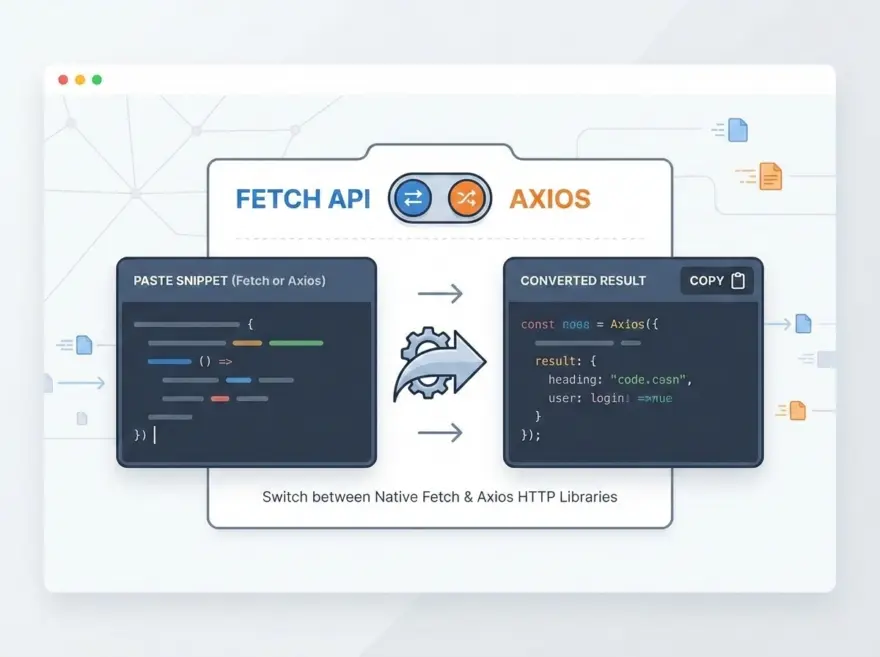
Fetch API to Axios HTTP Request Code Converter — Switch Between Native Fetch and Axios
The Fetch & Axios Code Converter translates small snippets between the native Fetch API and Axios so you can quickly switch HTTP libraries or generate “Axios to Fetch” / “Fetch to Axios” style reference content. It focuses on the most common patterns and keeps the logic intentionally simple; more complex code may still need manual tweaks.
Why Use This Tool?
- Migration: Move from Axios to Fetch (or the reverse) with a clean starting snippet.
- SEO: Publish converter pages that match queries like “convert axios to fetch” or “fetch to axios example.”
- Learning aid: See how typical Axios patterns translate into the native Fetch API and back.
- No server: All conversion runs in the browser.
Key Features
- Axios → Fetch: Replaces
axios.get/postwithfetchand maps.then(response => response.data)to.then(r => r.json()). - Fetch → Axios: Replaces
fetchcalls withaxios.get/postwhere a matching pattern is detected (including basicPOSTbody mapping). - Copy: One-click copy of the converted code for immediate use in projects or docs.
How it Works
The converter applies regex-style replacements to the pasted code: axios.get/post and .then(response => response.data) are mapped to fetch plus .then(r => r.json()), and the reverse mapping gives a basic Axios equivalent. This covers the majority of simple “read” and “write JSON” snippets developers use in day-to-day work.
For production code, you should still review and harden the result: custom headers, advanced config options, interceptors, and nuanced error handling (for example, Axios throwing on non‑2xx vs Fetch requiring explicit response.ok checks) all need manual attention after conversion.
Try the Fetch & Axios Code Converter
Select a conversion type, paste your snippet, and copy the result. Use it as a base for quick migrations, code reviews, or building long-tail “Axios ⇄ Fetch” converter landing pages.
简体中文
Fetch API 转 Axios 代码转换器
将原生 Fetch API 请求自动转换为更易维护的 Axios HTTP 请求代码。
한국어
Fetch API → Axios 변환기
기존 Fetch API 호출을 보다 관리하기 쉬운 Axios HTTP 요청 코드로 자동 변환합니다.
日本語
Fetch API から Axios への変換ツール
ネイティブ Fetch API リクエストを、保守しやすい Axios HTTP リクエストコードへ自動変換します。