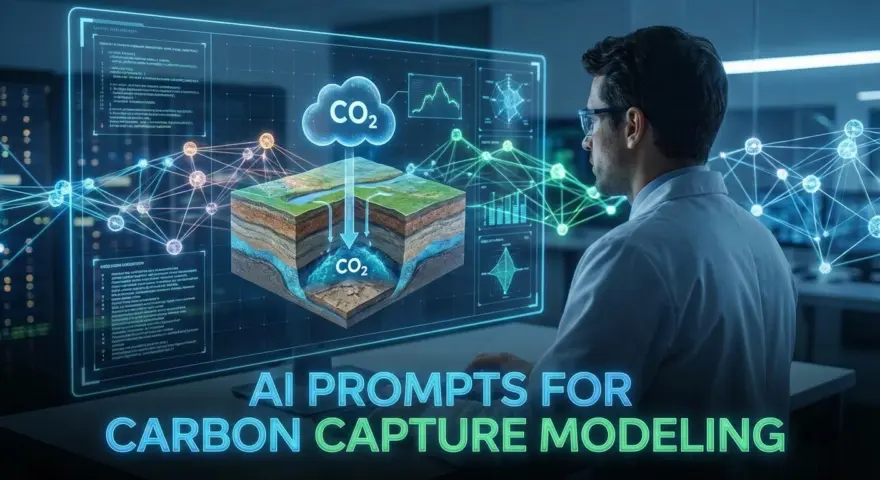
Modern Artificial Intelligence has evolved from a simple text generator into a robust computational partner for engineering disciplines. For Climate Tech Engineers, specifically those focused on carbon capture, utilization, and storage (CCUS), these tools offer unprecedented capabilities in accelerating thermodynamic modeling, material screening, and techno-economic assessments.
The following prompts have been rigorously tested and optimized for deployment across all major large language models, including ChatGPT, Gemini, Claude, and DeepSeek. While models like DeepSeek may excel in raw logic and coding, or Claude in nuance and safety assessments, these 10 prompts provide a universal, high-performance foundation for Climate Tech Engineers seeking to optimize carbon capture systems without being tied to a specific platform.
1. Thermodynamic Minimum Work Calculation
Model Recommendation: Best for DeepSeek or ChatGPT (Strong mathematical reasoning and formula application).
This prompt helps verify the thermodynamic limits of a separation process before deep simulation, saving time on unfeasible pathways.
Act as a Chemical Thermodynamics Expert. I need to calculate the minimum work of separation (Gibbs free energy change) for capturing CO2 from a flue gas stream.

Input Parameters:
- Gas Composition: [Insert Composition, e.g., 12% CO2, 5% O2, 83% N2]
- Temperature: [Insert Temp, e.g., 40°C]
- Pressure: [Insert Pressure, e.g., 1 atm]
- Capture Rate Target: [Insert Target, e.g., 90%]
- Purity Target: [Insert Purity, e.g., 99%]

Please derive the formula for minimum work of separation assuming ideal gas behavior, calculate the specific energy requirement (kJ/mol CO2 captured), and compare this to typical values for amine-based absorption systems.
The Payoff: Rapidly establishes the theoretical baseline for energy efficiency, allowing you to benchmark real-world process performance against thermodynamic limits.
2. Generating Kinetic Rate Expressions for Adsorbents
Model Recommendation: Best for Claude (High fidelity in technical writing and theory explanation) or Gemini.
When dealing with solid sorbents (MOFs, zeolites), defining the correct kinetic model is crucial for reactor sizing.
I am modeling a Pressure Swing Adsorption (PSA) cycle for Carbon Capture. I need to define the kinetic rate expression for CO2 uptake on [Insert Sorbent Name, e.g., Zeolite 13X].

Task:
1. Propose the most appropriate kinetic model (e.g., Linear Driving Force, Fickian Diffusion) based on this material's pore structure.
2. Provide the mathematical equation for the rate of adsorption (dq/dt).
3. List the key mass transfer coefficients I need to fit from TGA or breakthrough curve data.
4. Generate a Python function template using 'scipy.optimize' that I can use to fit experimental uptake data to this model.
The Payoff: Bridges the gap between raw material science and dynamic process simulation by generating ready-to-use code for parameter estimation.
3. Techno-Economic Analysis (TEA) Framework
Model Recommendation: Best for ChatGPT or Gemini (Versatile knowledge base for economic factors).
Estimating the cost of capture is as important as the physics. This prompt structures your CAPEX and OPEX calculations.
Act as a Process Economist in the CCUS sector. Build a Techno-Economic Analysis (TEA) framework for a [Insert Technology, e.g., Direct Air Capture] plant with a capacity of [Insert Capacity, e.g., 1 Million tons/year].

Output a structured Markdown table detailing:
1. Major CAPEX categories (Equipment, Civil, Contingency).
2. Major OPEX categories (Energy, Sorbent replacement, Maintenance).
3. Key sensitivity parameters that usually drive the Levelized Cost of Capture (LCOC) for this specific technology.
4. A list of standard "Scale-up Factors" used to estimate commercial costs from pilot data.
The Payoff: Provides a comprehensive checklist to ensure no cost drivers are overlooked during early-stage feasibility studies.
4. Isotherm Model Fitting Strategy
Model Recommendation: Best for DeepSeek (Excellent at code generation and algorithm logic).
Selecting the right isotherm model (Langmuir, Freundlich, Toth) changes the accuracy of your cycle design.
I have experimental equilibrium isotherm data for CO2 and N2 on a new porous material at three different temperatures.

Write a Python script using 'pandas' and 'scipy' that:
1. Loads a CSV file with columns: Pressure, Loading_CO2, Loading_N2.
2. Defines functions for Langmuir, Freundlich, and Toth isotherm models.
3. Performs a non-linear regression to fit the data and extracts the Henry's Law constants and saturation capacities.
4. Calculates the Heat of Adsorption (Qst) using the Clausius-Clapeyron equation based on the fitted parameters.
The Payoff: Automates the routine task of data fitting, providing immediate insights into the material’s selectivity and regeneration energy requirements.
5. Aspen Plus / HYSYS Simulation Troubleshooting
Model Recommendation: Best for ChatGPT (Extensive training on software documentation) or Claude.
Process simulators often fail due to convergence loops. This prompt helps diagnose the issue.
I am simulating a solvent-based carbon capture loop in [Insert Software, e.g., Aspen Plus] using [Insert Property Method, e.g., ENRTL-RK]. The simulation is failing to converge at the stripper column.

Configuration:
- Column Type: RadFrac
- Convergence Algorithm: Standard
- Recycle Stream: Active

Based on standard flowsheet topology for amine scrubbing, provide a step-by-step troubleshooting guide. Specifically, suggest initialization strategies for the recycle tear stream and parameter adjustments for the damping factors to stabilize convergence.
The Payoff: Acts as an instant senior simulation engineer, offering specific convergence strategies to unblock stalled process models.
6. Life Cycle Assessment (LCA) Boundary Definition
Model Recommendation: Best for Claude or Gemini (Contextual understanding and multi-step reasoning).
Avoiding “carbon leakage” in your calculations requires strict boundary definitions.
We are conducting a cradle-to-gate Life Cycle Assessment (LCA) for a mineralization carbon storage process.

Task:
Define the System Boundaries for the assessment in accordance with ISO 14040 standards.
1. Explicitly list what should be included in the "Upstream" (e.g., mining of reactants), "Core" (process emissions), and "Downstream" phases.
2. Identify potential "Hotspots" for indirect carbon emissions that are often overlooked in mineralization projects (e.g., grinding energy, transportation).
3. Suggest a functional unit for comparing this process against a standard geological storage approach.
The Payoff: Ensures your environmental claims are robust and compliant with international standards, preventing greenwashing accusations.
7. Regulatory Compliance & 45Q Tax Credit Logic
Model Recommendation: Best for Gemini or Claude (Strong at processing regulatory text and conditions).
Understanding the financial incentives is critical for project viability.
Analyze the requirements for the US Section 45Q tax credit for carbon sequestration as it applies to a [Insert Project Type, e.g., Direct Air Capture with Geologic Storage].

Create a "Compliance Checklist" covering:
1. Minimum capture thresholds (metric tons/year).
2. Monitoring, Reporting, and Verification (MRV) requirements for secure geologic storage (Class VI wells).
3. The distinction in credit value between utilization (EOR) and dedicated storage.
4. Timeline constraints for beginning construction to qualify.
The Payoff: Translates dense legal text into actionable project requirements, ensuring the engineering design aligns with financial incentives.
8. Material Screening for Impurity Tolerance
Model Recommendation: Best for DeepSeek or Gemini (Research synthesis and chemical logic).
Real-world flue gas contains impurities (SOx, NOx, H2O) that destroy lab-perfect materials.
I am evaluating a Metal-Organic Framework (MOF) containing [Insert Metal Center, e.g., Copper] and [Insert Linker] for flue gas capture.

Based on general chemical principles of coordination chemistry:
1. Predict the stability of this MOF in the presence of water vapor and acid gases (SOx, NOx).
2. Explain the likely degradation mechanism (e.g., ligand displacement, hydrolysis).
3. Suggest 3 alternative material classes or functionalization strategies (e.g., steric shielding) to improve stability against humid acidic streams.
The Payoff: rapid risk assessment of materials before investing in expensive lab synthesis and testing.
9. Python Script for Dynamic Breakthrough Simulation
Model Recommendation: Best for DeepSeek or ChatGPT (High-level coding capabilities).
Moving from equilibrium data to dynamic performance requires solving Partial Differential Equations (PDEs).
Write a Python script to simulate a 1D adsorption column breakthrough curve.

Requirements:
- Use the Method of Lines (MOL) to discretize the spatial domain.
- Solve the mass balance PDE: ∂C/∂t + u*∂C/∂z + ((1-ε)/ε)*ρ*∂q/∂t = Dax*∂²C/∂z²
- Assumptions: Isothermal operation, Linear Driving Force (LDF) model for kinetics, Langmuir isotherm for equilibrium.
- The code should plot Concentration (C/C0) vs. Time at the column outlet.
- Comment the code heavily to explain the discretization steps.
The Payoff: Provides a functional simulation prototype to predict how long a bed will last before saturation, critical for sizing equipment.
10. Membrane Process Multi-Stage Optimization
Model Recommendation: Best for DeepSeek (Logic/Optimization) or Claude.
Single-stage membranes rarely meet purity targets. This helps design the cascade.
I need to design a multi-stage membrane system to achieve 95% CO2 purity from a feed of 10% CO2.

Task:
1. Outline the architecture for a 2-stage vs. 2-stage with recycle configuration.
2. Explain the trade-off between "Stage Cut" and Permeate Purity for the first stage.
3. Provide a heuristic logic for determining the optimal pressure ratio across the membrane to minimize compression work while maintaining driving force.
The Payoff: Optimizes the trade-off between capital capability (membrane area) and operating cost (compression energy) for membrane cascades.
Pro-Tip: Context Injection for Engineering
When using AI for complex modeling, Prompt Chaining is non-negotiable. Do not try to get the final answer in one shot. First, ask the AI to “Outline the assumptions.” Once you verify the assumptions (e.g., Ideal Gas vs. Peng-Robinson), feed that confirmation back into the next prompt: “The assumptions are correct. Now, using the Peng-Robinson Equation of State, proceed to step 2…” This forces the model to adhere to rigorous engineering constraints rather than hallucinating generic answers.
The transition from theoretical chemistry to deployed climate infrastructure requires speed and precision. By integrating these prompts into your workflow, you shift your cognitive load from routine syntax and formula derivation to high-level system architecture and critical analysis. Master these interactions, and you turn generic AI models into specialized engineering assistants that scale with your ambitions.