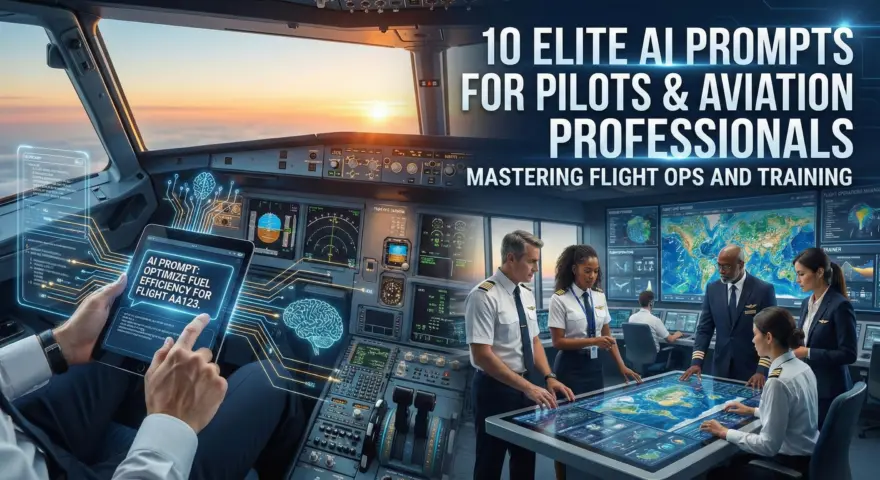
Modern artificial intelligence has evolved into a formidable copilot for ground training, operational planning, and regulatory review. While AI never replaces the judgment of a Pilot in Command, it serves as an indefatigable resource for simplifying complex aeronautical data and enhancing situational awareness.
The following prompts have been rigorously tested and optimized for the leading large language models: ChatGPT, Gemini, Claude, and DeepSeek. While each platform possesses unique architectural strengths, this collection provides a universal foundation for flight instructors, student pilots, and commercial aviators looking to streamline their workflow and deepen their technical knowledge.
1. Decoding Complex NOTAMs
Model Recommendation: DeepSeek for its superior ability to parse rigid logic and technical syntax.
Notices to Air Missions (NOTAMs) are notorious for their cryptic abbreviations and non-standard formatting. Use this prompt to instantly translate raw data into actionable intelligence.
Act as a senior flight dispatcher. I will paste a series of raw NOTAMs for [Insert Airport Code or Region].

Please perform the following:
1. Decode the abbreviations into plain English.
2. Categorize them by urgency (Critical/Warning/Informational).
3. Highlight any runway closures, navigational aid outages, or obstacle warnings specifically affecting approach and departure corridors.

[Insert Raw NOTAM Text Here]
The Payoff: Drastically reduces pre-flight briefing time by converting walls of capitalized text into a prioritized risk assessment.
2. Scenario-Based ADM Training
Model Recommendation: Claude for its nuance in handling safety-critical context and ethical decision-making.
Aeronautical Decision Making (ADM) is best practiced through simulation. This prompt turns the AI into a check airman presenting a developing situation.
Act as a strict Flight Examiner. Generate a dynamic "Go/No-Go" scenario for a [Insert Aircraft Type, e.g., Cessna 172 or Boeing 737] flight from [Origin] to [Destination].

Include variables regarding:
1. Deteriorating marginal weather at the destination.
2. A minor, non-grounding mechanical discrepancy (MEL item).
3. External pressures (e.g., passenger time constraints).

Ask me to make a decision, then critique my reasoning based on FAA/EASA regulations and safe risk management principles.
The Payoff: Sharpens pilot judgment and allows for low-stakes practice of high-stakes decisions before entering the cockpit.
3. METAR and TAF Visualization
Model Recommendation: Gemini for its strong data processing capabilities and long-context understanding.
Raw weather strings require mental decoding. This prompt helps visualize the weather progression over a planned route.
I am providing the METARs and TAFs for my departure, en-route alternates, and destination.

Create a chronological narrative of the weather I will experience for a flight departing at [Time]. specific focus on:
1. Cloud ceiling trends vs. terrain height.
2. Crosswind component changes at the destination.
3. Potential icing or turbulence hazards based on the temp/dewpoint spread and wind shear.

[Insert Weather Data Here]
The Payoff: Transforms abstract meteorological data into a concrete mental model of the flight environment.
4. Simplifying Aircraft Systems
Model Recommendation: ChatGPT for its versatility in explaining technical concepts using analogies.
Whether studying for a type rating or teaching a student, breaking down complex schematics is essential.
Explain the [Insert System, e.g., Electrical Bus Logic or Hydraulic System] of the [Insert Aircraft Type] to me as if I am a student pilot.

Use a hydraulic analogy (water flowing through pipes) to explain the flow of electricity/fluid. specifically explain what happens to the system redundancy if the [Insert Specific Component, e.g., AC Bus 1] fails.
The Payoff: Accelerates systems knowledge retention by linking complex engineering schematics to relatable physical concepts.
5. Regulatory Clarification (FAR/AIM or EASA)
Model Recommendation: DeepSeek for high-precision retrieval and logic checking.
Navigating the Code of Federal Regulations is often tedious. This prompt extracts the exact rule and its practical application.
Reference the current aviation regulations regarding [Insert Topic, e.g., Oxygen Requirements or Duty Time Limitations] for Part [91/121/135] operations.

1. Summarize the strict legal requirement.
2. Provide a practical example of a scenario where a pilot might inadvertently violate this rule.
3. List the specific regulation numbers for my reference.
The Payoff: Provides instant clarity on legal requirements, ensuring compliance and reducing the risk of deviations.
6. The “Stump the Chump” Oral Prep
Model Recommendation: ChatGPT for its interactive conversational mode.
Preparing for a checkride or interview requires fielding rapid-fire questions.
Act as an airline interviewer or checkride examiner. I am applying for a position on the [Insert Aircraft Type]. Ask me 5 difficult technical questions regarding:
1. Aerodynamics (critical mach, coffin corner, or stalls).
2. Aircraft limitations.
3. IFR procedures (holding entries, approach plate symbology).

Wait for my answer after each question, then grade my response for accuracy and depth.
The Payoff: Identifies knowledge gaps in a controlled environment, allowing pilots to study weak areas prior to official evaluations.
7. Creating Mnemonic Devices
Model Recommendation: Claude for creative and memorable language generation.
Aviation relies heavily on memory aids. When standard acronyms fail, generate custom ones.
I am struggling to memorize the [Insert Procedure, e.g., Engine Fire on Takeoff Checklist] for the [Insert Aircraft].

Create three different catchy mnemonic acronyms or rhymes to help me remember the memory items in the exact order. Make one serious, one funny, and one visually associative.
The Payoff: Enhances recall speed for emergency procedures where referencing a checklist is not immediately possible.
8. CFI Lesson Plan Generator
Model Recommendation: Gemini for structuring educational content logically.
Flight Instructors (CFIs) can automate the administrative side of lesson planning to focus on delivery.
Create a comprehensive ground school lesson plan for "Stalls and Spins."
Target Audience: Student Pilot (Pre-Solo).
Structure:
1. Objective of the lesson.
2. Key elements (Aerodynamics of the stall).
3. Common student errors.
4. Completion standards (ACS/PTS criteria).
5. A real-world accident case study related to stall/spin to emphasize safety.
The Payoff: Drastically reduces prep time for instructors while ensuring all ACS/PTS standards are covered systematically.
9. Radio Communication Simulation
Model Recommendation: ChatGPT for natural language dialogue simulation.
Radio fear is real for students. This prompt simulates ATC interaction.
Roleplay as Air Traffic Control at a busy Class C airport. I am a pilot in a [Aircraft Type] located at [Location/Altitude].

I will initiate a call for [Request, e.g., VFR Flight Following or Landing Clearance]. You will respond using standard ICAO/FAA phraseology. Introduce complications like traffic alerts or frequency changes. Correct my phraseology if I am non-standard.
The Payoff: Builds confidence and muscle memory for radio work without the pressure of a live frequency.
10. Passenger Announcement (PA) Scripting
Model Recommendation: Claude for tone calibration and professional empathy.
For commercial pilots, communicating delays or turbulence requires a balance of authority and calm.
Write three versions of a Passenger Announcement (PA) for a [Insert Situation, e.g., diversion due to medical emergency].

1. Version A: Brief and direct (Cockpit to Cabin Crew).
2. Version B: Calm and reassuring (Cockpit to Passengers).
3. Version C: Authoritative but empathetic (for a frustrated cabin during a long delay).
The Payoff: Helps pilots articulate difficult news professionally, maintaining command presence and passenger comfort.
Pro-Tip: Contextual Layering
To get the highest quality output from these models, always specify the Flight Rules (VFR vs. IFR) and the Jurisdiction (FAA vs. EASA/ICAO). An answer regarding fuel reserves for a VFR flight in the US will differ significantly from an IFR commercial flight in Europe. Adding “Assume Part 91 operations under FAA jurisdiction” prevents the AI from hallucinating regulations that do not apply to your specific mission.
Mastering aviation requires a commitment to lifelong learning and precision. By integrating these AI prompts into your study routine and operational planning, you are not cutting corners; you are leveraging advanced tools to visualize risks, solidify knowledge, and enhance safety. Treat these models as members of your crew—verify their input, trust your training, and use them to elevate your airmanship to the next level.