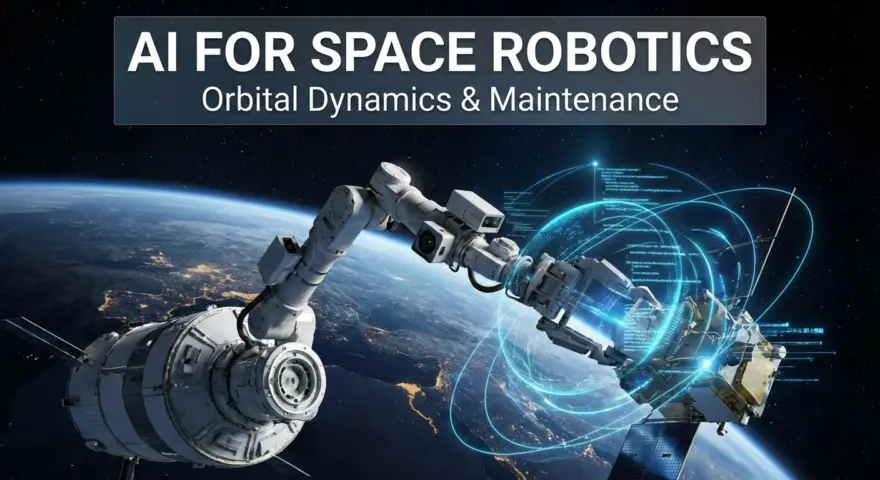
Space robotics engineering demands a rigorous balance between precise orbital mechanics and robust autonomous maintenance protocols. Modern AI has evolved into a critical partner for validating kinematics, simulating microgravity environments, and optimizing trajectory calculations.
These prompts have been rigorously tested and optimized for deployment across all major AI architectures, including ChatGPT, Gemini, Claude, and DeepSeek. While each model possesses distinct architectural advantages—such as DeepSeek’s aptitude for complex logic or Claude’s handling of technical nuance—these 10 prompts serve as a universal, high-performance foundation for Space Robotics Engineers seeking to accelerate simulation workflows and enhance mission reliability.
1. Generating Python Scripts for Orbital State Vector Propagation
Best for: DeepSeek (Excellent for generating mathematically dense code and algorithmic logic).
Act as a Senior Guidance, Navigation, and Control (GNC) Engineer. Write a Python script using the 'poliastro' and 'astropy' libraries to propagate the orbital state vectors of a maintenance satellite.

Input parameters:
- Initial Position Vector (r): [X, Y, Z] km
- Initial Velocity Vector (v): [Vx, Vy, Vz] km/s
- Propagation Duration: 48 hours
- Perturbations to include: J2 zonal harmonic and atmospheric drag.

The script must output the final state vector and plot the trajectory in a 3D matplotlib graph. Comment the code heavily to explain the integration method used.
The Payoff: Rapidly creates a visualization tool for orbital decay and positioning, allowing you to verify trajectory assumptions without writing boilerplate code from scratch.
2. Inverse Kinematics for 7-DOF Robotic Arms
Best for: ChatGPT (Strong at generating standard robotics algorithms and control theory explanations).
I am designing a control algorithm for a 7-DOF robotic manipulator mounted on a servicing satellite. Provide the mathematical formulation for the Inverse Kinematics (IK) using the Jacobian transpose method.

After deriving the equations, generate a pseudocode block that implements a singularity avoidance algorithm (e.g., Damped Least Squares) to ensure the end-effector does not lock up during high-precision docking maneuvers.
The Payoff: Provides a mathematical safety net for manipulator controls, ensuring that robotic arms function smoothly during critical proximity operations.
3. Failure Mode and Effects Analysis (FMEA) for Actuators
Best for: Claude (Superior for processing large context windows and generating nuanced, safe, and structured technical documentation).
Conduct a detailed Failure Mode and Effects Analysis (FMEA) for a harmonic drive actuator used in a space station robotic arm joint.

Focus on the following operational hazards:
1. Lubricant vacuum welding (cold welding).
2. Radiation-induced sensor degradation.
3. Thermal expansion seizing.

Format the output as a Markdown table with columns for: Failure Mode, Potential Cause, Local Effect, System Effect, and Recommended Mitigation Strategy.
The Payoff: Systematically identifies critical hardware vulnerabilities, allowing you to prioritize redundancy and hardening strategies early in the design phase.
4. Parsing Telemetry Data for Anomaly Detection
Best for: Gemini (Ideal for analyzing structured data patterns and synthesizing insights from complex datasets).
You are an Operations Support Engineer analyzing raw telemetry logs from a robotic grapple fixture. I will provide a sample dataset of motor current draw (Amps) and joint temperature (Celsius) over a 2-hour window.

Analyze the data correlation. Specifically, look for 'phantom torque' spikes—instances where current increases without a corresponding command or load. Suggest three potential root causes for such anomalies in a low-Earth orbit environment.
The Payoff: Transforms raw sensor noise into actionable diagnostic data, helping you distinguish between sensor glitches and genuine mechanical degradation.
5. Simulating Hohmann Transfer Windows
Best for: DeepSeek (Preferred for physics-based problem solving and minimizing calculation hallucinations).
Calculate the Delta-V requirements for a Hohmann transfer from a circular Low Earth Orbit (LEO) at 400 km altitude to a Geostationary Orbit (GEO) at 35,786 km.

Assume a standard impulse burn. detailed the following:
1. Delta-V for the initial burn (Periapsis).
2. Delta-V for the circularization burn (Apoapsis).
3. Total Delta-V budget required.
4. The time of flight (transfer duration).

Show all governing equations used for the Vis-viva equation calculations.
The Payoff: Verifies fuel budget estimates for orbit raising maneuvers, serving as a quick cross-check against complex mission planning software.
6. Designing Collision Avoidance Logic
Best for: Claude (Excellent for drafting safety-critical logic and explaining “decision-making” trees).
Draft a logic flow for an autonomous Collision Avoidance Maneuver (CAM) system for a free-flying inspector drone. The drone is approaching a target satellite.

Define the decision tree for triggering a 'Safe Retreat' based on:
1. LIDAR range data quality falling below a confidence threshold.
2. Relative velocity exceeding safety limits (0.5 m/s).
3. Loss of direct comms with the host station.

Present this as a step-by-step logic flow suitable for implementation in a C++ state machine.
The Payoff: Establishes a robust safety protocol for autonomous proximity operations, minimizing the risk of catastrophic impact with high-value assets.
7. Optimizing Grasping Strategies for Non-Cooperative Targets
Best for: ChatGPT (Great for brainstorming versatile engineering solutions and mechanical concepts).
Propose three distinct end-effector grasping strategies for capturing a defunct satellite that is tumbling (uncontrolled rotation). The target has no grapple fixture but has a standard Marman clamp band and a nozzle cone.

For each strategy, evaluate:
1. Mechanical complexity.
2. Risk of generating debris upon contact.
3. Control loop latency requirements.
The Payoff: Generates diverse mechanical approaches for debris removal or servicing missions, helping you select the most viable interface mechanism.
8. Writing Unit Tests for GNC Software
Best for: DeepSeek (High accuracy in generating rigorous code tests and edge-case scenarios).
I have a Python class `OrbitPredictor` that takes Keplerian elements and returns a Cartesian state vector. Write a suite of unit tests using the `pytest` framework to validate this class.

Include test cases for:
1. Circular equatorial orbits (eccentricity = 0, inclination = 0).
2. Highly elliptical Molniya orbits.
3. Edge case: Handling of division-by-zero errors if semi-major axis is invalid.
The Payoff: Automates the validation of critical guidance software, ensuring that code updates do not introduce regression errors in trajectory calculations.
9. Thermal Control System Sizing for Robotic Joints
Best for: Gemini (Strong at integrating multi-variable constraints like physics, materials, and environment).
Estimate the thermal dissipation requirements for a brushless DC motor in a robotic wrist joint operating in direct solar illumination.

Parameters:
- Solar flux: 1361 W/m^2.
- Absorptivity of surface material (anodized aluminum): 0.6.
- Duty cycle: 40% active, 60% idle.

Explain how the lack of convection in a vacuum alters the heat sink design compared to terrestrial robotics.
The Payoff: clarifying the thermal constraints of space-grade actuators, preventing overheating during extended extravehicular activity (EVA) operations.
10. Drafting a Concept of Operations (ConOps)
Best for: Claude (Top-tier for structuring professional, high-level strategic documents).
Draft a section of a Concept of Operations (ConOps) document for a In-Space Manufacturing (ISM) mission. The scenario involves a robotic arm 3D printing a truss structure on an exterior platform.

Detail the operational sequence for:
1. Pre-print calibration and material feed check.
2. Real-time error correction if the printer nozzle drifts due to spacecraft vibration.
3. Post-print structural verification using arm-mounted cameras.
The Payoff: Professionalizes mission planning documentation, ensuring all stakeholders have a clear, step-by-step understanding of autonomous manufacturing sequences.
Pro-Tip: Contextual Chaining for Physics Accuracy
To get the most accurate physics simulations from AI, use Context Chaining. Instead of asking for a complex calculation in a single prompt, break it down. First, ask the model to “Define the constants and environmental variables for a generic LEO orbit.” Once it outputs the correct constants (Earth’s gravitational parameter, radius, etc.), reply with the specific calculation request. This forces the model to load the correct mathematical context into its active memory before attempting to solve the equation, significantly reducing calculation errors.
The field of space robotics is moving from teleoperation to full autonomy. Mastering these prompts helps you transition from manual calculation to high-level system architecture. By leveraging the specific strengths of models like DeepSeek for math and Claude for safety logic, you can build systems that are not only intelligent but resilient enough to survive the harsh reality of the orbital environment.