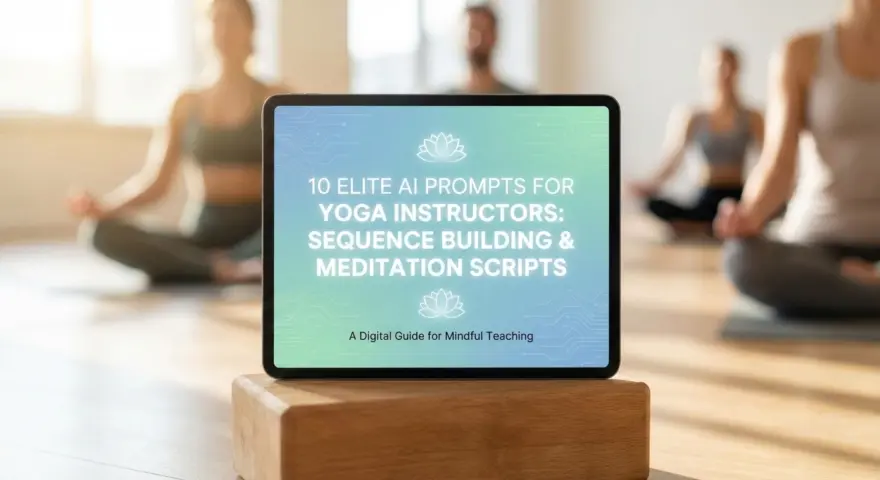
Artificial intelligence has fundamentally shifted how wellness professionals approach class planning and business management. For modern yoga instructors, leveraging AI is not about replacing the teacher’s intuition; it is about handling the cognitive load of sequencing, anatomical research, and administrative tasks so you can focus entirely on presence and student connection.
The prompts below have been vigorously tested and optimized for use with all major Large Language Models (LLMs), including ChatGPT, Gemini, Claude, and DeepSeek. While each platform possesses unique architectural strengths, these 10 prompts provide a universal, high-performance foundation for enhancing your teaching methodology and operational efficiency.
1. The Peak Pose Sequence Builder
Designing a safe and intelligent arc towards a challenging peak pose requires careful anatomical preparation. This prompt ensures all preparatory poses warm the necessary muscle groups.
- Model Recommendation: DeepSeek (Best for structured logic and sequencing chains) or ChatGPT.
Act as a senior Yoga Teacher Trainer with expertise in biomechanics. Create a 60-minute Vinyasa sequence leading up to the peak pose: [Insert Peak Pose, e.g., Hanumanasana].

Structure the response in a table with the following columns:
1. Section (Warm-up, Sun Salutations, Standing Series, Peak Prep, Peak, Cool Down)
2. Asanas (List specific poses)
3. Anatomical Focus (Which muscles are being prepped)
4. Counter-poses (Post-peak neutralization)

Ensure the sequence follows a logical anatomical progression.
- The Payoff: Eliminates “sequencing block” by providing an anatomically sound roadmap that ensures student safety and class flow.
2. Injury Modification & Contraindications
Instructors must instantly adapt poses for students with specific limitations. This prompt generates precise, actionable modifications.
- Model Recommendation: Gemini (Excellent for processing medical/anatomical context) or Claude.
I have a student in a mixed-level class presenting with [Insert Injury/Condition, e.g., tight hamstrings or mild wrist sensitivity].

Please provide:
1. 3 specific modifications for [Insert Pose, e.g., Adho Mukha Svanasana].
2. A list of prop usage (blocks, straps, wall) to support these modifications.
3. Exact verbal cues to ensure they do not aggravate the condition while remaining included in the flow.
- The Payoff: Enhances your ability to teach inclusive classes and provides immediate, safe alternatives for students with physical constraints.
3. Thematic Dharma Talk & Philosophy Integration
Weaving philosophy into a physical practice without sounding disjointed is a high-level skill. This prompt helps integrate ancient wisdom into modern movement.
- Model Recommendation: Claude (Superior for nuance, tone, and creative writing).
I am teaching a class focused on the theme of [Insert Theme, e.g., "Aparigraha/Non-attachment" or "Rooting to Rise"].

Write a brief, 2-minute "Dharma Talk" intro for the beginning of class. Then, provide 3 specific points in the class where I can verbally weave this theme back in during the physical practice (e.g., during a challenging hold or Savasana). Keep the tone grounded, secular, and accessible.
- The Payoff: Creates a cohesive student experience where the physical and mental aspects of yoga reinforce one another seamlessly.
4. Custom Guided Meditation Script
Writing a meditation script that regulates the nervous system requires specific pacing and language.
- Model Recommendation: Claude or ChatGPT.
Write a [Insert Duration, e.g., 5-minute] guided meditation script for [Insert Goal, e.g., deep relaxation, energetic grounding, or sleep].

Use sensory language (visual, auditory, kinesthetic). Include explicit instructions for pacing (e.g., [Pause for 10 seconds]). Use a soothing, second-person voice ("You feel..."). Avoid esoteric jargon; keep it focused on the breath and body scanning.
- The Payoff: Provides a professional-grade script that ensures you manage time effectively while delivering a profound rest experience.
5. Workshop Curriculum Designer
Moving from drop-in classes to workshops increases revenue. This prompt structures a comprehensive curriculum.
- Model Recommendation: DeepSeek (Best for outlining and structural hierarchy).
I am planning a 2-hour workshop titled "[Insert Title, e.g., Intro to Inversions]".

Outline a detailed schedule including:
1. Introduction & Theory (Time allocation)
2. Specific Warm-up Drills (Anatomy focused)
3. The "Lab" portion (Partner work/wall work)
4. Cool down & Q&A.

For the "Lab" section, list 3 specific drills that progress from beginner to intermediate difficulty.
- The Payoff: transforms a vague workshop idea into a sellable, professional syllabus that justifies a higher price point.
6. Verbal Cue Refinement
Overusing standard cues like “shoulders down” can become repetitive. This prompt refreshes your vocabulary for better biomechanical transmission.
- Model Recommendation: ChatGPT (Great for versatility and variation).
Give me 5 unique, anatomically accurate verbal cues for [Insert Pose, e.g., Warrior II] that focus on stability and expansion.

Do not use standard cues like "shoulders down." Instead, use imagery or internal action cues (e.g., "imagine tearing the mat apart with your feet"). Explain WHY each cue is effective for alignment.
- The Payoff: Refreshes your teaching vocabulary, helping students experience familiar poses in new, more aligned ways.
7. Private Client Intake & Progression Plan
Private clients expect personalized attention and long-term planning.
- Model Recommendation: Gemini (Strong at organizing data into plans).
I have a new private client with the following profile: [Insert Details, e.g., 40-year-old runner, limited flexibility, high stress].

Draft a 4-week progression plan.
Week 1 Focus: Foundation & Assessment.
Week 2 Focus: Mobility.
Week 3 Focus: Strength.
Week 4 Focus: Integration.

For each week, list the primary objective and 3 "homework" poses they should do between sessions.
- The Payoff: Demonstrates high value to private clients by providing a structured roadmap rather than random sessions.
8. Anatomy-Based Class Description (Marketing)
To fill classes, descriptions need to bridge the gap between “woo-woo” and tangible benefits.
- Model Recommendation: Claude (Best for persuasive, empathetic copy).
Write a compelling class description for my website for a class titled "[Insert Title, e.g., Core & Restore]".

Target Audience: Corporate workers with back pain.
Tone: Professional, inviting, and scientific.
Key Benefits to highlight: Postural correction, stress relief, core stability.
Length: Under 150 words.
- The Payoff: generated high-converting copy that clearly communicates value to prospective students, filling your classes faster.
9. Sanskrit Etymology & Pronunciation Guide
Accuracy in terminology respects the lineage of yoga. This prompt ensures you explain terms correctly.
- Model Recommendation: GPT-4o or Gemini (Access to broad knowledge bases).
For the pose [Insert Sanskrit Name, e.g., Utthita Trikonasana]:

1. Break down the etymology (what does each root word mean?).
2. Provide a phonetic pronunciation guide.
3. Explain the mythological or philosophical significance of this term, if any, in 2 sentences suitable for sharing in class.
- The Payoff: Increases your credibility as an instructor and ensures cultural appreciation rather than appropriation.
10. Retreat Itinerary Planner
Retreats are logistically complex. This prompt handles the time-blocking.
- Model Recommendation: DeepSeek or ChatGPT.
Create a daily itinerary for Day 2 of a generic Yoga Retreat.
Theme of the day: "Fire & Transformation."

Include specific time blocks for:
- Morning Practice (Active)
- Breakfast
- Free Time/Excursions
- Afternoon Workshop (Technical)
- Dinner
- Evening Practice (Restorative/Nidra)

Ensure there is adequate downtime to avoid attendee burnout.
- The Payoff: Saves hours of logistical planning and ensures a balanced energy flow for retreat attendees.
Pro-Tip: Context Injection for Style
To get the best results, always “prime” the AI with your specific teaching lineage before asking for a sequence. For example, start your prompt with: “I teach in the Iyengar tradition, focusing heavily on precision and props,” or “I teach Power Yoga with a focus on cardiovascular intensity.” This ensures the AI does not suggest long static holds for a cardio flow, or rapid movement for an alignment-based class.
Mastering these prompts allows you to automate the administrative and structural heavy lifting of your yoga business. By offloading sequence logic and copy generation to AI, you reclaim the mental energy required for what truly matters: holding space, observing bodies, and guiding students through their practice with genuine presence.