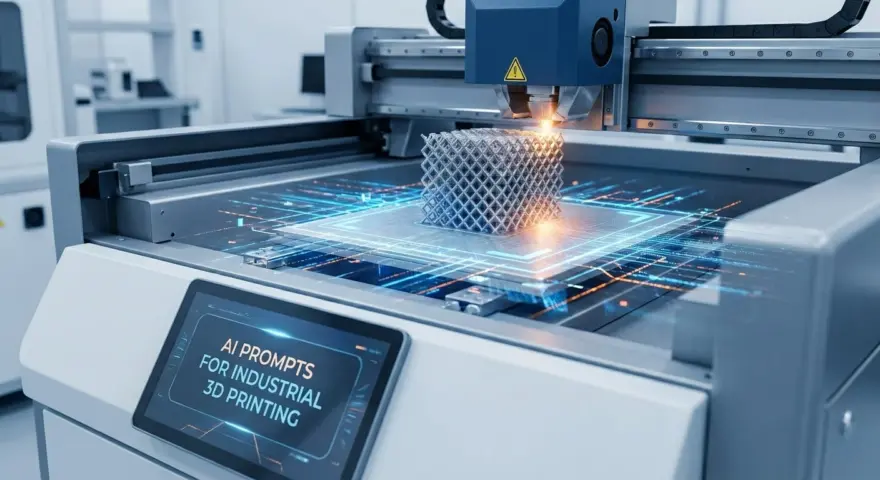
Additive Manufacturing (AM) has moved beyond rapid prototyping into the realm of full-scale production, yet the complexity of process variables remains a significant bottleneck. Achieving the perfect print requires balancing material science, thermal dynamics, and precise machine geometry.
Modern AI models—ChatGPT, Gemini, Claude, and DeepSeek—offer distinct advantages for tackling these engineering challenges. While DeepSeek excels at the complex mathematical logic required for parameter optimization and G-code analysis, Claude offers superior nuance for drafting SOPs and failure analysis. Gemini serves as a robust research assistant for material standards, and ChatGPT remains a versatile tool for brainstorming and general troubleshooting.
These 10 prompts provide a universal foundation for Additive Manufacturing Experts to reduce failure rates, optimize build strategies, and streamline the digital thread from CAD to part.
1. Material Selection & Compatibility Analysis
The Task: Determining the optimal feedstock for a specific industrial application based on mechanical, thermal, and chemical constraints.
Best for: Gemini (Excellent at retrieving and synthesizing technical data from vast specifications).
The Prompt:
Act as a Senior Materials Engineer in Additive Manufacturing. I need a comparative analysis between [Material A, e.g., PEKK] and [Material B, e.g., Ultem 9085] for an aerospace duct application.

Compare them based on the following criteria:
1. Heat Deflection Temperature (HDT) at 1.8 MPa.
2. Chemical resistance to [Specific Fluid, e.g., Skydrol].
3. Printability considerations for [Printer Type, e.g., FDM/FFF] (chamber temperature requirements, bed adhesion).
4. Post-processing requirements for achieving [Specific Certification, e.g., UL94 V-0] flammability compliance.

Output the data in a comparison table followed by a recommendation for a part that experiences cyclical thermal loading.
The Payoff: Instantly synthesizes complex data sheets into a decision matrix, ensuring material selection aligns with specific environmental stressors and certifications.
2. Design for Additive Manufacturing (DfAM) Audit
The Task: analyzing a conceptual geometry to identify potential print failures before slicing.
Best for: Claude (Strong at qualitative analysis and explaining geometric nuance).
The Prompt:
Act as a DfAM Specialist for [Process, e.g., Laser Powder Bed Fusion (LPBF)]. I am designing a [Part Name/Function] with internal cooling channels and a lattice structure.

Review the following design constraints and list the top 5 risks:
- Minimum wall thickness: [Value, e.g., 0.5mm]
- Overhang angle without support: [Value, e.g., 45 degrees]
- Powder removal requirement: Channels must be cleared of unfused powder.

Provide a checklist of specific geometric features I must inspect in the CAD file to prevent build failure, specifically addressing thermal distortion and powder entrapment.
The Payoff: Acts as a pre-flight checklist to catch design flaws that automated software checks often miss, specifically regarding post-process viability.
3. Laser Parameter Logic & Optimization
The Task: Calculating initial process parameters for a new metal alloy or custom layer height.
Best for: DeepSeek (Exceptional at handling logic, physics-based reasoning, and math).
The Prompt:
Act as a Process Physicist for Metal AM. I am developing a parameter set for [Material, e.g., Ti-6Al-4V] on a [Machine Type, e.g., EOS M290].

My target layer thickness is [Value, e.g., 60 microns].
Current baseline settings for 30 microns are:
- Laser Power: [Value, e.g., 280W]
- Scan Speed: [Value, e.g., 1200 mm/s]
- Hatch Distance: [Value, e.g., 0.14mm]

Using the concept of Volumetric Energy Density (VED) = P / (v * h * t), propose a starting set of parameters (Power, Speed) to maintain equivalent energy density for the thicker 60-micron layer. Explain the potential impact on surface roughness and porosity.
The Payoff: Provides a mathematically sound starting point for Design of Experiments (DoE), significantly reducing the number of test builds required to dial in new materials.
4. Advanced Support Structure Strategy
The Task: Developing a support strategy that balances build stability with ease of removal and surface finish.
Best for: ChatGPT (Versatile brainstorming for practical production strategies).
The Prompt:
Act as an Application Engineer. I am printing a [Geometry Description, e.g., cantilevered turbine blade] using [Material, e.g., Inconel 718].

The part is prone to warping due to residual stress. Propose a support structure strategy that prioritizes:
1. Anchoring the part to the build plate to resist thermal stress.
2. Heat dissipation from the melt pool.
3. Minimal contact on critical airflow surfaces.

Suggest specific support types (e.g., block, tree, gussets) and interface settings (e.g., tooth fragmentation, contact diameter) to achieve these goals.
The Payoff: Shifts focus from “just printing” to “printing for success,” providing strategic choices for support generation that automated slicers may not default to.
5. Automated Cost Estimation Model
The Task: Creating a logic structure to calculate the true cost per part, including machine amortization and post-processing.
Best for: DeepSeek (Strong code generation and logical structuring).
The Prompt:
Write a Python script (or Excel formula logic) to calculate the Total Cost per Part (TCP) for an SLM process.

The logic must include variables for:
- Material Cost (based on part volume + support volume + waste factor).
- Machine Hourly Rate (amortization + maintenance + energy).
- Print Time (calculated from total volume / build rate).
- Post-processing labor (fixed time per batch).
- Consumables (argon gas, filter changes).

Output the variable list and the step-by-step calculation logic clearly so I can implement it in a pricing tool.
The Payoff: Enables precise quoting and ROI analysis by accounting for hidden variables often ignored in basic material-cost calculations.
6. G-Code Analysis for Texture/Strength
The Task: Understanding or modifying specific G-code commands to alter mechanical properties or surface finish.
Best for: DeepSeek (Superior code interpretation).
The Prompt:
Explain the following G-code segment intended for an FDM printer. specifically focusing on the speed and extrusion changes in the transition between the perimeter and the infill.

[Insert Snippet of G-code here]

Identify where the feed rate changes and calculate the percentage increase in flow rate if the 'E' value increases non-linearly relative to the 'X/Y' movement. How would this specific sequence affect layer adhesion?
The Payoff: Demystifies the machine language, allowing experts to troubleshoot slicer bugs or manually inject code for custom mechanical behaviors.
7. Root Cause Analysis for Build Failures
The Task: Systematically diagnosing a print failure to prevent recurrence.
Best for: Claude (Great at deductive reasoning and structured troubleshooting).
The Prompt:
Act as a Senior Quality Engineer. I experienced a build failure with [Material, e.g., Nylon 12] in an SLS process.

Symptoms:
- Delamination occurred at layer 500.
- "Curling" was observed at the edges of the parts in the Z-axis.
- The build chamber temperature log shows a fluctuation of +/- 5 degrees C around layer 500.

Provide a Fishbone (Ishikawa) diagram analysis listing potential root causes across: Machine, Material, Method, and Environment. Rank the top 3 most likely causes based on the thermal sensitivity of Nylon 12.
The Payoff: Moves troubleshooting from “guessing” to a structured engineering methodology, rapidly isolating thermal management issues from material degradation.
8. Post-Processing SOP Generation
The Task: Standardizing the critical steps after the print is finished to ensure consistency.
Best for: Claude (Produces clear, human-readable, and safe instructional text).
The Prompt:
Draft a Standard Operating Procedure (SOP) for the depowdering and stress-relief heat treatment of Titanium (Ti-6Al-4V) parts produced via DMLS.

The SOP must include:
1. PPE requirements for handling reactive metal powders.
2. Step-by-step powder removal in an inert environment.
3. Thermal cycle profile (Ramp up rate, Soak temperature/time, Cool down rate) to relieve residual stress without altering microstructure.
4. Quality checkpoints.

Maintain a formal, safety-first tone suitable for an ISO 9001 certified manufacturing floor.
The Payoff: Generates professional-grade documentation that ensures safety compliance and reduces part-to-part variability caused by manual post-processing inconsistencies.
9. Digital Inventory & Supply Chain Logic
The Task: Justifying the switch from physical warehousing to digital inventory for spare parts.
Best for: Gemini (Good at integrating business logic with technical concepts).
The Prompt:
Act as a Supply Chain Analyst. I need to justify moving 20% of our slow-moving MRO (Maintenance, Repair, and Operations) inventory to a "Digital Inventory" model printed on-demand.

Create a logic argument comparing "Traditional Warehousing" vs. "On-Demand AM" considering:
- Holding costs (storage, insurance, depreciation).
- Lead time (ordering vs. printing).
- Obsolescence risk.
- Minimum Order Quantities (MOQ).

Provide a list of criteria to screen our current catalog to identify which parts are suitable candidates for this transition (e.g., material, complexity, annual volume).
The Payoff: Provides the business case language needed to convince management to invest in on-demand manufacturing, linking technical capability to financial metrics.
10. Inspection & QA Protocol Creation
The Task: Establishing a testing plan to validate part integrity against industry standards.
Best for: ChatGPT (Excellent at outlining comprehensive plans and protocols).
The Prompt:
Create a Quality Assurance (QA) Inspection Plan for a critical load-bearing bracket printed in 17-4 PH Stainless Steel.

The plan must align with general principles of ASTM F3122 (Mechanical Properties of AM Metals). Include:
1. Non-Destructive Testing (NDT) methods to detect internal porosity (e.g., CT Scan, Ultrasonic).
2. Witness coupon testing requirements (tensile bars printed in X, Y, and Z orientations).
3. Dimensional tolerance verification (CMM points).
4. Acceptance criteria for surface roughness (Ra).

Format this as a numbered verification list for a quality technician.
The Payoff: Ensures that AM parts meet the rigorous quality standards required for end-use production, bridging the gap between “prototype” and “production part.”
Pro-Tip: The “Context-Constraint” Chaining Method
For the most effective results, never let the AI guess your constraints. Use Prompt Chaining to refine the output. Start with the material generation or parameter prompts above, and then follow up with a constraint injection prompt:
Now, refine the previous answer assuming the part must adhere to [Specific Standard, e.g., ASTM F2924]. Highlight any parameters in your previous suggestion that might violate this standard.By explicitly forcing the AI to cross-reference its creative suggestions against rigid industrial standards, you transform it from a general knowledge engine into a specialized compliance officer.