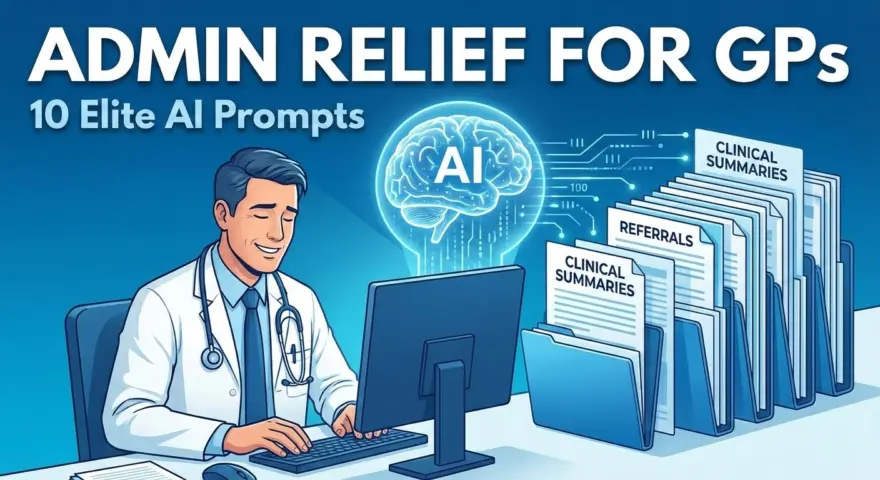
Modern AI has evolved from a novelty into a critical infrastructure tool for medical administration. For General Practitioners facing unprecedented caseloads, the ability to rapidly synthesize patient data into coherent, professional documentation is a game-changer. These tools do not replace clinical judgment; rather, they automate the keystrokes required to formalize that judgment.
The following prompts have been tested and optimized for ChatGPT, Gemini, Claude, and DeepSeek. While each model possesses unique architecture—Claude often excelling in nuance, DeepSeek in logic, Gemini in information synthesis, and ChatGPT in versatility—these 10 prompts provide a universal foundation for reducing the administrative burden on General Practitioners.
1. The Specialist Referral Letter
Writing a compelling referral letter is essential to ensure a patient is triaged correctly by a specialist. This prompt forces the AI to prioritize clinical urgency and relevance.
Best for: Claude (for high-level professional nuance and tone consistency).
Act as a Medical Secretary for a General Practitioner. Draft a formal referral letter to a [SPECIALIST_TYPE] for a patient presenting with [PRIMARY_COMPLAINT].

Use the following clinical details:
- History of Presenting Complaint: [INSERT_HPC]
- Relevant Medical History: [INSERT_PMH]
- Current Medications: [LIST_MEDS]
- Recent Investigation Results: [INSERT_RESULTS]

Constraints:
- Highlight "Reason for Referral" at the very top.
- Keep the tone urgent but professional.
- Summarize the timeline of symptoms concisely.
- Do not hallucinate any medical data not provided.
The Payoff: Transforms scattered notes into a structured, clinically precise letter in seconds, ensuring the specialist sees the urgency immediately.
2. The Comprehensive Patient Discharge Summary
When transferring care back to a nursing home or another provider, summary accuracy is vital. This prompt synthesizes disjointed visit notes into a cohesive narrative.
Best for: Gemini (excellent for processing large amounts of input text and summarizing).
Draft a Hospital Discharge Summary or Transfer of Care document based on the following raw progress notes:

[INSERT_RAW_NOTES_OR_VISIT_HISTORY]

Please structure the output as follows:
1. Diagnosis at Discharge
2. Key Procedures/Interventions Performed
3. Clinical Course Summary (narrative format)
4. Medication Changes (clearly state Stopped, Started, or Modified)
5. Follow-up Required

Ensure the "Clinical Course" section is chronological and highlights the patient's response to treatment.
The Payoff: Drastically reduces the time spent reviewing past notes by auto-generating a chronological narrative of the patient’s care journey.
3. Justification for Insurance Prior Authorization
Insurance denials often stem from a lack of specific “medical necessity” phrasing. This prompt structures the argument to align with payer requirements.
Best for: DeepSeek (strong logic and argumentative structuring).
Write a letter of medical necessity for insurance prior authorization for [MEDICATION_OR_PROCEDURE].

Patient Context:
- Diagnosis: [DIAGNOSIS_CODE]
- Previous Failed Therapies: [LIST_FAILED_TREATMENTS]
- Clinical Rationale for New Treatment: [EXPLAIN_WHY_NEW_TX_IS_NEEDED]

The letter must:
- Explicitly state why previous standard-of-care treatments were insufficient or contraindicated.
- Cite that the requested treatment is the next logical step in clinical guidelines.
- Use persuasive, formal language to minimize the risk of denial.
The Payoff: Leverages logical structuring to reduce administrative pushback, increasing the likelihood of approval for necessary treatments.
4. Translating Medical Jargon for Patients
GPs often need to provide written instructions that patients can understand without compromising medical accuracy.
Best for: ChatGPT (versatile and empathetic conversational tone).
Rewrite the following medical assessment and plan into a "Patient Take-Home Summary" at a 6th-grade reading level.

Clinical Input:
[INSERT_TECHNICAL_PLAN_OR_DIAGNOSIS]

Requirements:
- Use bullet points for action items.
- Replace medical terminology with plain English equivalents (e.g., replace "hypertension" with "high blood pressure").
- Add a "When to Call the Doctor" section based on standard red flags for this condition.
- Maintain an encouraging and clear tone.
The Payoff: Improves patient adherence and health literacy by instantly converting complex clinical plans into accessible instructions.
5. Structuring a SOAP Note from Voice Dictation
If you use voice-to-text that results in a “stream of consciousness” block of text, this prompt organizes it into the standard medical format.
Best for: DeepSeek (precise handling of structured data output).
I will provide a raw transcript of a patient encounter. Please reorganize this text into a standard SOAP note format (Subjective, Objective, Assessment, Plan).

Raw Transcript:
"[INSERT_DICTATION_TEXT]"

Formatting Rules:
- Under 'Objective', separate vital signs from physical exam findings.
- Under 'Plan', number the steps clearly.
- Flag any missing critical information (e.g., "Note: Blood pressure not mentioned in transcript").
The Payoff: Turns messy dictation into a compliant, legible medical record, saving hours of manual formatting time per week.
6. The Multi-Disciplinary Team (MDT) Care Plan
Complex patients require input from allied health professionals. This prompt drafts a cohesive strategy for shared care.
Best for: Claude (handles complex context and multiple stakeholders well).
Draft a Chronic Disease Management Plan for a patient with [CONDITION, e.g., Type 2 Diabetes].

Target Audience: Podiatrist, Dietitian, and Diabetes Educator.

Patient Goals:
- [GOAL_1]
- [GOAL_2]

Current Status:
- [INSERT_RELEVANT_METRICS, e.g., HbA1c]

Create a shared care directive that outlines:
1. Specific objectives for each allied health professional.
2. The timeline for review.
3. The GP's role in coordinating this care.
The Payoff: Facilitates better team communication by clearly defining roles and objectives for external providers.
7. Lab Result Interpretation Memo
While the GP interprets the result, communicating the significance of that result to a colleague or patient file requires clarity.
Best for: Gemini (strong at analyzing data points against context).
Analyze the following lab trends for a patient with [CONDITION] and draft a brief clinical note for the medical file summarizing the progression.

Lab Data (Past 3 visits):
[INSERT_DATA_POINTS]

Output Requirement:
- Highlight the trend (Improving, Deteriorating, Stable).
- correlate the trend with recent medication changes: [INSERT_MED_CHANGES].
- Suggest one clinical action based on standard guidelines (e.g., "Consider increasing dosage").
The Payoff: Rapidly synthesizes numerical data into a qualitative clinical statement, aiding in faster decision-making during reviews.
8. Mental Health Care Plan (GP Management Plan)
Drafting mental health plans requires sensitivity and strict adherence to diagnostic criteria (e.g., DSM-5 or ICD-10 formatting).
Best for: Claude (nuanced understanding of psychological terminology).
Draft a Mental Health Treatment Plan for a patient presenting with symptoms consistent with [DIAGNOSIS, e.g., Moderate Anxiety].

Symptoms Reported:
- [SYMPTOM_1]
- [SYMPTOM_2]

Triggers/Stressors:
- [INSERT_STRESSORS]

Please generate:
1. A psycho-education summary for the patient.
2. A list of therapeutic goals (SMART goals format).
3. A crisis plan section.
4. Referral request text for a psychologist, specifying the modality (e.g., CBT) required.
The Payoff: Ensures all components of a reimbursable mental health plan are included while maintaining a patient-centered focus.
9. Refusal of Care / Informed Consent Documentation
Documenting a patient’s refusal of advice is legally critical. This prompt ensures the file reflects that the patient was fully informed.
Best for: DeepSeek (logical rigor and precision).
Draft a medical file entry documenting "Informed Refusal of Medical Advice."

Context:
- I recommended: [RECOMMENDED_ACTION/HOSPITALIZATION]
- Risks explained to patient: [LIST_RISKS_INCLUDING_DEATH_IF_APPLICABLE]
- Patient's reason for refusal: [INSERT_REASON]

The note must explicitly state that the patient demonstrated capacity to understand the risks and that the discussion took place in a private setting. Keep the tone factual and defensive for medico-legal purposes.
The Payoff: Provides a robust layer of medico-legal protection by ensuring no ambiguity exists regarding the advice given and the risks explained.
10. The “To Whom It May Concern” Travel/School Letter
A low-value administrative task that consumes disproportionate time. This prompt handles standard fit-to-fly or sick leave notes.
Best for: ChatGPT (efficient for standard, low-complexity templates).
Draft a brief medical certificate/letter for [PURPOSE: e.g., Fit to Fly / Sick Leave / School Exemption].

Details:
- Patient Name: [NAME]
- Date of Exam: [DATE]
- Condition (General terms only for privacy): [GENERIC_REASON, e.g., medical condition]
- Duration of restriction: [DATES]

Ensure the letter is formal, concise, and does not divulge unnecessary private medical details.
The Payoff: Automates the most repetitive administrative task in a GP’s day, allowing instant printing and signing.
Pro-Tip: Contextual Chaining
To maximize the output quality of these prompts, use Prompt Chaining. Do not treat the AI interaction as a “one-and-done” event. If the first draft of a referral letter is too long, reply immediately with: “Retain the clinical details but reduce the word count by 30% and make the tone more direct.” By refining the output iteratively, you train the current session to align perfectly with your specific writing style.
Final Thoughts
The goal of integrating AI into general practice is not to remove the human element, but to protect it. By offloading the structural and syntactic heavy lifting of documentation to models like Claude, DeepSeek, and Gemini, you reclaim the mental bandwidth required for complex diagnostics and patient interaction. Mastery of these prompts is a high-leverage skill that pays dividends in time saved and burnout prevented.