The Bottleneck: It’s Not Just About the Model Anymore
In 2026, the challenge in Generative AI isn’t finding a model that works—it’s serving it efficiently. While Hugging Face Diffusers remains the “standard library” for diffusion models, it is no longer the default answer for high-performance production.
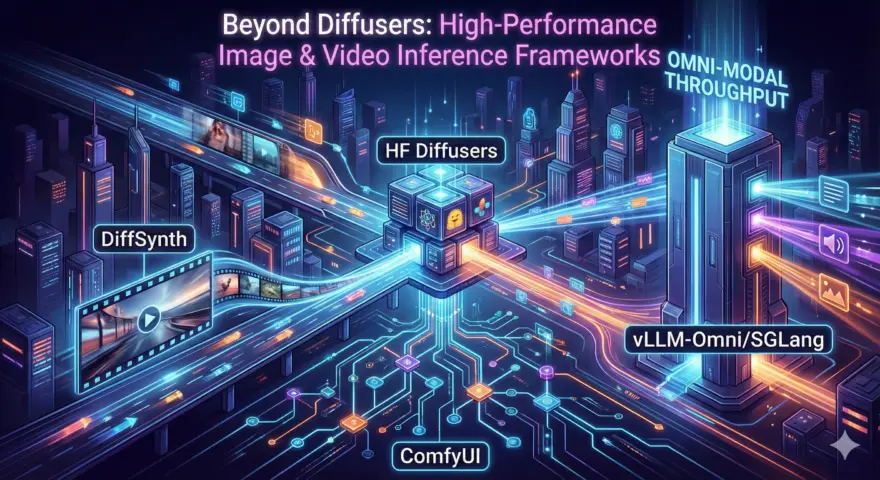
We are witnessing a fragmentation in the inference landscape. Developers are now forced to choose between pipeline flexibility (Diffusers), graph-based optimization (ComfyUI), video-native efficiency (DiffSynth), or the new wave of Omni-modal serving (vLLM-Omni/SGLang).
This post dissects the architecture of these four paradigms, explaining why you would choose one over the other for your next AI product.
Core Concept: The Four Architectures of Inference
Understanding the underlying execution model is critical for optimization.
- Sequential Pipelines (Diffusers): Linear execution of Python code. Easy to debug, hard to optimize globally.
- Graph Execution (ComfyUI): A Directed Acyclic Graph (DAG) where nodes represent operations. Allows for aggressive caching and VRAM management.
- Video-Native Engines (DiffSynth): Specialized kernels for temporal consistency and long-context video, often optimizing the “Attention” mechanism across frames.
- Omni-Serving (vLLM-Omni/SGLang): Decoupled architectures that treat images/video as tokens, allowing LLMs to orchestrate generation in a single pass.
Architecture Visualization
graph TD
    subgraph "Standard (Diffusers)"
        A1["Python Script"] -->|"Call"| B1["Pipeline"]
        B1 -->|"Sequential"| C1["UNet/Transformer"]
        C1 -->|"VRAM: High"| D1["Image"]
    end

    subgraph "Graph (ComfyUI)"
        A2["Node Graph"] -->|"Topological Sort"| B2["Execution Queue"]
        B2 -->|"Smart Offload"| C2["Model Patching"]
        C2 -->|"VRAM: Low"| D2["Image"]
    end

    subgraph "Omni-Serving"
        A3["Request"] -->|"Tokens"| B3["LLM Core"]
        B3 -->|"Decoupled"| C3["Modal Generator"]
        C3 -->|"Streaming"| D3["Multimodal Output"]
    end
1. The Standard: Hugging Face Diffusers
Best for: General-purpose applications, researchers, and standard web APIs.
Diffusers remains the bedrock of the open-source ecosystem. Its primary strength is modularity. It treats schedulers, autoencoders, and UNets/Transformers as interchangeable Lego blocks.
- Pros: Massive community support, immediate support for new papers (e.g., SD3.5, Flux), easy to read Python code.
- Cons: “Jack of all trades, master of none.” Default pipelines often lack the aggressive VRAM optimizations found in specialized tools.
- Key Tech:
StableDiffusionPipeline,FluxPipeline.
2. The Modular Powerhouse: ComfyUI
Best for: Rapid prototyping, complex workflows, and low-VRAM environments.
ComfyUI is not just a GUI; it is a highly efficient backend. By representing the generation process as a graph, ComfyUI can determine exactly which model weights need to be on the GPU at any given microsecond.
- The Breakthrough: Smart Memory Management. ComfyUI aggressively moves weights between VRAM and RAM based on the graph execution state. This allows consumer GPUs (e.g., 8GB VRAM) to run massive models like Flux or SDXL that would OOM (Out of Memory) in standard Diffusers pipelines.
- Implementation: It uses a custom execution model that patches model weights on the fly (LoRAs, ControlNets) without reloading the base model.
3. The Video Specialist: DiffSynth-Studio
Best for: High-resolution video generation, long-context consistency.
DiffSynth-Studio (and its backend DiffSynth-Engine) addresses the specific pain points of video generation: flickering and memory explosion.
- The Problem: Generating video requires maintaining context across disparate frames. Standard attention mechanisms scale poorly (quadratically) with the number of frames.
- The Solution: DiffSynth implements specialized optimizations like Partitioned Cross-Attention and Deflickering algorithms (e.g., FastBlend) directly into the engine. It is the preferred backend for models like Wan2.1/2.2 (Mixture-of-Experts video models).
- Key Feature: Supports “Text-to-Video” with extremely long durations by optimizing the latent management that other frameworks ignore.
4. The LLM Invaders: vLLM-Omni & SGLang
Best for: High-throughput serving, Multimodal Agents, and Real-time interaction.
This is the frontier of late 2025. Tools originally built for LLM serving are now swallowing image generation.
vLLM-Omni
vLLM-Omni introduces a decoupled pipeline architecture.
Mechanism: It splits the process into a Modal Encoder (inputs), LLM Core (reasoning/text), and Modal Generator (output pixels/audio).
Why it matters: It allows you to serve a model that can listen to audio, think in text, and reply with an image, all within a single optimized PagedAttention memory space.
SGLang (Multimodal Gen)
SGLang applies RadixAttention (automatic prefix caching) to multimodal workloads.
Use Case: If you are building an agent that generates images based on a long conversation history, SGLang caches the conversation context (KV cache) so you don’t recompute it for every new image generation request.
Technical Comparison
| Framework | Hugging Face Diffusers | ComfyUI | DiffSynth-Studio | vLLM-Omni | SGLang (Multimodal) |
| Core Architecture | Sequential Python Pipeline | Directed Acyclic Graph (DAG) | Video-Native Engine | Decoupled Serving Engine | Runtime with RadixAttention |
| Primary Philosophy | Modularity (Swap components easily) | Memory Efficiency (Run big models on small GPUs) | Temporal Consistency (Long-form video) | Low Latency (Real-time interaction) | Structure & Caching (Complex workflows) |
| VRAM Management | Manual (requires enable_model_cpu_offload) |
Dynamic Swapping (Auto-loads/unloads weights per node) | Tiled Processing (Optimized for high-res frames) | PagedAttention (Optimized for KV cache & concurrency) | RadixAttention (KV Cache reuse across requests) |
| Throughput (Concurrency) | Low (Designed for single streams) | Medium (Queue-based) | Low (Focus on single high-quality render) | Extremely High (Continuous Batching) | High (Optimized for cache hits) |
| Video Capabilities | Basic (Standard pipelines) | High (Via AnimateDiff/Video Helper nodes) | Native / Best-in-Class (Deflickering, long context) | Emerging (Streaming frame tokens) | Emerging (Token-based generation) |
| Developer Interface | Python API | Node Graph GUI / JSON API | Python API / Gradio | REST / OpenAI-compatible API | Python / OpenAI-compatible API |
| Key Optimization | torch.compile / XFormers |
Smart Weight Management / FP8 | Partitioned Cross-Attention | Decoupled Input/Output Processing | Automatic Prefix Caching |
| Best Use Case | General SaaS / Apps requiring standard features | R&D / Art Tools & Local Deployment | AI Movie Production & High-Fidelity Video | Voice-to-Video Agents & Real-time Chat | Complex Agents requiring history & structured output |
Implementation Strategy
If you are building a generative AI product in late 2025, follow this decision tree:
- Are you building a chatbot that sends images? Action: Deploy vLLM-Omni. It unifies the text and image stack, reducing latency and infrastructure cost.
- Are you building a specialized video editing tool? Action: Use DiffSynth. Its support for Wan2.1/2.2 and deflickering algorithms is unmatched.
- Are you building a prototyping interface for internal teams? Action: Use ComfyUI. The node graph allows non-engineers to tweak workflows without touching code.
- Are you building a standard SaaS (e.g., Profile Picture Generator)? Action: Stick with Diffusers. It is stable, well-documented, and easiest to hire for.
The era of “one inference engine fits all” is over. The “Omni” trend (vLLM/SGLang) suggests a future where generation is just another token stream, but for high-fidelity creative tasks (Video/Art), specialized engines like DiffSynth and ComfyUI remain superior. Choose your engine based on your bottleneck: Memory (Comfy), Throughput (vLLM), or Temporal Quality (DiffSynth).