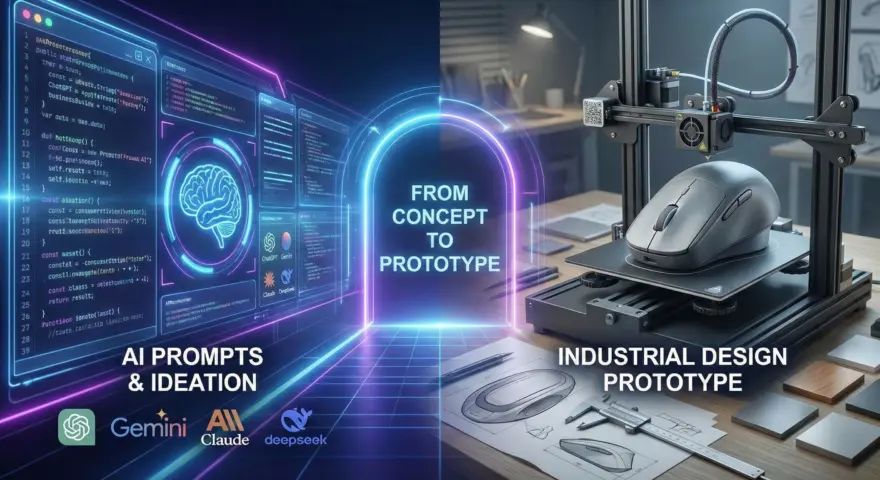
Industrial design stands at the intersection of engineering, art, and user psychology. The introduction of advanced AI models has not replaced the designer’s eye but has dramatically accelerated the path from abstract thought to tangible prototype.
The prompts below have been rigorously tested and optimized for the leading AI powerhouses: ChatGPT, Gemini, Claude, and DeepSeek. While each model possesses unique architectural strengths—DeepSeek often excelling at logic and code, Claude at nuanced natural language, Gemini at large-context data processing, and ChatGPT at versatile problem solving—these 10 prompts provide a universal foundation for modern Industrial Designers. They are designed to act as your digital studio assistant, handling everything from material science research to ergonomic compliance.
1. Generating Divergent Concepts from Constraints
Best for: Claude (for creative nuance) or ChatGPT (for rapid ideation).
This prompt forces the AI to move beyond obvious solutions by strictly adhering to functional constraints while maximizing aesthetic variance.
Act as a Senior Industrial Designer. I am designing a [PRODUCT TYPE, e.g., handheld vacuum cleaner].
Constraints:
1. Target Audience: [AUDIENCE, e.g., urban millennials living in small apartments].
2. Key Material: [MATERIAL, e.g., recycled ocean plastic].
3. Aesthetic Goal: [STYLE, e.g., brutalist minimalism].

Generate 5 distinct conceptual directions. For each direction, provide:
- A unique "Concept Name."
- A description of the form factor and silhouette.
- A specific User Experience (UX) feature that solves a common pain point.
- An analogy for the visual language (e.g., "looks like a pebble smoothed by water").
The Payoff: This instantly creates a “mood board” of text-based ideas, preventing creative block and ensuring all concepts remain viable within your initial constraints.
2. Materials Science & Manufacturing Feasibility
Best for: DeepSeek (for technical logic) or Gemini (for sourcing technical data).
Before committing to a rendering, validate your material choices against manufacturing realities.
I am designing a [PRODUCT PART, e.g., snap-fit enclosure for a wearable health monitor].
I intend to use [PROPOSED MATERIAL, e.g., Polycarbonate (PC)].
The product requires [SPECIFIC PROPERTY, e.g., high impact resistance and optical clarity].

Analyze this choice for Injection Molding.
1. List potential defects or risks (e.g., sink marks, warping) specific to this geometry and material.
2. Suggest 2 alternative materials that might offer better performance or lower cost without sacrificing the core properties.
3. specific draft angle recommendations for this material.
The Payoff: This prompt acts as an early-stage engineering audit, saving costly revisions by flagging manufacturing issues before you open CAD software.
3. Creating Detailed User Personas & Scenarios
Best for: Claude (for empathetic, human-centric profiling).
Great design starts with understanding the user’s daily friction points.
Create a detailed user persona for a [PRODUCT, e.g., ergonomic office chair].
The target demographic is [DEMOGRAPHIC, e.g., remote software engineers working 10+ hours a day].

1. Define the persona's physical environment and ergonomic pain points.
2. Write a "Day in the Life" scenario focusing strictly on their interaction with current solutions and where they fail.
3. List 3 "delight factors"—subtle design features that would surprisingly improve their quality of life.
The Payoff: Deepens empathy and helps you design features that solve actual user problems rather than hypothetical ones.
4. Ergonomic Data Retrieval & Application
Best for: Gemini (for processing large datasets) or DeepSeek (for precise numerical data).
Avoid guesswork regarding human factors and anthropometric data.
I am designing a [PRODUCT, e.g., gaming controller] intended for the 5th to 95th percentile of adult hand sizes globally.

Provide a table of critical anthropometric dimensions I must consider (e.g., grip width, thumb reach).
Include:
1. The dimension name.
2. The measurement range (in mm) for the 5th % female to 95th % male.
3. How this specific dimension should dictate the geometry of the device (e.g., button placement).
The Payoff: Provides immediate, actionable constraints for your CAD modelling, ensuring your product is physically accessible to the widest possible audience.
5. Writing Design for Manufacturing (DFM) Checklists
Best for: DeepSeek (for rigorous logic) or ChatGPT (for comprehensive lists).
Ensure your transition from prototype to production is seamless.
Generate a Design for Manufacturing (DFM) checklist for a product made primarily of [MATERIAL/PROCESS, e.g., Sheet Metal Bending].

Categorize the checklist into:
1. Tolerance & Fit.
2. Geometry Constraints (e.g., bend radii, hole proximity to edges).
3. Assembly efficiency.
4. Finishing limitations.

Ensure the tone is technical and suitable for reviewing a SolidWorks or Fusion 360 file.
The Payoff: Functions as a quality assurance gatekeeper, helping you catch non-manufacturable geometry before sending files to vendors.
6. CMF (Color, Material, Finish) Strategy
Best for: Claude (for descriptive aesthetics) or Gemini (for trend analysis).
Translate brand values into tactile experiences.
Develop a CMF (Color, Material, Finish) strategy for a [PRODUCT, e.g., high-end coffee maker] aimed at the [MARKET SEGMENT, e.g., luxury minimalist] market.

Propose 3 distinct palettes:
1. "Tech Noir" (Dark, modern, matte).
2. "Organic Warmth" (Natural tones, texture-heavy).
3. "Clinical Precision" (High-gloss, metallic, clean).

For each palette, define:
- Primary Color (Pantone or RAL reference).
- Secondary Accent Material.
- Surface Finish (e.g., sandblasted aluminum, soft-touch rubber).
- The emotional response this combination aims to evoke.
The Payoff: Elevates the perceived value of your product by ensuring visual and tactile elements tell a cohesive story.
7. Competitor Product Analysis
Best for: Gemini (for accessing broad web info) or ChatGPT.
Understand the market landscape to identify your “Blue Ocean.”
Act as a Product Strategist. Analyze the current market for [PRODUCT CATEGORY, e.g., smart water bottles].

Identify the top 3 competitors and analyze them based on:
1. Form Factor Strengths (what do they look like?).
2. Functional Weaknesses (what do user reviews complain about?).
3. The "Gap": Describe a design opportunity that none of these competitors are currently addressing.
The Payoff: rapidly identifies market saturation and opportunities for innovation, ensuring your design has a unique value proposition.
8. Generating Midjourney/Stable Diffusion Prompts
Best for: ChatGPT or Claude (for descriptive imagery).
Use text-based AI to write better prompts for image-generation AI.
I need to generate photorealistic concept renders using an AI image generator.
Write 3 detailed text prompts to generate a [PRODUCT, e.g., futuristic bicycle helmet].

Include detailed keywords for:
- Lighting (e.g., studio lighting, rim light).
- Camera angle (e.g., isometric view, macro detail).
- Material rendering (e.g., carbon fiber texture, subsurface scattering).
- Style (e.g., Dieter Rams inspired, Syd Mead futurism).

Format the output as raw text strings ready to copy-paste.
The Payoff: Bridges the gap between verbal concepts and visual exploration, allowing for rapid iteration of form and mood.
9. Sustainability Impact Assessment
Best for: Gemini (for sourcing environmental data) or DeepSeek.
Evaluate the lifecycle impact of your design decisions early.
Conduct a preliminary Lifecycle Assessment (LCA) for a product consisting of [COMPONENT A] and [COMPONENT B].

Analyze the environmental impact across:
1. Sourcing & Extraction.
2. Manufacturing energy intensity.
3. End-of-Life (Recyclability vs. Landfill).

Suggest one design change (e.g., snap-fits instead of glues) that would significantly improve the product's circularity.
The Payoff: Empowers you to make responsible design decisions that align with modern sustainability standards and regulations.
10. Pitching the Design to Stakeholders
Best for: Claude (for persuasive rhetoric) or ChatGPT.
Sell the “why” behind the “what.”
I need to pitch this design concept to [STAKEHOLDER, e.g., the VP of Marketing].
The design features [KEY FEATURE, e.g., a modular battery system].

Write a persuasive 3-paragraph pitch that frames this feature not just as a design choice, but as a business advantage.
1. Paragraph 1: The Problem (User frustration).
2. Paragraph 2: The Solution (Our design).
3. Paragraph 3: The Benefit (ROI, brand loyalty, or reduced returns).
The Payoff: Translates technical design decisions into business language, increasing the likelihood of concept approval.
Pro-Tip: Context Injection
To get the most out of these models, never assume they know your project history. Use Prompt Chaining: Start by uploading your design brief or pasting a comprehensive project summary into the chat before asking for specific outputs. For example, “Here is the project brief for my new kettle design… [PASTE BRIEF]. Acknowledge you have read this, and then wait for my next instruction.” This primes the model’s context window, ensuring every subsequent answer is aligned with your specific constraints.
Mastering these prompts is not about automating creativity; it is about automating the friction that slows it down. By offloading research, data synthesis, and preliminary validation to AI, you reclaim valuable time for the high-level critical thinking and aesthetic refinement that defines exceptional industrial design. Start integrating these into your workflow today, and watch your design process become sharper, faster, and more data-driven.