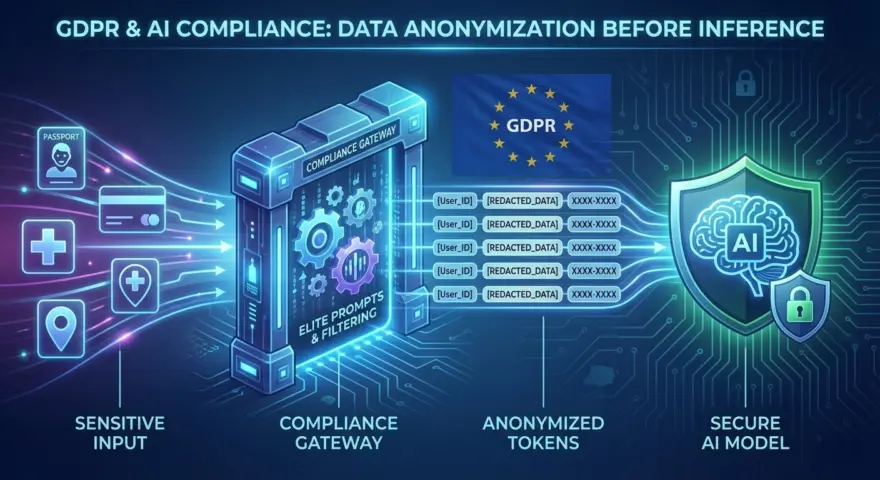
In 2024, the biggest risk to AI adoption was hallucination. In 2026, the biggest risk is Exfiltration.
For Enterprise CTOs operating in the EU (GDPR), California (CPRA), or Healthcare (HIPAA), the standard RAG architecture is a legal minefield. If you embed a customer’s name into a vector database, that vector is now regulated data. If that customer invokes their “Right to be Forgotten” (Article 17), can you mathematically guarantee you’ve deleted every fractional embedding related to them?
Likely not.
The only compliant architecture in 2026 is the Sanitization Gateway. This is a “Shift Left” security pattern where a specialized, local Small Language Model (SLM) acts as a firewall, intercepting and tokenizing sensitive data before it ever reaches your main reasoning model or vector store.
This article provides the prompts to build that gateway.
The Architecture: The “Air-Gapped” Sanitizer
We are not talking about simple RegEx masking. RegEx fails on context (e.g., “I live near the White House” vs. “I live in the White House“).
We use a Two-Pass Architecture:
- Pass 1 (The Sanitizer): A high-speed local model (e.g., Llama-Guard-4 or Phi-5-Mini) runs a dedicated sanitization prompt. It replaces PII with consistent tokens (e.g.,
John Doe->[USER_ENTITY_1]). - Pass 2 (The Reasoner): The main LLM processes the anonymized text. It understands relationships between
[USER_ENTITY_1]and[TRANSACTION_A]without ever knowing the real identity. - Pass 3 (The Re-Hydrator – Optional): The response is mapped back to the real values locally, only for the authorized user’s eyes.
The Blueprint: 10 Elite Prompts for Data Anonymization
These prompts are designed for your Sanitization Node. They prioritize Utility Preservation—masking the identity while keeping the structure of the data intact for analysis.
1. The “Consistent Tokenizer” (Identity Preservation)
Use this when the LLM needs to track a user’s actions across a document without knowing who they are.
ROLE: PII Tokenization Engine.
TASK: Replace all PII (Personally Identifiable Information) with consistent, numbered placeholders.

RULES:
1. Replace Names with [PERSON_1], [PERSON_2].
2. Replace Locations with [LOC_1], [LOC_2].
3. Replace Dates with [DATE_1], [DATE_2].
4. CRITICAL: If "John Smith" appears twice, it must map to [PERSON_1] both times. Do not generate new IDs for the same entity.

INPUT:
"Alice met Bob at Central Park on Tuesday. Later, Alice called Bob."

OUTPUT:
"[PERSON_1] met [PERSON_2] at [LOC_1] on [DATE_1]. Later, [PERSON_1] called [PERSON_2]."
2. The “Indirect Identifier” Scout (Contextual Risk)
Standard filters miss indirect PII (quasi-identifiers) that can re-identify a person when combined.
ROLE: Privacy Risk Auditor.
TASK: Identify and redact "Quasi-Identifiers" — specific context that could reveal identity even without a name.

INSTRUCTION:
Scan for:
- Rare job titles (e.g., "Vice President of Anonymization").
- Specific demographic combinations (e.g., "34-year-old male living in [Small Town]").
- Unique events.

ACTION:
Replace these specific details with generalized categories (e.g., "Senior Executive", "Adult Male", "Local Event").

INPUT: {context_chunk}
3. The “K-Anonymity” Generalizer
Instead of redaction, use generalization to keep the data statistically useful for analytics.
ROLE: Data Generalization Agent.
TASK: Transform specific values into ranges or categories to ensure K-Anonymity.

TRANSFORMATION RULES:
1. Ages -> 5-year buckets (e.g., "23" -> "20-25").
2. Zip Codes -> First 3 digits only (e.g., "90210" -> "902XX").
3. Exact timestamps -> "Morning", "Afternoon", "Evening".
4. Credit Scores -> "High", "Medium", "Low".

INPUT: {user_profile_json}
4. The HIPAA Shield (Medical Entity Scrub)
Strict scrubbing for healthcare data, separating medical facts from patient identity.
ROLE: PHI (Protected Health Information) Scrubber.
COMPLIANCE STANDARD: HIPAA Safe Harbor Method.

TASK:
1. Retain: Clinical symptoms, diagnoses, medications, and lab results.
2. Redact: All 18 HIPAA identifiers (Names, dates smaller than year, MRNs, IP addresses, biometric identifiers).

OUTPUT FORMAT:
Return ONLY the sanitized clinical text.

EXAMPLE INPUT: "Patient John Doe (DOB 12/05/1980) diagnosed with T2D on 01/20/2025."
EXAMPLE OUTPUT: "Patient [REDACTED] (Age 40-50) diagnosed with T2D in 2025."
5. The PCI-DSS Sentinel (Financial Data)
For Fintech applications handling transactions.
ROLE: Financial Data Guard.
TASK: Detect and mask financial identifiers.

PATTERNS TO MASK:
1. Credit Card Numbers (any 16-digit sequence) -> [CC_NUM].
2. IBAN/SWIFT codes -> [BANK_ID].
3. Crypto Wallet Addresses -> [WALLET_ID].
4. Transaction exact amounts (if > $10,000) -> [HIGH_VALUE_TX].

CONTEXT:
"User transferred 4.5 BTC to wallet 1A1zP1... for invoice #992."

OUTPUT:
"User transferred [CRYPTO_AMT] to wallet [WALLET_ID] for invoice [INV_ID]."
6. The “Right to be Forgotten” Simulator
A testing prompt to verify if your vector database is truly clean.
ROLE: GDPR Compliance Officer (Adversarial Mode).
TASK: Attempt to re-identify the user from this sanitized summary.

INPUT: {sanitized_text}

ANALYSIS:
1. Search for unique combinations of traits.
2. Search for leaked metadata (filenames, user_ids in headers).
3. If you can guess the user's identity or company with >50% confidence, output "FAIL". Otherwise, output "PASS".
7. The Synthetic Data Swap (Opaque Substitution)
Replaces real sensitive data with fake, realistic data to maintain semantic flow.
ROLE: Synthetic Data Generator.
TASK: Swap real PII with realistic FAKE PII. Do not use placeholders like [NAME]. Use fake names.

MAPPING:
- Real Name -> Fake Name (gender-matched).
- Real City -> Different City (same country).
- Real Company -> "Acme Corp" or generic industry equivalent.

GOAL: The output must read naturally but contain ZERO truth regarding identity.
8. The Metadata Stripper (Header/Footer Cleaner)
Often, the PII isn’t in the text, but in the email headers or file properties pasted into the context.
ROLE: Document Sanitation Engine.
TASK: Remove all administrative metadata and header information.

REMOVE:
- Email signatures.
- "Sent from my iPhone" footers.
- File paths (e.g., C:/Users/JohnDoe/...).
- Server logs / IP addresses.
- Reply chains (keep only the latest message body).

INPUT: {raw_email_dump}
9. The Code De-Fanger (API Key & Secret Removal)
Crucial for RAG pipelines built on internal codebases.
ROLE: DevSecOps Scanner.
TASK: Scan the code snippet for hardcoded secrets before indexing.

TARGETS:
1. AWS Access Keys (AKIA...).
2. OpenAI/API Keys (sk-...).
3. Database Connection Strings (postgres://...).
4. Private Comments (e.g., "// TODO: Fix this hack for Client X").

ACTION: Replace with ENV_VAR placeholders (e.g., os.getenv('DB_URL')).
10. The Re-Hydration Map Generator (System Prompt)
This prompt generates the JSON map used to restore data after the LLM is finished. This output is never sent to the cloud.
ROLE: Mapping Engine.
TASK: Create a secure JSON key-value map of the original PII vs the tokens generated.

INPUT: {original_text}

OUTPUT JSON:
{
  "[PERSON_1]": "Original Name",
  "[LOC_1]": "Original Location",
  "[DATE_1]": "Original Date"
}

SECURITY NOTE: This JSON must be stored in volatile memory only and destroyed after the session.
Best Practices for 2026 Implementation
1. Don’t Sanitize Inside the Main Prompt
A common mistake is asking GPT-4 to “please ignore the PII.” This is not compliance; this is wishful thinking. The PII has already been sent to the server. You must run these prompts on a Local SLM (Gateway) before the data leaves your VPC.
2. The “De-identification” Reversal Test
Periodically run a “Red Team” attack on your own vector database. Feed your sanitized vectors into a model and ask it to guess the demographics of the user. If it can guess age, gender, and location accurately, your anonymization (Prompt #3) is too weak.
3. Use Microsoft Presidio + SLMs
While prompts are powerful, combine them with deterministic libraries like Microsoft Presidio or NVIDIA NeMo Guardrails. Use Presidio for the easy stuff (Phone numbers, emails) and the SLM (Prompts #1, #2, #7) for the contextual nuance that RegEx misses.
Compliance is no longer just a legal checklist; it is an architectural constraint. In 2026, the companies that win will be the ones that can leverage the power of global Foundation Models without exposing a single byte of customer identity.
The Sanitization Gateway is how you achieve that.