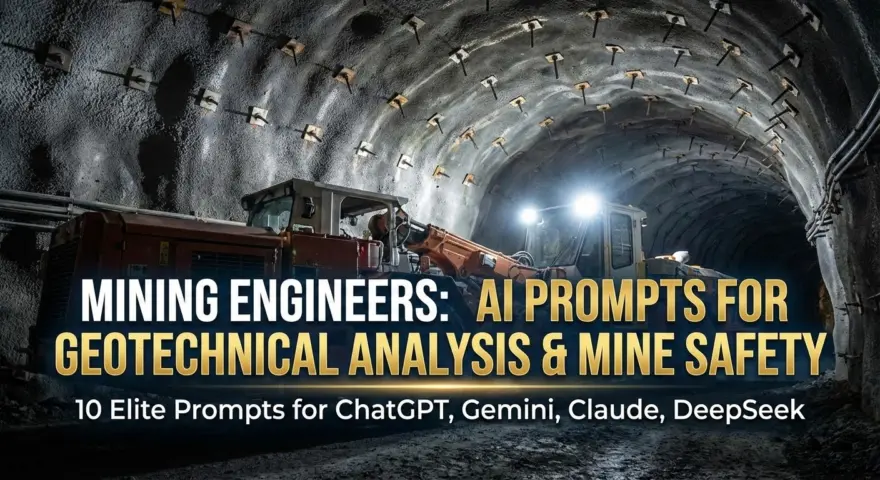
Modern artificial intelligence has evolved beyond simple text generation into a sophisticated computational partner capable of handling complex engineering parameters, risk modeling, and safety protocols. For Mining Engineers, specifically those focused on geotechnical stability and operational safety, these tools offer a significant advantage in data synthesis and decision support.
The following prompts have been rigorously tested and optimized for deployment across the major AI powerhouses: ChatGPT, Gemini, Claude, and DeepSeek. While each model possesses distinct architectures—DeepSeek often excelling in logic-heavy tasks and Claude in textual nuance—these ten prompts provide a universal, high-performance foundation for elevating your engineering workflows.
1. Rock Mass Rating (RMR) Interpretation
Best for: Claude (for handling qualitative descriptions and nuance) or ChatGPT (for versatile summarization).
Field data often comes in fragmented logs. This prompt helps synthesize geological descriptions into a preliminary RMR estimation to guide ground support decisions.
Act as a Senior Geotechnical Engineer. Based on the following field log descriptions of rock quality, discontinuity spacing, condition of discontinuities, groundwater conditions, and uniaxial compressive strength, estimate the Rock Mass Rating (RMR89).

Provide a step-by-step breakdown of the rating assignment for each parameter. After calculating the total RMR, classify the rock mass (I to V) and suggest preliminary stand-up time and ground support guidelines based on empirical charts.

[INSERT FIELD LOG DATA HERE]
The Payoff: Rapidly converts raw geological field notes into actionable classification data, allowing for faster initial support design verification.
2. Slope Stability Factor of Safety (FoS) Analysis Code
Best for: DeepSeek (for complex logic and code generation) or ChatGPT (for standard scripting).
Automate the setup for limit equilibrium analysis by generating Python scripts that interact with geotechnical libraries.
Write a Python script using the `shapely` and `scipy` libraries to perform a simplified 2D slope stability analysis using the Method of Slices (Bishop's Simplified Method).

The script should accept the following input variables:
1. Slope geometry coordinates (x, y).
2. Soil/Rock properties: Cohesion (c), Friction Angle (phi), and Unit Weight (gamma).
3. Pore water pressure ratio (ru).

Include comments explaining the logic for the slice discretization and the iterative loop for calculating the Factor of Safety (FoS).
The Payoff: Provides a custom computational tool for quick sensitivity analysis without needing to immediately launch heavy-duty commercial software.
3. Root Cause Analysis for Safety Incidents
Best for: Claude (for structured reasoning) or Gemini (for analyzing complex context).
When a safety incident occurs, identifying the systemic failure is critical. This prompt utilizes the ICAM (Incident Cause Analysis Method) framework.
Act as a Lead Safety Investigator. I will provide a brief description of a recent mine safety incident involving [INSERT INCIDENT TYPE, e.g., mobile equipment collision].

Conduct a Root Cause Analysis using the "5 Whys" technique combined with the ICAM framework. Categorize your findings into:
1. Absent/Failed Defenses
2. Individual/Team Actions
3. Task/Environmental Conditions
4. Organizational Factors

Generate a formatted report that identifies the systemic root cause rather than just the immediate human error.
The Payoff: Shifts focus from blame to systemic improvement, ensuring investigation reports are comprehensive and actionable.
4. Tailings Storage Facility (TSF) Piezometer Trend Analysis
Best for: Gemini (for processing large data patterns) or DeepSeek (for analytical depth).
Detecting subtle shifts in pore pressure is vital for TSF integrity. This prompt helps analyze raw sensor data for anomalies.
Analyze the provided dataset of piezometer readings from a Tailings Storage Facility over the last [INSERT TIME PERIOD].

Identify any trends that indicate a rising phreatic surface or potential seepage anomalies that deviate from the expected hydrostatic lines. Flag any readings that exceed a variance of [INSERT %] from the moving average.

Provide a bulleted summary of "At-Risk" zones requiring immediate physical inspection.

[INSERT PIEZOMETER DATASET OR CSV FORMAT]
The Payoff: Automates the “first pass” review of monitoring data, highlighting critical stability risks that might be missed in manual spreadsheet reviews.
5. Design of Experiments (DoE) for Shotcrete Mix Optimization
Best for: ChatGPT (for experimental design) or Claude (for specification clarity).
Optimizing shotcrete for strength and rebound reduction requires careful testing. This prompt designs the testing matrix.
I need to optimize a shotcrete mix for an underground decline. The constraints are:
1. Target UCS: [INSERT MPA] at 28 days.
2. Max Aggregate Size: [INSERT MM].
3. Accelerator type: [INSERT TYPE].

Design a Taguchi Design of Experiments (DoE) matrix to test the effects of three variables: Water/Cement ratio, Accelerator dosage, and Fiber content. Explain which combinations offer the highest statistical significance for determining early strength development.
The Payoff: structure a scientific approach to material testing, saving time on trial-and-error and ensuring cost-effective mix designs.
6. Ventilation Network Troubleshooting
Best for: DeepSeek (for solving physics-based logic) or Gemini (for broad system analysis).
When airflow doesn’t match the model, use this prompt to diagnose potential network resistance issues.
You are a Ventilation Engineer. We are experiencing insufficient airflow at the face of [INSERT DRIFT/STOPE ID].

Current parameters:
- Fan operating point: [INSERT PRESSURE/VOLUME].
- Duct diameter: [INSERT DIAMETER].
- Duct length: [INSERT LENGTH].
- Measured flow at face: [INSERT MEASURED FLOW].

Calculate the theoretical shock losses and friction losses (k-factor) based on these parameters. List 5 probable physical causes for the discrepancy between the fan curve and actual delivery (e.g., leakage rates, shock losses at bends), and suggest a diagnostic checklist to isolate the issue.
The Payoff: Bridges the gap between theoretical fan curves and physical reality, providing a logical troubleshooting checklist for field technicians.
7. Drill and Blast Fragmentation Optimization
Best for: ChatGPT (for general calculations) or DeepSeek (for mathematical precision).
Poor fragmentation impacts loading and crushing efficiency. This prompt adjusts blast patterns based on outcomes.
Our current blast design is producing excessive oversize (> [INSERT SIZE] mm) in a massive sulphide ore body.

Current parameters:
- Burden: [INSERT M].
- Spacing: [INSERT M].
- Stemming height: [INSERT M].
- Explosive density: [INSERT G/CC].

Using the Kuz-Ram model principles, suggest adjustments to the Burden/Spacing ratio or stemming confinement to improve fragmentation. Explain the trade-offs of your suggested changes regarding ground vibration and powder factor.
The Payoff: Offers data-driven adjustments to blast geometry to optimize downstream crushing efficiency while maintaining wall control.
8. Regulatory Compliance Audit Checklist
Best for: Claude (for high-context textual comprehension).
Translating dense regulatory codes (MSHA/Local Regulations) into actionable field checklists.
Reference the standard safety regulations regarding [INSERT TOPIC, e.g., Ground Control Plans or Explosives Storage].

Create a tiered audit checklist for a shift supervisor. The checklist must be divided into:
1. "Critical/Stop-Work" items (immediate hazards).
2. "Compliance" items (documentation and signage).
3. "Best Practice" items (housekeeping and maintenance).

Ensure the language is clear, direct, and usable on a tablet in the field.
The Payoff: Transforms dense legal text into practical, operational tools that supervisors can use to ensure ongoing compliance.
9. Seismic Event Re-entry Protocol Generator
Best for: Gemini (for synthesizing safety procedures) or ChatGPT (for drafting standard operating procedures).
After a seismic event, determining safe re-entry is critical. This prompt helps draft the protocol based on magnitude and location.
Draft a "Seismic Re-entry Protocol" for a deep underground mine.

The protocol must define exclusion zones and wait times based on:
1. Local Magnitude (ML) of the event (categorize into <0.5, 0.5-1.5, >1.5).
2. Proximity to active workings.
3. Post-event micro-seismic activity rates (Omori's Law decay).

Include a section on the specific geotechnical inspections required before normal operations can resume in the affected sector.
The Payoff: Establishes a clear, rigid framework for decision-making under pressure, ensuring personnel safety after ground movements.
10. Risk Assessment Workshop Facilitator (HAZOP/FMEA)
Best for: Claude (for facilitating structured dialogue) or ChatGPT (for brainstorming).
AI can act as a “devil’s advocate” during risk workshops to identify overlooked hazards.
Act as a Risk Management Facilitator for a Failure Modes and Effects Analysis (FMEA) regarding a new [INSERT SYSTEM, e.g., Paste Backfill Plant].

I will list the process steps. For each step, generate three potential failure modes:
1. A common mechanical failure.
2. A rare but catastrophic failure.
3. A failure caused by human error/miscommunication.

For each failure mode, suggest a specific engineering control (hard barrier) rather than administrative control.
The Payoff: Overcomes cognitive bias in risk workshops by forcing the team to consider edge cases and hard engineering controls.
Pro-Tip: Advanced Context Chaining
To get the most out of these models, use Context Chaining. Do not treat the prompt as a “one-and-done” query. Once the AI provides a slope stability analysis or a ventilation plan, follow up with constraints: “Now, re-evaluate this plan assuming a budget cut of 15%,” or “Critique this design from the perspective of a maintenance technician.” This forces the model to refine its output and uncover blind spots.
The integration of AI into mining engineering does not replace the professional judgment required for signing off on ground support or safety plans. Instead, it acts as a force multiplier, processing the “heavy lifting” of data analysis and drafting, allowing you to focus on high-level strategy and critical decision-making. Mastery of these prompts is the new standard for technical leadership in the mining sector.