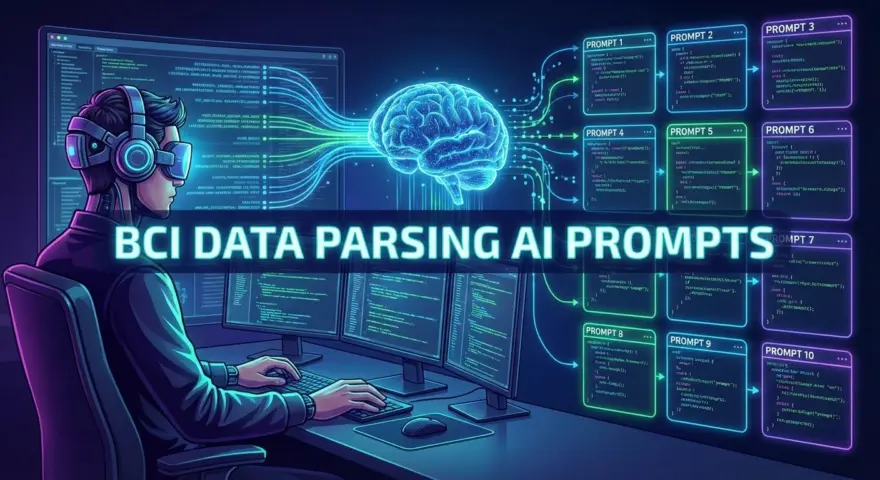
The integration of artificial intelligence into neurotechnology has fundamentally shifted how we approach Brain-Computer Interface (BCI) development. From filtering noisy EEG data to decoding complex neural spike trains, modern Large Language Models (LLMs) act as force multipliers for neurotech engineers, accelerating the path from raw signal to actionable insight.
The following prompts have been rigorously tested and optimized for deployment across all major AI architectures, including ChatGPT, Gemini, Claude, and DeepSeek. While each model possesses unique architectural strengths—DeepSeek often excelling in logic-heavy optimization, Gemini in large-context synthesis, and Claude in technical nuance—these ten prompts provide a universal, robust foundation for any developer working with neural data pipelines.
1. Automating EEG Artifact Rejection Strategies
Best for: DeepSeek (due to strong logic and algorithmic reasoning capabilities)
Filtering out ocular and muscular artifacts is the first critical step in BCI data processing. This prompt forces the AI to not just suggest filters, but to architect a robust rejection strategy based on Independent Component Analysis (ICA).
Act as a Senior Signal Processing Engineer. I am working with raw EEG data contaminated by EOG (eye blinks) and EMG (muscle movement) artifacts.

Design a Python-based strategy using the MNE-Python library to:
1. Apply a band-pass filter (1-40Hz).
2. Implement Independent Component Analysis (ICA) to identify artifact components.
3. Define the specific statistical thresholds (e.g., z-scores) I should use to automatically label and exclude these artifact components without removing relevant neural features.
4. Provide the code snippet for the automatic rejection loop.
The Payoff: It moves beyond simple frequency filtering to establish an automated, statistical method for cleaning data, significantly reducing manual preprocessing time.
2. Feature Extraction for Motor Imagery
Best for: ChatGPT (excellent for generating standard boilerplate code and library implementation)
Motor imagery tasks require extracting specific spectral power features (like Mu and Beta rhythms). This prompt generates the precise code structure needed to isolate these features for downstream classification.
I am building a BCI pipeline for a motor imagery task (left vs. right hand movement). Write a Python script using SciPy and NumPy to extract the Power Spectral Density (PSD) features.

The script must:
1. Compute the PSD using Welch's method.
2. Specifically isolate the average power in the Mu band (8-12 Hz) and Beta band (13-30 Hz).
3. Structure the output as a feature vector suitable for feeding into a Scikit-Learn classifier.
4. Include comments explaining the window size and overlap parameters chosen.
The Payoff: Accelerates the creation of feature extraction modules, ensuring that the correct frequency bands are mathematically isolated for model training.
3. Optimizing Real-Time Data Buffering
Best for: DeepSeek (strong performance in code optimization and latency reduction)
Latency is the enemy of real-time BCI. This prompt focuses on circular buffer management to ensure data flows smoothly from acquisition hardware to processing units without memory leaks or lag.
Review the concept of a circular buffer for a real-time BCI application streaming 32 channels at 500Hz.

Write a high-performance C++ class implementation (or highly optimized Python equivalent using NumPy views) for a ring buffer that:
1. Handles incoming data chunks efficiently.
2. Allows for 'look-back' window retrieval for sliding window processing.
3. Minimizes memory copying operations to reduce latency.
4. Explain how this implementation avoids race conditions if data acquisition and processing occur in separate threads.
The Payoff: Provides a low-latency architectural pattern essential for closed-loop systems where millisecond-timing precision is non-negotiable.
4. Neural Spike Sorting Logic
Best for: Claude (handles complex technical explanations and nuanced code logic well)
For invasive BCI, distinguishing between single-unit activities is difficult. This prompt leverages AI to outline a clustering approach for sorting spikes from raw extracellular recordings.
I am dealing with extracellular recordings and need to perform spike sorting. Outline a complete workflow using the K-Means clustering algorithm and Principal Component Analysis (PCA).

Your response should:
1. Explain the preprocessing steps (thresholding detection).
2. Provide a Python code snippet that extracts waveforms around the threshold crossing.
3. Apply PCA to reduce the dimensionality of the waveforms.
4. Use K-Means to cluster the spikes and assign them to distinct neurons.
5. Discuss potential pitfalls regarding overlapping spikes.
The Payoff: Clarifies the mathematical pipeline for separating neural sources, providing a clear template for converting raw voltage traces into discrete neural events.
5. Interpreting LFP Phase-Amplitude Coupling
Best for: Gemini (adept at synthesizing complex theoretical concepts into practical analysis)
Phase-Amplitude Coupling (PAC) is a sophisticated metric for understanding brain state communication. This prompt guides the AI to implement the Modulation Index method.
I need to analyze Local Field Potentials (LFPs) to detect Phase-Amplitude Coupling (PAC) between Theta phase and Gamma amplitude.

Generate a Python function that:
1. Filters the signal into Theta (4-8 Hz) and Gamma (30-80 Hz) bands using Hilbert transforms to get analytic signals.
2. Extracts the instantaneous phase of Theta and the amplitude envelope of Gamma.
3. Computes the Modulation Index (MI) to quantify the coupling strength.
4. Suggests a visualization method (e.g., Comodulogram) to display the results.
The Payoff: Translates complex signal processing theory into an executable function, enabling advanced analysis of cross-frequency neural interactions.
6. Designing a Common Spatial Pattern (CSP) Filter
Best for: DeepSeek (highly effective for mathematical algorithms and matrix operations)
CSP is the gold standard for spatial filtering in EEG. This prompt ensures the mathematical implementation is correct for maximizing the variance between two classes of signal.
Act as a Machine Learning Engineer specializing in BCI. I need a Common Spatial Pattern (CSP) algorithm implementation from scratch in Python to maximize the variance ratio between two classes (Class A and Class B).

Please provide:
1. The mathematical derivation steps briefly (covariance matrices calculation).
2. The code to solve the generalized eigenvalue decomposition problem.
3. A function that projects the raw EEG trial data into the CSP space.
4. An explanation of how to select the number of spatial filters.
The Payoff: Demystifies the “black box” of library functions by providing a raw implementation, allowing developers to debug and customize spatial filters for specific hardware configurations.
7. Synthesizing BCI Training Data
Best for: Gemini (strong generative capabilities for creating realistic data scenarios)
Data scarcity is a major issue in BCI. This prompt uses AI to generate synthetic datasets for stress-testing pipelines before human trials begin.
I need to stress-test my signal processing pipeline but lack sufficient patient data. Generate a Python script to create a synthetic EEG dataset.

The script should:
1. Simulate 64 channels of noise with 1/f spectral characteristics (pink noise).
2. Inject a synthetic 10Hz Alpha sine wave into the occipital channels (O1, O2).
3. Randomly inject high-amplitude artifacts resembling eye blinks in the frontal channels (Fp1, Fp2).
4. Output the data in a standard format (like .mne or numpy array) ready for pipeline ingestion.
The Payoff: Enables rapid prototyping and robustness testing of pipelines without the immediate need for human subjects or hardware setup.
8. P300 Speller Classification Pipeline
Best for: ChatGPT (great for end-to-end workflow generation)
The P300 speller is a classic BCI paradigm. This prompt asks for the complete classification chain, from epoching to decision making.
Design a classification pipeline for a P300 Event-Related Potential (ERP) speller paradigm.

Outline the step-by-step process and provide pseudo-code or Python code for:
1. Epoching the data from -100ms to 800ms around the stimulus onset.
2. Baseline correction.
3. Downsampling and feature vector flattening.
4. Training a Linear Discriminant Analysis (LDA) classifier ( shrinkage regularization recommended).
5. A logic block for character selection based on the highest classifier score across rows and columns.
The Payoff: providing a comprehensive blueprint for a working BCI application, bridging the gap between signal processing and user interface logic.
9. Asynchronous BCI State Detection
Best for: Claude (excellent at handling logic flows and state machine definitions)
Unlike synchronous BCIs, asynchronous systems must decide when a user is intending to act. This prompt tackles the “Brain Switch” logic.
I am developing an asynchronous 'Brain Switch' BCI that needs to distinguish between 'Intentional Control' (IC) and 'Non-Control' (NC) states continuously.

Propose a detection framework that:
1. Uses a sliding window approach to calculate features continuously.
2. Implements a 'dwell time' or evidence accumulation threshold to prevent false positives from transient noise.
3. Includes a refractory period logic after a successful activation.
4. Write the logic flow for this state machine.
The Payoff: Solves the critical usability challenge of false positives in self-paced BCIs by defining a robust state-machine logic.
10. Neurodata Without Borders (NWB) Conversion
Best for: Gemini (proficient at handling complex file formats and data standards)
Standardization is key for collaboration. This prompt helps convert proprietary data formats into the open NWB standard.
I have a custom HDF5 file containing neural recordings and behavioral timestamps. I need to convert this into the Neurodata Without Borders (NWB) format.

Write a Python script using the PyNWB library to:
1. Initialize an NWBFile with required metadata (session start time, identifier).
2. Create a TimeSeries object for the raw voltage data.
3. Add a processing module for LFP data.
4. Align and add behavioral events (trial start/stop) as an Epochs table.
The Payoff: Ensures data interoperability and long-term archival compliance, a requirement for many modern academic and industrial neurotech projects.
Pro-Tip: Contextual Prompt Chaining
To get the most out of these prompts, use iterative chaining. Do not stop at the first code block. If DeepSeek provides a filter design, immediately follow up with: “Now, rewrite this code to utilize GPU acceleration via CuPy” or “Simulate how this filter behaves when the signal-to-noise ratio drops by 50%.” By feeding the output of one prompt into the context of the next, you evolve the code from a snippet into a production-ready module.
Final Thoughts
The gap between theoretical neuroscience and deployed neurotechnology is closing rapidly. By leveraging these AI prompts, you are not just writing code faster; you are standardizing your approach to signal processing and data parsing. Focus on understanding the biological underpinnings of the signals you are analyzing, and let the AI handle the heavy lifting of matrix algebra and syntax.