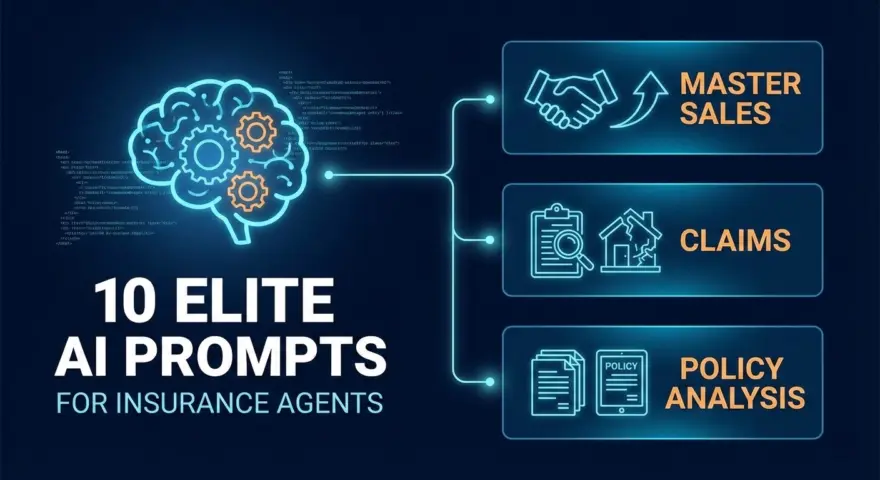
The insurance industry is currently undergoing a massive operational shift. Speed-to-lead, regulatory compliance, and the ability to simplify complex policy language are no longer just “nice-to-haves”—they are the baseline for survival.
Modern AI offers more than just generic text generation; it is a tactical engine for risk assessment, claims processing, and client retention. The prompts below are rigorously tested and optimized for the leading AI models: ChatGPT, Gemini, Claude, and DeepSeek. While each model possesses distinct architectures—DeepSeek for logic, Claude for nuance, Gemini for data synthesis, and ChatGPT for versatility—these ten scripts provide a universal toolkit for the modern Insurance Agent.
1. The “Plain English” Policy Translator
Model Recommendation: Claude for professional nuance and high-accuracy summarization.
The Prompt:
Act as a Senior Insurance Underwriter with 20 years of experience. I am pasting a specific "Exclusions" clause from a [Policy Type, e.g., Commercial General Liability] policy below.

Your task:
1. Rewrite this clause in "Plain English" at a 6th-grade reading level so a client without insurance knowledge can understand exactly what is NOT covered.
2. Provide one concrete, real-world example of a scenario that would fall under this exclusion.
3. Maintain a helpful, advisory tone, avoiding alarmist language.

[PASTE POLICY TEXT HERE]
The Payoff: Instantly bridges the knowledge gap between technical jargon and client understanding, reducing friction during the signing process and preventing future disputes.
2. The “Pattern Interrupt” Cold Outreach
Model Recommendation: ChatGPT for conversational flow and creative hooks.
The Prompt:
I am targeting [Target Audience, e.g., Small Business Owners in the Construction sector]. Most of them receive dozens of generic sales emails about "saving money on premiums."

Write 3 distinct cold outreach email subject lines and opening hooks that use a "Pattern Interrupt" strategy.
- Avoid clichés like "I hope this finds you well" or "Quick question."
- Focus on a specific, under-appreciated risk specific to their industry (e.g., equipment breakdown vs. theft).
- Keep the tone peer-to-peer, not salesperson-to-prospect.
The Payoff: Breaks through the noise of a crowded inbox by focusing on specific, high-stakes problems rather than generic price competition.
3. The Logical Risk Assessment Calculator
Model Recommendation: DeepSeek for complex logic processing and structured reasoning.
The Prompt:
I am assessing the risk profile for a new client application.
Client Profile:
- Industry: [e.g., Independent Trucking]
- Years in Business: [Number]
- Claims History: [Number of claims in last 5 years]
- Location: [City, State]
- Revenue: [Amount]

Based on general underwriting principles for this industry, perform a logical risk assessment.
1. Identify the Top 3 High-Probability Risk Factors.
2. Assign a "Risk Score" from 1-10 for each factor, explaining the logic behind the score.
3. Suggest 2 specific questions I should ask the client to mitigate these risks before submitting to the carrier.
The Payoff: Acts as a “second pair of eyes” for pre-underwriting, helping you catch red flags early and submit cleaner applications that get approved faster.
4. The Competitor Policy Comparison Table
Model Recommendation: Gemini for its ability to process large amounts of data and (in some integrations) access real-time web context.
The Prompt:
I have pasted the "Coverage Limits" sections from two competing quotes below (Quote A and Quote B).

Create a comparison table that highlights the differences.
- Columns: Coverage Category, Quote A Limit, Quote B Limit, "Winner".
- In the "Winner" column, strictly identify which policy offers better protection for the client and briefly explain why.
- Flag any "silent gaps" where one policy is missing coverage that the other includes.

[PASTE QUOTE A TEXT]
[PASTE QUOTE B TEXT]
The Payoff: Saves hours of cross-referencing documents and provides clients with a visual, data-backed decision-making tool.
5. The Empathy-First Claims Update
Model Recommendation: Claude for its superior ability to handle sensitive tones and avoid robotic phrasing.
The Prompt:
I need to send an email to a client regarding their claim status.
Situation: The claim is currently stalled because we are waiting for the [Specific Document, e.g., Police Report] from the third party. The client is frustrated and has called twice today.

Draft an email that:
1. Validates their frustration without admitting agency liability.
2. Clearly explains the external bottleneck (the missing report).
3. Outlines exactly what I am doing today to chase it down.
4. Uses a tone that is empathetic but professional and reassuring.
The Payoff: De-escalates tense situations during the claims process, turning a potential service failure into a demonstration of advocacy.
6. The Cross-Sell Opportunity Detector
Model Recommendation: DeepSeek or ChatGPT for identifying logical gaps in coverage.
The Prompt:
Analyze the following Client Portfolio Summary. Based on their current life stage and assets, identify 3 logical "Cross-Sell" opportunities.

Client Profile:
[e.g., Male, 45, married, owns a landscaping business, just bought a second home in a coastal area, currently holds only Auto and Primary Homeowners policies].

For each opportunity:
1. Name the product (e.g., Umbrella, Flood, Key Person).
2. Write a 1-sentence "Transition Script" I can use in conversation to naturally introduce this gap without sounding pushy.
The Payoff: Systematizes account rounding by leveraging data to find genuine coverage gaps, increasing revenue per client while better protecting them.
7. The Objection Handling Dojo
Model Recommendation: ChatGPT for interactive roleplay and rapid iteration.
The Prompt:
I am selling [Product, e.g., Whole Life Insurance]. My prospect just gave me the objection: "[Insert Objection, e.g., 'I can get better returns investing in the market myself']."

Provide 3 different responses to handle this objection:
1. The "Feel-Felt-Found" approach (empathy-based).
2. The "Challenger" approach (challenging their assumption with data).
3. The "Question-Based" approach (asking a question to reveal the flaw in their logic).
The Payoff: Arms you with versatile verbal judo to navigate the most common sales roadblocks without freezing up.
8. The Compliance & Regulatory Auditor
Model Recommendation: Claude for its rigorous adherence to safety and instruction following.
The Prompt:
Review the following email draft I intend to send to a list of cold prospects.
Check it specifically for compliance red flags regarding:
1. Absolute guarantees (e.g., "We ensure you will save money").
2. Misleading urgency.
3. Unverified claims about carrier stability.

Highlight the problematic phrases and rewrite them to be compliant while maintaining persuasiveness.

[PASTE EMAIL DRAFT]
The Payoff: Protects your license and agency reputation by catching non-compliant language before it leaves your outbox.
9. The Local Market Trend Report
Model Recommendation: Gemini for synthesizing broad market trends and news.
The Prompt:
Act as a Risk Consultant. I need a brief "State of the Market" summary for [Specific Region/State] regarding [Specific Insurance Line, e.g., Homeowners Insurance in Florida].

Focus on:
1. Recent legislative changes affecting premiums or coverage.
2. Major environmental or economic factors driving rate increases this quarter.
3. A talking point I can use to explain to clients why their renewal rate has increased despite having no claims.
The Payoff: Positions you as a trusted advisor who understands the macro-economic forces affecting the client’s wallet, rather than just an order taker.
10. The Lead Qualification Scorer
Model Recommendation: DeepSeek for analytical precision.
The Prompt:
I have a transcript of a discovery call with a prospect. Analyze the text and score the lead on a scale of 1-5 based on the "BANT" framework (Budget, Authority, Need, Timing).

1. Provide the score for each letter of BANT with a direct quote from the text supporting your score.
2. Give a final "Go/No-Go" recommendation on whether I should prioritize this lead.

[PASTE CALL TRANSCRIPT OR NOTES]
The Payoff: Eliminates “happy ears” by forcing an objective, evidence-based review of whether a prospect is actually ready to buy, saving you time on dead-end leads.
Pro-Tip: The “Context-Stacking” Technique
Don’t treat these prompts as one-off commands. Use Context Stacking to build a comprehensive client file.
Start with Prompt #3 (Risk Assessment) to analyze a new lead. Take the output from that and feed it into Prompt #6 (Cross-Sell Opportunity) to see what else they need. Finally, use Prompt #1 (Plain English Translator) to explain the policies you just recommended. By chaining these prompts together within a single chat session, the AI “learns” the client’s specific context, making every subsequent answer more accurate and personalized.
Mastering these prompts is not just about saving minutes on administrative tasks; it is about elevating your role from a transaction processor to a strategic risk advisor. Start with one prompt today, refine the output to match your voice, and integrate it into your daily workflow. The agents who thrive in this era will be those who combine their industry expertise with the leverage of high-level AI.