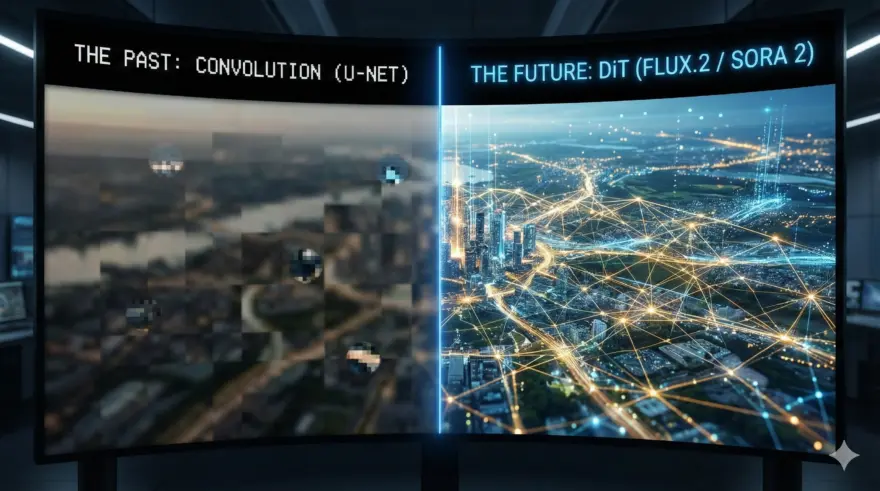
The reign of the U-Net is over. Here is the architecture powering the 2025 generative AI revolution.
For years, the U-Net was the undisputed king of diffusion. From Stable Diffusion 1.5 to early video models, convolutional networks ruled. But the release of Sora 2 and FLUX.2 has cemented a new reality: the future belongs to Diffusion Transformers (DiT).
We are witnessing a “brain transplant” in AI. By swapping convolutional backbones for Transformers, models can now scale predictably with compute, understand physics, and maintain temporal consistency in video like never before.
Why The U-Net Failed (And DiT Won)
To understand DiT, you must understand what it replaces. The U-Net architecture (used in SDXL and older models) relies on convolutions. Convolutions are great at processing local details (edges, textures) but struggle with global context. They have a hard time “seeing” the whole image at once, which leads to disjointed objects or warping in video.
Diffusion Transformers (DiT) apply the architecture behind GPT-4 (Transformers) to visual generation. Instead of predicting the next word, they predict the next “patch” of an image or video frame.
The DiT Advantage:
- Scalability: Unlike CNNs, Transformers get smarter linearly as you add more parameters and data (Scaling Laws).
- Global Attention: Every patch of the image can “talk” to every other patch instantly. A hand on the left knows exactly what the arm on the right is doing.
- Context Awareness: FLUX.2, for example, couples a 24B Vision-Language Model (Mistral-3) with the DiT, allowing it to understand complex prompts and physics, not just keywords.
The Code: A Simple DiT Block
The core of Sora 2 and FLUX.2 isn’t magic; it’s a stack of these blocks. Here is the PyTorch implementation of a single DiT Block. Note the use of AdaLN (Adaptive Layer Norm), which acts as the “control stick,” injecting the timestep and text prompt into the generation process.
import torch
import torch.nn as nn

class DiTBlock(nn.Module):
    """
    A single Diffusion Transformer Block.

    Args:
        hidden_size (int): Dimension of the transformer tokens.
        num_heads (int): Number of attention heads.
        mlp_ratio (float): Multiplier for the hidden dimension in the MLP.
    """
    def __init__(self, hidden_size, num_heads, mlp_ratio=4.0):
        super().__init__()
        self.norm1 = nn.LayerNorm(hidden_size, elementwise_affine=False, eps=1e-6)
        self.attn = nn.MultiheadAttention(hidden_size, num_heads, batch_first=True)
        self.norm2 = nn.LayerNorm(hidden_size, elementwise_affine=False, eps=1e-6)

        # Feed Forward Network (MLP)
        mlp_hidden_dim = int(hidden_size * mlp_ratio)
        self.mlp = nn.Sequential(
            nn.Linear(hidden_size, mlp_hidden_dim),
            nn.GELU(),
            nn.Linear(mlp_hidden_dim, hidden_size),
        )

        # Adaptive Layer Norm (AdaLN) modulation
        # Predicts shift (gamma) and scale (beta) based on conditioning (time/label)
        self.adaLN_modulation = nn.Sequential(
            nn.SiLU(),
            nn.Linear(hidden_size, 6 * hidden_size, bias=True)
        )

    def forward(self, x, c):
        """
        x: Input tokens [Batch, Sequence_Length, Hidden_Size]
        c: Conditioning embedding (Time + Text) [Batch, Hidden_Size]
        """
        # 1. Regress modulation parameters from conditioning
        shift_msa, scale_msa, gate_msa, shift_mlp, scale_mlp, gate_mlp = (
            self.adaLN_modulation(c).chunk(6, dim=1)
        )

        # 2. Self-Attention Block with AdaLN
        x_norm1 = (1 + scale_msa.unsqueeze(1)) * self.norm1(x) + shift_msa.unsqueeze(1)
        attn_output, _ = self.attn(x_norm1, x_norm1, x_norm1)
        x = x + gate_msa.unsqueeze(1) * attn_output

        # 3. MLP Block with AdaLN
        x_norm2 = (1 + scale_mlp.unsqueeze(1)) * self.norm2(x) + shift_mlp.unsqueeze(1)
        mlp_output = self.mlp(x_norm2)
        x = x + gate_mlp.unsqueeze(1) * mlp_output

        return x

# Example Usage
# batch_size=4, seq_len=256 (patches), dim=1152
x = torch.randn(4, 256, 1152)
c = torch.randn(4, 1152) # Conditioning vector (Time + Text)
model = DiTBlock(hidden_size=1152, num_heads=16)
output = model(x, c)
print(f"Output Shape: {output.shape}")
The Architecture Visualization
flowchart TD
    subgraph "Preprocessing"
    A["Input Image/Video"] --> B["VAE Encoder"]
    B --> C["Latent Representation"]
    C --> D["Patchify (Chop into Patches)"]
    end

    subgraph "Diffusion Transformer (DiT)"
    D --> E["Linear Embedding + Positional Encoding"]
    E --> F["DiT Block 1 (Attn + MLP)"]
    F --> G["DiT Block 2 (Attn + MLP)"]
    G --> H["... DiT Block N ..."]
    H --> I["Depatchify (Reshape)"]
    end

    subgraph "Conditioning"
    J["Text Prompt"] --> K["T5/CLIP/Mistral Encoder"]
    L["Timestep (Noise Level)"] --> M["MLP"]
    K --> N["Conditioning Vector (c)"]
    M --> N
    N --"Inject via AdaLN"--> F
    N --"Inject via AdaLN"--> G
    end

    subgraph "Output"
    I --> O["Predicted Noise / Latent"]
    O --> P["VAE Decoder"]
    P --> Q["Final Generated Media"]
    end

    style A fill:#333,stroke:#fff,color:#fff
    style Q fill:#333,stroke:#fff,color:#fff
    style F fill:#000,stroke:#0f0,color:#fff
    style G fill:#000,stroke:#0f0,color:#fff
Step-by-Step: Running FLUX.2 Locally
Since Sora 2 is closed-source, FLUX.2 is your best entry point into high-performance DiT models. It requires significant VRAM (it’s a 32B parameter monster), so ensure you have at least 24GB VRAM or use 8-bit quantization.
- Prepare Your Environment:
You need the latestdiffuserslibrary supporting FLUX.2 architectures.pip install -U diffusers transformers accelerate sentencepiece - Authenticate with Hugging Face:
Accessingblack-forest-labs/FLUX.2-devrequires a gated license acceptance on Hugging Face.huggingface-cli login # Enter your HF Token - Run the Pipeline (FP8 Quantization):
To fit this on a consumer 4090, we load in 8-bit.import torch from diffusers import FluxPipeline # Load the model with FP8 optimization pipe = FluxPipeline.from_pretrained( "black-forest-labs/FLUX.2-dev", torch_dtype=torch.bfloat16 ) # Enable offloading to save VRAM pipe.enable_model_cpu_offload() prompt = "A cinematic shot of a futuristic datacenter, glowing blue lights, 8k resolution, photorealistic" image = pipe( prompt, height=1024, width=1024, guidance_scale=3.5, num_inference_steps=50, max_sequence_length=512 ).images[0] image.save("flux2_output.png") - Prompting Strategy for DiT:
- Be Descriptive: Unlike early SD models that needed “word salad” (e.g., masterpiece, best quality), DiT models like FLUX.2 use powerful LLM encoders (Mistral/T5). They understand natural language. Write sentences, not tags.
- Mention Physics/Lighting: DiT excels at rendering light transport. Explicitly describe lighting (e.g., “volumetric lighting entering from the window”).
The shift to Diffusion Transformers is not just an incremental update; it is the standard for the next 5 years of generative AI. Whether you are using Sora 2’s app or running FLUX.2 locally, you are interacting with a model that “thinks” in patches and attention, not just pixels and convolutions. Mastering this architecture is mastering the future of digital creation.