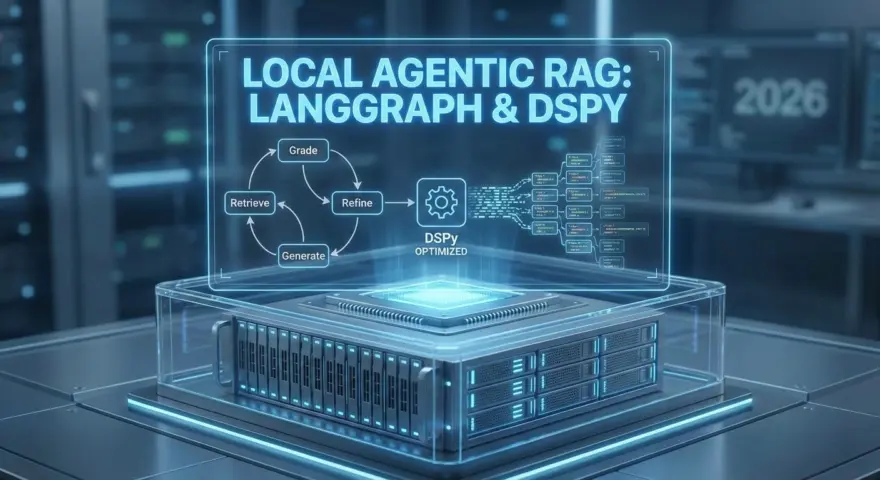
Do you remember the “blind RAG” pipelines of 2024? You would embed a PDF, shove top-k chunks into a context window, and hope for the best.
That architecture is dead.
In 2026, Agentic RAG is the only viable enterprise standard. We are no longer building passive retrieval systems; we are building Reasoning Engines. The shift from “Retrieval” to “Reasoning” has changed the financial equation entirely. We aren’t just paying for tokens anymore; we are optimizing for inference steps.
Today, we dive into the Local Agentic Stack: running LangGraph orchestration, GraphRAG memory, and SLMs (Small Language Models like Llama-5-8B or Phi-5) on your own metal. Whether you are deploying on NVIDIA Blackwell B200s or edge-native NPUs, the goal remains the same: Zero-Trust, Zero-Latency, autonomous intelligence.
The 2026 Stack: Why “Standard” RAG Fails
The “retrieve-then-generate” loop of the past failed because it lacked state. It couldn’t correct itself. If the vector search returned garbage, the LLM hallucinated garbage.
The modern Agentic RAG pipeline solves this via:
- Graph + Vector Hybrid (GraphRAG): We don’t just store embeddings. We store relationships. Knowledge Graphs (like Neo4j or FalkorDB) handle the structured data (entities), while Vector Stores (Weaviate/Chroma) handle the unstructured nuance.
- Cyclic Reasoning (LangGraph): Linear chains are out. We use cyclic graphs where the model can loop back, critique its own retrieval, and re-query if the context is insufficient.
- Compiled Prompts (DSPy): We stopped hand-writing prompts in 2025. We now compile them. Using DSPy, we optimize prompts mathematically against validation sets, treating prompts as model weights.
Hardware Note: For this guide, we assume you are running quantized SLMs (GGUF/EXL2) on consumer hardware (RTX 5090) or enterprise edge nodes (NVIDIA L40S / Blackwell B200).
The Blueprint: 10 Elite Prompts & Configurations
Below are the configurations that define a production-grade Agentic RAG system in 2026. These cover LangGraph state definitions, DSPy signatures, and System 2 reasoning prompts.
1. The “Supervisor” Node (LangGraph Routing)
This system prompt sits at the center of your graph, deciding whether to query the Vector DB, the Knowledge Graph, or reply directly.
ROLE: Master Orchestrator (Agentic Router)
GOAL: Route the user query to the correct worker node based on data requirements.

ROUTING LOGIC:
1. IF query requires factual definitions or specific entity relationships (e.g., "Who reports to the VP of Engineering?"):
   -> RETURN "TOOL: KNOWLEDGE_GRAPH"
2. IF query requires thematic exploration or fuzzy matching (e.g., "Summarize the sentiment of last year's Q3 reports"):
   -> RETURN "TOOL: VECTOR_STORE"
3. IF query is a greeting or meta-question:
   -> RETURN "DIRECT_REPLY"

CRITICAL: Do not answer the question yourself. ONLY route.
INPUT: {user_query}
2. The Hallucination Grader (Self-Reflection)
A critical “Check” node in your graph. If the score is low, the agent effectively “loops” back to search again.
ROLE: QA Auditor
TASK: Grade the generated answer against the retrieved documents.

INPUTS:
- [Documents]: {retrieved_chunks}
- [Generated Answer]: {agent_response}

INSTRUCTIONS:
1. Check for "Hallucinations": Does the answer contain facts NOT present in the documents?
2. Check for "Relevance": Does the answer address the user's core intent?

OUTPUT JSON ONLY:
{
  "binary_score": "yes" (if grounded) OR "no",
  "reasoning": "Brief explanation of the failure",
  "action": "retry_query" OR "pass"
}
3. The DSPy Signature (Compiled Reasoning)
Stop writing long prompts. Define the Signature and let the DSPy compiler optimize the instructions.
import dspy

class GenerateAnswer(dspy.Signature):
    """
    Answer the question based strictly on the context.
    If context is missing, output 'Insufficient Context'.
    """
    context = dspy.InputField(desc="retrieved chunks from Graph and Vector stores")
    question = dspy.InputField()
    reasoning_trace = dspy.OutputField(desc="Chain of thought logic steps")
    answer = dspy.OutputField(desc="Final concise answer with [DocID] citations")

# In 2026, we let the BootstrapFewShot optimizer fill in the examples/instructions automatically.
4. The Query Rewriter (Multi-Hop)
Before searching, this agent breaks complex questions into atomic sub-queries.
ROLE: Query Decomposition Engine (System 2)
TASK: Break down the input into atomic, executable search steps.

USER QUERY: "Compare the revenue of our EU branch in 2024 vs the US branch in 2025."

OUTPUT PLAN:
1. query_vector_store("EU branch revenue 2024 financial report")
2. query_vector_store("US branch revenue 2025 financial report")
3. calculate_diff(step_1, step_2)
5. The MCP (Model Context Protocol) Tool Definition
In 2026, agents speak MCP. This system prompt defines how your local SLM interacts with external tools via the standard protocol.
SYSTEM: You are an agent connected via Model Context Protocol (MCP).
AVAILABLE TOOLS:
- {
    "name": "search_internal_docs",
    "description": "Semantic search over the company Wiki.",
    "schema": {"query": "string", "filter_date": "YYYY-MM-DD"}
  }

PROTOCOL:
1. To call a tool, output a JSON block with `tool_use`.
2. Wait for the `tool_result` message before proceeding.
3. NEVER fabricate tool outputs.
6. The Context Compressor (Long-Context Optimization)
Even with 1M token windows, noise kills reasoning. Use this to distill 50 documents into 5 key points before generation.
ROLE: Information Distiller.
TASK: Compress the following 50 retrieved snippets into a single "Knowledge Context" block.

RULES:
1. Remove all overlapping information.
2. Preserve every unique Entity (Names, Dates, IDs).
3. If two documents conflict, note the conflict explicitly: "Conflict: Doc A says X, Doc B says Y."

[Input Chunks]: {chunks}
7. The “Devil’s Advocate” (Risk Agent)
Useful for FinTech/Legal RAG. This agent runs in parallel and critiques the main answer.
ROLE: Risk Assessment Bot.
TASK: Review the Proposed Answer and identify potential liability or omitted context.

PROPOSED ANSWER: {answer}
SOURCE DOCS: {context}

ANALYSIS:
1. Did the answer over-generalize a specific clause?
2. Is the confidence level warranted by the source text?
3. Flag any PII that might have leaked into the final output.
8. The GraphRAG Cypher Generator
For translating natural language into graph database queries (Cypher for Neo4j).
ROLE: Graph Database Specialist.
TASK: Translate the natural language query into a Cypher Query.

SCHEMA:
(:Person)-[:WORKS_FOR]->(:Company)
(:Company)-[:PUBLISHED]->(:Document)

USER: "Find all documents published by OpenAI employees in 2025."

CYPHER:
MATCH (p:Person)-[:WORKS_FOR]->(c:Company {name: 'OpenAI'})
MATCH (c)-[:PUBLISHED]->(d:Document)
WHERE d.date STARTS WITH '2025'
RETURN d.title, d.url
9. The Semantic Router (Intent Classification)
Updated for 2026 to handle “Agentic” intents vs “Chat” intents.
ROLE: Intent Classifier.
CATEGORIES:
- "COMPLEX_REASONING": Requires multi-step thought, planning, or math. (Routes to o1-style Reasoning Model)
- "FAST_RETRIEVAL": Simple fact lookup. (Routes to Llama-5-8B)
- "ACTION_REQUEST": User wants to modify state (create ticket, email). (Routes to Action Agent)

INPUT: {query}
OUTPUT: [CATEGORY_NAME]
10. The JSON Schema Enforcer (Pydantic Parser)
Strict output formatting for API integration.
SYSTEM: You are a structural parsing engine.
TASK: Map the unstructured context into the following Pydantic Schema.

SCHEMA:
{
  "summary": "string",
  "citations": [{"id": "int", "text": "string"}],
  "confidence_score": "float (0.0-1.0)",
  "follow_up_suggestions": ["string"]
}

WARNING: If the confidence score is below 0.5, the "summary" field must be null.
Best Practices for 2026 Implementation
1. Adopt “Flow Engineering”
Stop trying to fix everything with one giant prompt. In 2026, we build Flows. Use LangGraph to define distinct states: Retrieve -> Grade -> Refine -> Generate. If the Grade step fails, the flow automatically loops back to Retrieve with a rewritten query.
2. Move to SLMs (Small Language Models)
Don’t use a 70B parameter model for simple routing. Use a specialized SLM (like Phi-5 or Gemma-4-2B) for the routing and grading steps. Only call the “big gun” (e.g., Llama-5-405B) for the final synthesis. This reduces latency by 60%.
3. Implement “Episodic Memory”
Stateless RAG is annoying. Your agent should remember past interactions. Implement a Checkpointer in LangGraph (using Redis or Postgres) to save the state of the conversation graph. This allows users to say “Apply that last change to the other document” without re-explaining context.
The Agentic Era
The debate between “Fine-tuning” and “RAG” is over. The winner is Hybrid Agentic RAG.
By 2027, we expect purely vector-based RAG to be considered “legacy tech,” replaced entirely by GraphRAG systems that understand the structure of your data, not just the similarity.
Your Next Step:
Don’t just copy-paste these prompts. Take Prompt #2 (The Hallucination Grader) and integrate it into your current pipeline as a post-processing step. If you aren’t grading your model’s outputs programmatically, you aren’t ready for production.