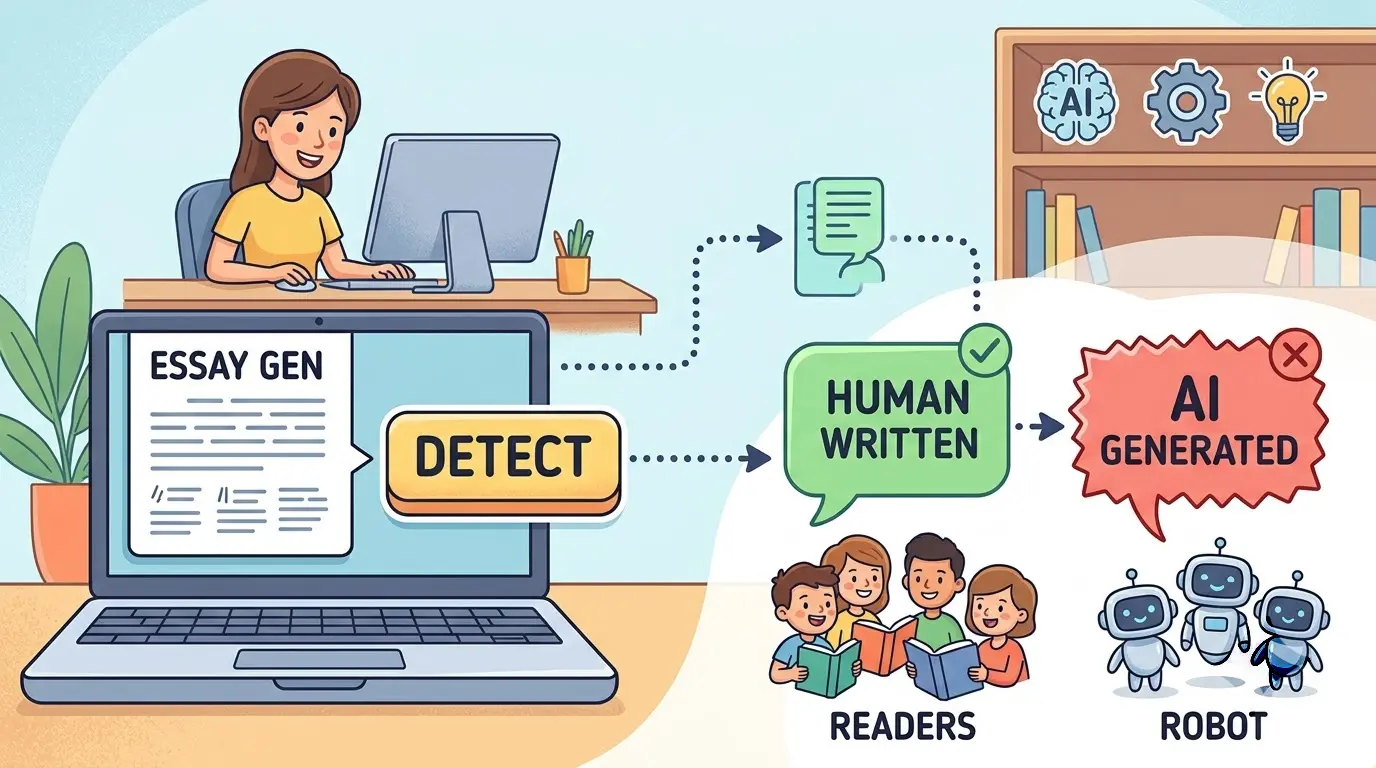
Editorial teams, teachers, SEO reviewers, hiring managers, and compliance leads all run into the same bottleneck: a draft feels suspiciously polished, a detector returns a scary score, and suddenly everyone wants a binary answer that the tool cannot actually prove. That is where most AI-content debates go off the rails.
Whether a team works with ChatGPT, Gemini, Claude, or DeepSeek, detector mistakes tend to come from the same place. These systems do not observe who wrote the text. They infer patterns from the output itself. The AI Prompts below are built as a universal foundation for reviewers, editors, and policy owners who need a better way to interpret detector results. Each model has different strengths, but the workflow only becomes reliable when the detector is treated as one weak signal inside a stronger review process.
What AI Content Detectors Actually Measure
Most detectors are not measuring authorship. They are measuring probability patterns.
In practice, that often means they react to signals such as:
- Uniform sentence rhythm
- Predictable transitions and phrasing
- Low-surprise word choice
- Generic claims without grounded detail
- Consistent paragraph structure across the draft
That sounds reasonable until you look at real writing. Academic prose, policy documents, customer support macros, and carefully edited brand copy often share the same traits. A human can easily produce text that looks statistically “machine-like,” especially when the writing must be clear, neutral, and tightly structured.
The reverse is also true. Once AI-generated copy is revised with real examples, stronger specificity, reordered logic, and human judgment, the detector may miss it entirely. That is the first limit to understand: detectors are style classifiers, not truth machines.
Why False Positives Happen So Often
False positives are not edge cases. They are a predictable outcome of narrow signals being used for high-stakes decisions.
Common causes include:
- Second-language writing that is grammatically careful but stylistically restrained
- Academic and technical writing that uses repetitive structure on purpose
- Brand-governed content written to a strict tone and formatting guide
- Heavy editing tools such as grammar correction, translation, autocomplete, or paraphrasing
- Short samples where the detector has too little evidence to make a stable judgment
- Template-based work like emails, SOPs, landing pages, product descriptions, and rubrics
This is why teams get bad outcomes when they treat a detector score like a courtroom verdict. The detector may be reacting to constrained writing, collaborative editing, or simply competent copy cleanup.
Where Detector Scores Are More Useful
The better use case is not “prove this was written by AI.” The better use case is triage.
Detector output is more useful when it helps a reviewer decide:
- which passages need a closer human read
- where a draft sounds too generic or under-sourced
- whether two versions of a document changed meaningfully
- when to ask for source notes, examples, or authorship disclosure
- which vendor or student submissions deserve deeper audit rather than instant judgment
That is also where tools can help without pretending to deliver certainty. A second-pass utility like Forensic AI Content Detector is more useful when it supports review prioritization than when it is asked to settle authorship by itself.
The shift is operational, not cosmetic. Teams get better outcomes when they move from score-chasing to workflow design, which is the same broader move behind Prompt Engineering 3.0: The End of Prompting and the Rise of Flow Engineering. A detector should sit inside a process with human review, evidence requests, and revision standards.
Prompt 1: Diagnose What The Detector Is Probably Reacting To
Model Recommendation: Claude is often the better fit when you need careful reasoning about language patterns without jumping to a false accusation.
You are reviewing a piece of writing that was flagged by an AI content detector.

Do not decide whether the text was written by AI or by a human.
Instead, diagnose which surface-level patterns may have triggered the detector.

Return:
1. The top 5 likely trigger patterns
2. A short explanation of each pattern
3. Direct quotes from the text that match each pattern
4. Whether the pattern is also common in legitimate human writing
5. What additional evidence a human reviewer would need before making any authorship claim
6. Three revision suggestions that improve specificity and accountability without changing the author's meaning

Rules:
- Do not make a binary authorship judgment
- Do not use detector-style hype language
- Focus on style signals, not certainty

Text:
[PASTE THE FLAGGED DRAFT]
The Payoff: This turns a vague detector score into a concrete language diagnosis. That is the fastest way to separate “this sounds generic” from “this is probably synthetic,” which are not the same claim.
Prompt 2: Compare Versions Before You Trust A Single Score
Model Recommendation: Gemini is useful when you need to compare multiple draft versions, author notes, and revision history in one pass.
You are comparing three versions of the same document:
- original draft
- revised draft
- final submitted draft

Your goal is to explain how the writing changed and whether the changes reduce or increase the kinds of patterns that AI content detectors usually flag.

Return a table with these columns:
1. Passage or section
2. What changed
3. Detector-sensitive pattern reduced, increased, or unchanged
4. Human signals added, if any
5. Specificity gained or lost
6. Risk of false positive after revision: low / medium / high

Then return:
- a short summary of the most meaningful revisions
- whether the final draft shows stronger evidence of human editorial intervention
- what a reviewer should inspect manually next

Original draft:
[PASTE]

Revised draft:
[PASTE]

Final draft:
[PASTE]
The Payoff: A single detector score on a final draft hides the editing process. Version comparison reveals whether the document has been meaningfully shaped by a human, which is often more useful than the raw score.
Prompt 3: Turn A Detector Flag Into A Human Review Checklist
Model Recommendation: DeepSeek works well for structured decomposition when you need a repeatable review rubric instead of ad hoc judgment.
You are designing a human review checklist for content that was flagged by an AI content detector.

Create a checklist that helps a reviewer assess quality, accountability, and disclosure without claiming the detector proves authorship.

The checklist must include:
1. Evidence of first-hand knowledge
2. Evidence of sourced facts or verifiable claims
3. Specific examples, data points, or concrete process detail
4. Consistency with the writer's known voice or domain level
5. Signs of generic filler or empty transitions
6. Whether the draft should be approved, revised, escalated, or rejected

Return:
- a 10-point checklist with yes/no items
- a 4-level disposition matrix: approve / revise / escalate / reject
- a short reviewer note template
- a warning list of things the reviewer must not infer from the detector score alone

Content type:
[PASTE CONTENT TYPE]

Flagged draft:
[PASTE DRAFT]
The Payoff: This prompt helps teams stop outsourcing judgment to a tool. The review becomes grounded in traceability, specificity, and policy, which are the things that actually matter.
Prompt 4: Rewrite Flagged Passages For Specificity, Not For Randomness
Model Recommendation: ChatGPT works well for practical day-to-day rewriting tasks where the goal is cleaner, more grounded language rather than elaborate analysis.
You are revising a passage that was flagged by an AI content detector.

Your job is not to "make it sound human" through gimmicks.
Your job is to make it more accountable, specific, and useful.

Rewrite the passage using these rules:
- keep the original meaning
- replace generic claims with concrete detail where possible
- add process language, constraints, tradeoffs, or examples
- remove empty transitions and padded sentences
- preserve professional tone
- do not add typos, slang, or artificial messiness

Return:
1. Revised version
2. Bullet list of what changed
3. Which changes improve specificity
4. Which claims still need real evidence, citations, or human confirmation

Passage:
[PASTE PASSAGE]

Optional context about audience, brand voice, or source material:
[PASTE CONTEXT]
The Payoff: Bad detector advice tells people to add randomness. Good revision work adds evidence, context, and judgment. That improves the writing even if no detector existed.
Prompt 5: Audit Whether A Draft Has Real Human Accountability
Model Recommendation: Claude is often a strong fit when you need nuanced editorial review around confidence, evidence gaps, and missing ownership signals.
You are auditing a draft for human accountability.

Do not determine whether AI was used.
Instead, assess whether the draft contains enough evidence of accountable authorship and responsible review.

Score the draft from 1 to 5 on:
1. Source traceability
2. Specificity
3. Domain judgment
4. Original synthesis
5. Presence of unsupported generic language

Then return:
- the weakest 5 sentences or passages
- why each one is weak
- what kind of human-added evidence would strengthen it
- whether the draft is acceptable for publication, internal use only, or requires revision

Draft:
[PASTE DRAFT]
The Payoff: This reframes the problem around accountability. In most real workflows, that is the real question anyway: not “was AI involved,” but “can this text be defended, trusted, and published responsibly?”
Prompt 6: Build A Better Detector Policy For Your Team
Model Recommendation: DeepSeek is often the better fit when you need to convert messy organizational concerns into a clean policy with explicit thresholds and escalation rules.
You are creating an internal policy for how an organization should use AI content detectors.

The organization wants a policy that is practical, fair, and resistant to false positives.

Create a policy that defines:
1. Approved use cases for detectors
2. Disallowed use cases for detectors
3. What detector scores can and cannot prove
4. When a flagged document requires human review
5. What evidence reviewers must gather before escalating
6. What communication template should be used with writers, students, vendors, or applicants
7. How to document uncertainty
8. How to handle writing that was AI-assisted but legitimately edited and approved

Return:
- a policy summary
- a reviewer workflow
- a one-page escalation matrix
- a short training note for staff

Context:
[PASTE TEAM TYPE, RISK LEVEL, AND CONTENT TYPES]
The Payoff: Most detector misuse is a policy failure, not a tooling failure. A good policy makes it much harder for teams to confuse suspicion with proof.
Pro-Tip
Chain the prompts instead of using them in isolation. Start with Prompt 1 to interpret the flag, use Prompt 3 to create a human review checklist, and finish with Prompt 4 or Prompt 5 to strengthen the draft itself. That sequence turns a weak detector signal into a useful editorial workflow.
The teams that get real value from detectors stop asking them to act like lie detectors. The stronger path is to use them as triage tools, then judge the draft by specificity, traceability, and accountable review. That is a better habit for human writing, AI-assisted writing, and everything in between.