In 2024, we built “Chatbots.” You asked them to write a tweet, and they wrote a tweet.
In 2026, we build Autonomous Agents. You give them a goal—”Increase LinkedIn engagement by 20% this quarter”—and they research the trends, draft the content, schedule the posts, and reply to comments while you sleep.
For the Enterprise CTO or CMO, this distinction is critical. Chatbots are Assistants (Passive). Agents are Workers (Active).
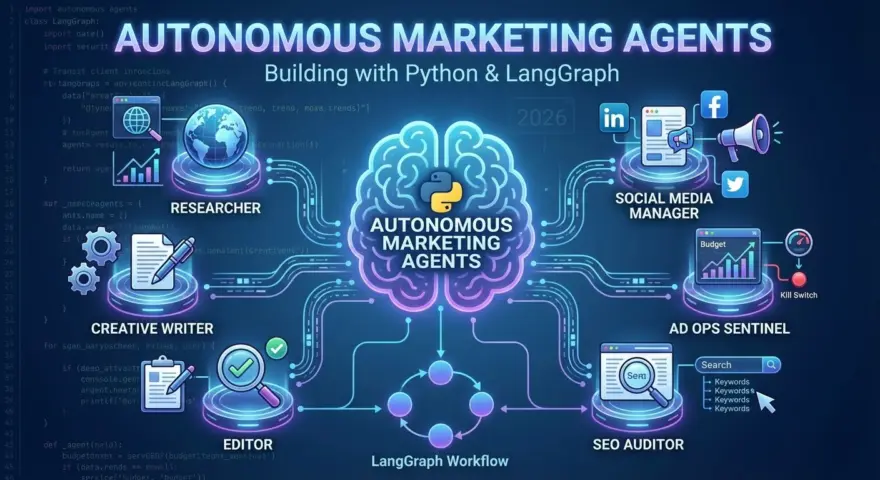
The modern marketing stack has moved beyond “Generative AI” to “Agentic Workflows.” We are using Python frameworks like LangGraph and CrewAI to orchestrate swarms of specialized agents—Researchers, Copywriters, Editors, and Media Buyers—that collaborate to execute complex campaigns.
This guide moves beyond the hype to the code. We will explore how to architect these systems and provide the actual configurations to deploy them.
The 2026 Agentic Stack: Tools of the Trade
To build a production-grade marketing agent, you need more than just import openai. You need a stateful orchestration layer.
- Orchestration: LangGraph is the standard for 2026. Unlike linear chains, it allows for Cyclic Graphs (Loops). If the “Editor Agent” rejects a draft, it loops back to the “Writer Agent” with feedback.
- Browser Automation: Browserbase or headless Playwright. Agents need to “see” the web to verify ad placements or scrape competitor landing pages.
- Action Layer: Model Context Protocol (MCP). This is how your agents connect to HubSpot, LinkedIn, and Google Ads APIs in a standardized way.
The Blueprint: 10 Elite Prompts & Configurations
Below are the Python configurations and System Prompts to build a “Viral Content Factory”—a multi-agent swarm that autonomously produces high-quality technical content.
1. The “Editor-in-Chief” (Critique Node)
This agent does not write. It brutally critiques. It prevents the “slop” that generic LLMs produce.
ROLE: Senior Editor (The Critic).
TASK: Review the draft provided by the Writer Agent.

CRITERIA:
1. "The Fluff Test": If a sentence can be removed without losing meaning, flag it.
2. "The Hook Test": Does the first sentence force the reader to read the second?
3. "The Insight Test": Is there a contrarian or novel takeway? (Ban generic advice like "AI is changing the world").

OUTPUT:
If PASS -> Return "APPROVED".
If FAIL -> Return specific feedback bullet points for the Writer to fix.
2. LangGraph State Definition (Python)
Define the shared memory that your agents use to collaborate.
from typing import TypedDict, List, Annotated
import operator

class MarketingCampaignState(TypedDict):
    # The user's high-level goal
    campaign_goal: str
    # Research gathered by the Research Agent
    research_notes: List[str]
    # The current draft content
    draft_content: str
    # Feedback history from the Editor
    editor_feedback: List[str]
    # Final approval status
    status: str # 'researching', 'drafting', 'reviewing', 'approved'
3. The “Trend Spotter” (Research Agent)
Connects to a Search Tool (e.g., Tavily or Perplexity API) to find what is trending now.
ROLE: Market Researcher.
TASK: Identify 3 rising trends in {niche} that happened in the LAST 48 HOURS.

TOOLS: [Tavily_Search]

CONSTRAINT:
Do not report generic trends. Look for:
- New API releases.
- Sudden stock drops/spikes.
- Viral tweets/posts with >10k engagement.

OUTPUT FORMAT:
Return a JSON list of "Content Angles" based on these news items.
4. The “Brand Voice Guardian” (Style Transfer)
Inject this into your Writer Agent to ensure it sounds like you, not ChatGPT.
SYSTEM: You are a Ghostwriter for TipTinker.
VOICE_GUIDELINES:
- TONE: Authoritative, cynical, engineering-focused.
- VOCABULARY: Use "latency", "throughput", "architecture". Avoid "delve", "unlock", "game-changer".
- STRUCTURE: Short paragraphs. Punchy sentences.

FEW-SHOT EXAMPLES:
Input: "AI is great for marketing."
Output: "Stop guessing. Start measuring. AI isn't magic; it's a math equation for conversion."
5. The LinkedIn “Smart Connect” Tool (Code Snippet)
A Python function (Tool) the agent can call to draft a connection request. Note: We do NOT automate the click (ToS risk), only the draft.
@tool
def draft_connection_note(profile_text: str, shared_interest: str):
    """Generates a personalized 280-char LinkedIn connection note."""
    prompt = f"""
    Draft a LinkedIn invite for this profile:
    {profile_text}

    Context: We both care about {shared_interest}.
    Rule: NO sales pitch. Just a professional observation.
    Max Length: 280 chars.
    """
    return llm.invoke(prompt)
6. The “Viral Hook” Generator (Psychology-based)
A specific prompt to generate 10 variations of headlines using viral psychology.
TASK: Generate 10 variations of the headline for the attached draft.
USE THESE PATTERNS:
1. The "Negative Frame": "Why X is failing..."
2. The "Specific Number": "The $40,000 mistake..."
3. The "Us vs Them": "Senior Engineers do X; Juniors do Y."
4. The "Counter-Intuitive": "Stop using RAG for..."

Select the top 3 based on "Click-Through Probability".
7. The Ad Spend “Kill Switch” (Risk Management)
An autonomous agent that watches your Facebook/Google Ads spend and kills bleeding campaigns.
ROLE: Ad Ops Sentinel.
TASK: Monitor ROAS (Return on Ad Spend) every hour.

LOGIC:
IF (Spend > $500 AND ROAS < 1.2):
   ACTION: CALL tool `pause_campaign(campaign_id)`
   REASON: "Bleeding cash. ROAS below threshold."

IF (Spend > $500 AND ROAS > 4.0):
   ACTION: CALL tool `scale_budget(campaign_id, 20%)`
   REASON: "Winner detected. Scaling."
8. The SEO Auditor (Keyword Optimization)
Runs after the content is written to ensure semantic density.
ROLE: SEO Specialist.
TASK: Analyze the draft against the target keyword: "{target_keyword}".

CHECKLIST:
1. Is the keyword in the H1?
2. Is the keyword in the first 100 words?
3. Are there at least 3 LSI (Latent Semantic Indexing) keywords present?

ACTION:
Rewrite the H2s to include the missing LSI keywords naturally.
9. The HubSpot “Lead Scorer” Agent
Instead of static point systems, use an agent to qualitatively analyze lead intent.
ROLE: SDR Qualifier.
INPUT: Lead's Recent Activity (Page views, Webinar attendance, Email replies).

TASK: Assign a "Buying Intent Score" (1-10).
REASONING:
- Did they visit the "Pricing" page? (+3 pts)
- Did they look at "API Docs"? (+5 pts - Technical Buyer)
- Is their email @gmail.com? (-5 pts - Non-corporate)

OUTPUT:
{ "score": 8, "segment": "Hot_Technical_Lead" }
10. The Human-in-the-Loop “Approval Node”
The most important node. Agents should draft, but Humans must approve.
def human_approval_node(state: MarketingCampaignState):
    """Pauses execution and waits for human input via Slack/Console."""
    print(f"--- DRAFT READY FOR REVIEW ---\n{state['draft_content']}")

    decision = input("Approve? (yes/no/feedback): ")

    if decision == "yes":
        return {"status": "approved"}
    else:
        return {"status": "revision_needed", "editor_feedback": [decision]}
Best Practices for 2026 Implementation
1. Build “Swarm” Architectures, Not Monoliths
Don’t write one giant prompt called “MarketingGPT.” Break it down. Have a “Subject Line Agent” that does nothing but write email subject lines. Specialized agents outperform generalists every time.
2. Respect Platform Limits (Rate Limiting)
Your agents are fast. LinkedIn is strict. If your agent tries to comment on 50 posts in 1 minute, you will be banned. Implement Exponential Backoff and Jitter (random delays) in your Python tool definitions to mimic human behavior.
3. Observability is Key (Trace Your Agents)
Use Arize Phoenix or LangSmith to visualize the agent’s thought process. When the agent goes off-rails and starts hallucinating fake trends, you need to see exactly which step in the graph failed.
The ” CMO” of the Future is a Systems Engineer
Marketing is no longer just about “Creative.” It is about Engineering. The teams that win in 2026 will be the ones that build the best machines—the ones that can turn a raw idea into a multi-channel campaign in minutes, not weeks.
Take the “Editor-in-Chief” (Prompt #1) and run your last 3 blog posts through it. If it doesn’t hurt your feelings, your prompt isn’t strict enough.