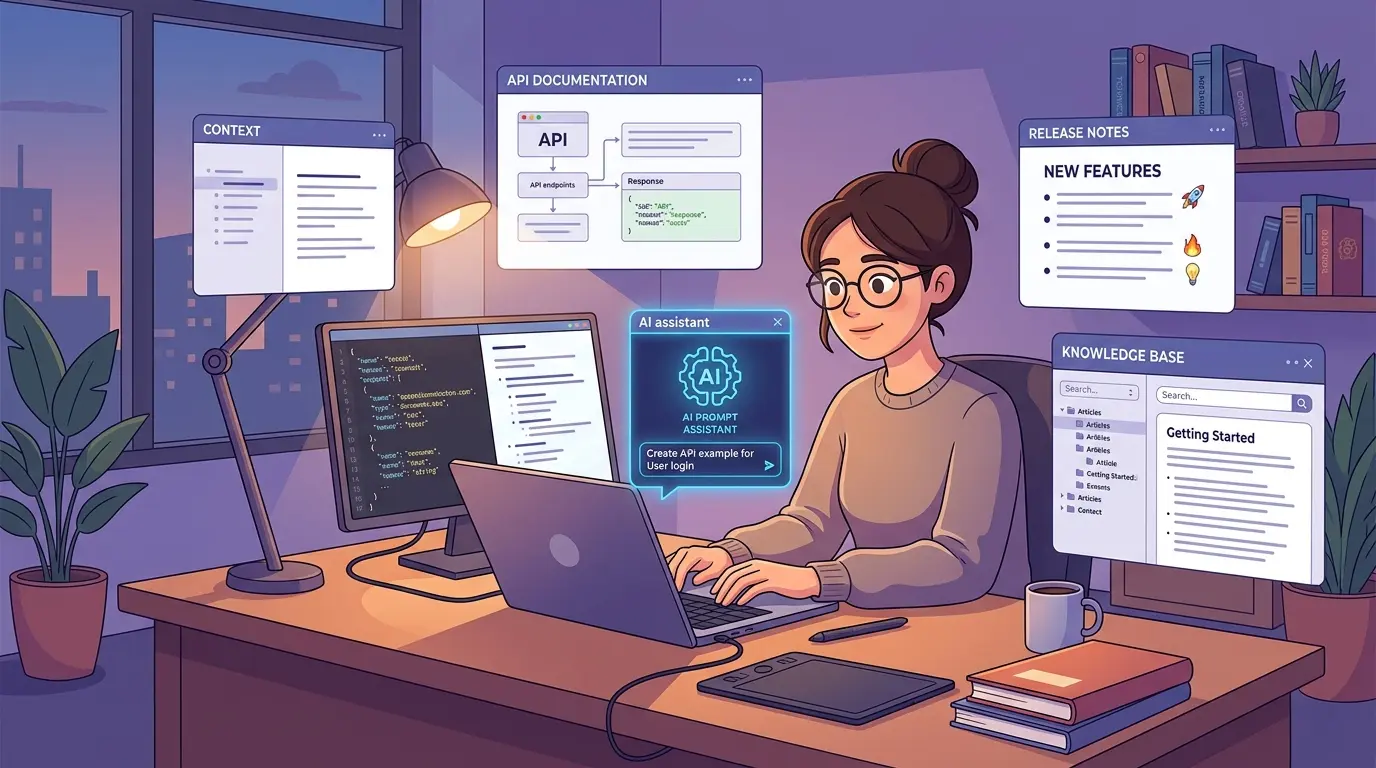
Technical writers rarely struggle with writing alone. The real bottleneck is turning scattered SME comments, partial tickets, OpenAPI fragments, commit history, and support escalations into documentation that is accurate, consistent, and publishable. That workload gets harder when API behavior changes late, release scope keeps shifting, and the knowledge base has to stay aligned with the product.
ChatGPT, Gemini, Claude, and DeepSeek can all support that process. These prompts are designed as a universal foundation for technical writers, so they transfer well across models even though each one has different strengths. ChatGPT works well for day-to-day drafting, Claude is often the better fit for structured documentation and editorial nuance, Gemini is useful when you need to synthesize multiple source files, and DeepSeek works well for logic-heavy decomposition and gap analysis.
If you are building reusable documentation workflows instead of one-off requests, TipTinker’s Universal Workflow: 10 Elite AI Prompts to Supercharge Any Profession is a useful companion to the technical-writer patterns below.
Turn Raw Endpoint Notes Into an API Reference Draft
Model Recommendation: Claude
You are a senior technical writer producing API reference documentation for developers.

Task:
Convert the source material below into a clean API documentation draft.

Audience:
Developers integrating this endpoint for the first time.

Source Material:
- Endpoint path:
- HTTP method:
- Authentication method:
- Required headers:
- Request parameters:
- Response fields:
- Error cases:
- Rate limits:
- Notes from engineers:
- Example payloads:

Output Requirements:
1. Write a short endpoint summary.
2. Create sections for purpose, authentication, request format, parameter table, response schema, error handling, and example request/response.
3. Flag missing details explicitly under "Open Questions".
4. Preserve technical accuracy and do not invent fields.
5. Rewrite internal jargon into developer-facing language.
6. Keep wording concise and reference-style, not marketing-style.

Return the result in Markdown.
Payoff: This gives you a structured first draft without pretending the source material is complete. It cuts blank-page time while keeping missing details visible for engineering review.
When the source is an OpenAPI document instead of freeform notes, the OpenAPI Spec to LLM Function Calling Schema Generator can help normalize endpoint structure before you run the drafting prompt.
Generate Release Notes From Pull Requests and Changelog Fragments
Model Recommendation: DeepSeek
You are a technical writer creating customer-facing release notes from engineering source material.

Task:
Turn the inputs below into release notes that are accurate, concise, and grouped by user impact.

Inputs:
- Pull request titles and summaries:
- Ticket list:
- Changelog fragments:
- Known bug fixes:
- Breaking changes or migration notes:
- Internal engineering notes:

Instructions:
1. Group the release notes into Added, Improved, Fixed, Deprecated, and Action Required when applicable.
2. Rewrite internal phrasing into customer-facing language.
3. Remove items that are not meaningful to end users unless they affect migration, reliability, security, or integrations.
4. Flag ambiguous changes under "Needs Verification" instead of guessing.
5. Call out breaking changes, configuration changes, and rollout dependencies explicitly.
6. Keep the tone factual and product-documentation oriented.
7. Produce a second section called "Internal Review Questions" listing anything product or engineering must confirm before publication.

Return the result in Markdown.
Payoff: This prompt helps separate real user-facing changes from engineering noise. It is especially useful when release inputs are spread across pull requests, tickets, and chat threads.
Build a Knowledge Base Article From Support Signals
Model Recommendation: Gemini
You are a senior knowledge base writer.

Task:
Create a help center article using the source material below.

Source Material:
- Support tickets:
- Chat transcripts:
- Existing documentation links:
- Product notes:
- Common user errors:
- Internal workaround notes:

Audience:
Users trying to solve the problem without contacting support.

Output Requirements:
1. Write a title that describes the user problem clearly.
2. Start with a short "What This Article Solves" summary.
3. Add prerequisites if any setup, permissions, or product tier requirements exist.
4. Write step-by-step instructions.
5. Add a section for common edge cases or failure states.
6. Include a short escalation section that explains when support intervention is still needed.
7. Remove internal-only language and tool references.
8. List any duplicate or conflicting articles that should be merged, redirected, or updated.

Return the result in Markdown.
Payoff: Technical writers often inherit the same problem described five different ways across support systems. This prompt helps consolidate those signals into one searchable, user-facing article.
Audit Documentation Gaps Before a Release
Model Recommendation: DeepSeek
You are a documentation gap analyst working before a product release.

Task:
Compare release scope against current documentation and identify what is missing, outdated, or at risk.

Inputs:
- Release scope summary:
- Merged tickets or PRs:
- Changed endpoints or settings:
- Existing API docs:
- Existing release note template:
- Existing help center articles:
- Deprecations and migrations:

Output Requirements:
1. Create a table with columns: Missing Item, Doc Type, Priority, Source Evidence, Recommended Owner.
2. Separate findings into API Docs, Release Notes, Knowledge Base, and Migration Guidance.
3. Mark any item that depends on unresolved product behavior.
4. Identify outdated screenshots, terminology, and configuration paths when evidence exists.
5. End with a short publication checklist sorted by release risk.

Do not invent missing evidence. If the inputs are incomplete, state the limitation directly.
Payoff: This prompt is useful when the writing team is asked to “make sure docs are covered” without a real audit pass. It turns release scope into an actionable documentation backlog.
For teams standardizing multi-step prompt workflows instead of relying on a single magic request, Prompt Engineering 3.0: The End of Prompting and the Rise of Flow Engineering is a practical framing.
Enforce Terminology and Style Consistency Across Docs
Model Recommendation: Claude
You are an editorial QA reviewer for technical documentation.

Task:
Review the draft below against the style guide and glossary, then produce a corrected version plus an edit log.

Inputs:
- Documentation draft:
- Product terminology glossary:
- Style guide rules:
- Prohibited terms or deprecated product names:

Instructions:
1. Standardize terminology, capitalization, UI labels, and verb style.
2. Preserve technical meaning exactly.
3. Rewrite vague phrases into clearer instructional language.
4. Keep headings and lists structurally consistent.
5. Flag any sentence that may still require SME verification.
6. Return two sections:
   - Clean Revised Draft
   - Editorial Change Log

Do not remove important caveats, limitations, or warnings.
Payoff: This is useful when multiple writers, product managers, and engineers have all touched the same page. It helps restore one voice without flattening technical accuracy.
Convert SME Review Into Actionable Edits
Model Recommendation: ChatGPT
You are helping a technical writer process SME feedback efficiently.

Task:
Turn the review comments below into an actionable edit plan.

Inputs:
- Raw SME comments from Slack, email, docs review, or tickets:
- Current documentation excerpt:

Output Requirements:
1. Categorize each comment as Factual Correction, Scope Expansion, Terminology Fix, Missing Warning, UX Clarification, or Unresolved Question.
2. For each category, propose the exact documentation edit to make.
3. Identify conflicting comments and isolate them under "Needs Resolution".
4. Draft follow-up questions for SMEs where the feedback is too vague to implement safely.
5. End with a revised version of the excerpt if enough information is available.

Keep the response concise, specific, and editor-friendly.
Payoff: SME reviews often arrive as fragments, not decisions. This prompt converts informal feedback into a clean edit queue and reduces the time spent translating reviewer intent.
Build a Knowledge Base Update Plan From Product Changes
Model Recommendation: Gemini
You are a documentation strategist responsible for keeping the knowledge base aligned with product changes.

Task:
Use the source material below to create an update plan for the help center.

Inputs:
- New or changed features:
- Settings or navigation changes:
- Deprecated behavior:
- Support ticket trends:
- Existing help center article list:
- Search terms users commonly use:

Output Requirements:
1. Identify which existing articles should be updated, merged, archived, redirected, or created from scratch.
2. Suggest better titles based on the user's problem language.
3. Add a short search-intent note for each proposed article.
4. Recommend internal linking paths between related KB articles.
5. Call out places where release notes, API docs, and help content should reference the same change.

Return the result as a prioritized Markdown plan.
Payoff: This keeps the knowledge base from becoming a patchwork of stale articles after each release. It is especially useful when product changes affect settings, navigation, or repeated user confusion.
Pro-Tip: Chain Evidence First, Draft Second
The strongest technical-writing workflow is usually a three-step chain: first extract facts from source material, then draft the document, then run an editorial QA pass for terminology, missing prerequisites, and unsupported claims. That split works better than asking one model to infer, draft, and edit everything at once because each stage has a different failure mode.
Technical writers get the most value from AI when prompts become part of a repeatable editorial system, not a shortcut for unreviewed copy. Better source handling, tighter prompt framing, and the right model at the right stage will produce cleaner API docs, clearer release notes, and knowledge base content that stays useful longer.