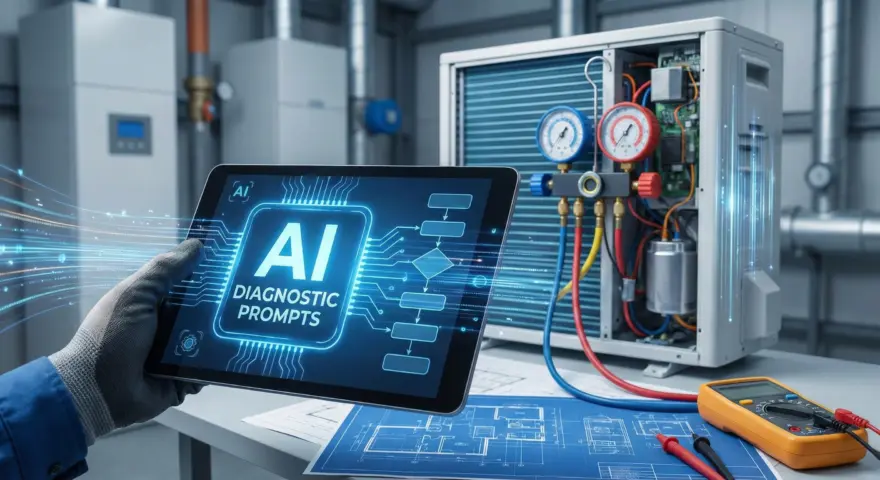
Modern AI models have evolved into sophisticated technical partners for the HVAC industry. By leveraging the computational power and vast technical training of these systems, technicians can move from reactive troubleshooting to high-precision diagnostics and design.
The following prompts have been tested and optimized for all major AI models, including ChatGPT, Gemini, Claude, and DeepSeek. While each model possesses unique strengths—such as Claude’s ability to handle nuanced technical documentation or DeepSeek’s proficiency with complex logical sequencing—these 10 prompts provide a universal foundation for modern HVAC professionals to improve accuracy and reduce time on site.
1. Complex Diagnostic Flowcharting
Best for: DeepSeek for complex logic.
Act as a Senior HVAC Diagnostic Specialist. I am troubleshooting a residential
split-system central AC that is "running but not cooling."

Current vitals:
- Superheat: [Insert Value]
- Subcooling: [Insert Value]
- Delta T across coil: [Insert Value]
- Compressor Amps: [Insert Value]

Provide a step-by-step logical elimination tree to identify the most likely
root cause (e.g., metering device failure, non-condensables, or airflow restriction).
Explain the reasoning for each branch of the logic tree.
The Payoff: This prompt forces the AI to move beyond generic advice and provide a structured, data-driven diagnostic path that mirrors the thought process of a master technician.
2. Preliminary Heat Load Estimation (Manual J Prep)
Best for: Gemini for multi-document/data analysis.
I need a preliminary residential heat load estimation for a 2-story home.
Square footage: [Insert Sq Ft]
Location (Zip Code): [Insert Zip]
Windows: [Insert Type, e.g., Double-pane, low-E]
Insulation: [Insert R-values for Attic/Walls]

Calculate the approximate sensible and latent heat loads. Note: Use standard
ASHRAE design conditions for this region. Provide a recommended tonnage range
and explain the impact of the local climate on this specific sizing.
The Payoff: While not a replacement for certified software, this prompt provides an instant “sanity check” for system sizing, helping to catch potential over-sizing errors before they reach the proposal stage.
3. Interpreting Obscure Error Codes
Best for: Claude for professional nuance and technical literature.
I am at a job site with a [Insert Brand] Communicating Variable Speed Furnace.
The control board is flashing Error Code [Insert Code].

Search your technical knowledge for this specific brand’s service manual.
1. Define exactly what this code triggers.
2. List the sequence of components to test with a multimeter.
3. Provide the expected voltage or resistance ranges for a healthy component in this circuit.
The Payoff: Saves 15–20 minutes of digging through PDF manuals on a mobile device by extracting the exact testing parameters needed for immediate action.
4. Technical Explanation for Homeowners
Best for: ChatGPT for versatile daily tasks.
Translate this technical diagnosis into a customer-friendly explanation:
"The TXV is hunting due to a lost bulb charge, causing the evaporator to
periodically flood and starve, leading to liquid slugging at the compressor."

Make it professional, empathetic, and focus on the long-term benefits of
replacing the valve rather than just adding refrigerant. Use an analogy
if it helps clarify the concept of "metering."
The Payoff: Enhances the professional image of the technician and improves sales conversion by making complex mechanical failures understandable to a non-technical audience.
5. Refrigerant Pressure/Temperature (P/T) Analysis
Best for: DeepSeek for mathematical precision.
Analyze the following system data for an R-410A system:
- High Side Pressure: [Insert PSI]
- Low Side Pressure: [Insert PSI]
- Liquid Line Temp: [Insert Temp]
- Suction Line Temp: [Insert Temp]
- Ambient Outdoor Temp: [Insert Temp]

Determine if the system is overcharged, undercharged, or has a restriction.
Calculate the target subcooling based on the provided pressures and compare
it to the actual subcooling measured.
The Payoff: Automates the “mental math” of P/T charts, reducing the risk of misdiagnosis in extreme weather conditions where standard “rules of thumb” often fail.
6. Ductwork Sizing & Static Pressure Troubleshooting
Best for: Claude for nuanced engineering concepts.
I have a system with a Total External Static Pressure (TESP) of [Insert Value, e.g., 0.9" WC].
The blower is rated for [Insert CFM] at [Insert Static].

Based on a duct system consisting of [Insert Duct Types], identify which
section is likely undersized. Suggest three specific modifications to
reduce the static pressure to a target of 0.5" WC without replacing the
entire trunk line.
The Payoff: Provides immediate engineering suggestions for high-static issues, preventing premature blower motor failure and improving system efficiency.
7. Electrical Troubleshooting & Wiring Logic
Best for: DeepSeek for logic-heavy tasks.
I am troubleshooting a 24V control circuit where the contactor is not engaging,
despite a call for cooling. I have 24V at the thermostat 'Y' terminal but
0V at the condenser contactor.

There is a [Insert Safety, e.g., Float Switch/High-Pressure Switch] in the
circuit. Guide me through a point-to-point continuity test to isolate where
the signal is being dropped. Explain the 'Common' wire relationship in this path.
The Payoff: Acts as a virtual lead technician, walking a junior tech through the electrical path to find a “ghost” break in the low-voltage wiring.
8. Heat Pump Defrost Cycle Optimization
Best for: Gemini for environmental data integration.
This heat pump is located in [Insert Climate/City] and is experiencing
excessive coil icing. The current defrost interval is set to [Insert Setting].

Considering the high humidity and average winter temperatures of this
region, should I adjust the timing or look for a mechanical fault?
List the sensors involved in the defrost initiation and their typical
resistance-to-temperature values for testing.
The Payoff: Specifically targets the most common heat pump “callback” issue by providing regional-specific advice on defrost settings.
9. Retrofit Equipment Compatibility Check
Best for: Claude for professional nuanced comparisons.
I am replacing a 20-year-old [Insert Brand A] condenser but keeping the existing
[Insert Brand B] evaporator coil and furnace.

Provide a compatibility report:
1. Are the metering devices compatible (Piston vs TXV)?
2. Will the SEER2 rating be significantly impacted?
3. What specific modifications are needed for the line set if moving from R-22 to R-410A?
The Payoff: Minimizes liability by identifying mismatched equipment issues before the installation crew arrives on-site.
10. Preventative Maintenance SOP Creation
Best for: ChatGPT for versatile daily tasks.
Create a comprehensive 25-point preventative maintenance checklist for
a commercial Rooftop Unit (RTU).

Include sections for:
- Electrical/Amperage checks
- Gas pressure and combustion analysis
- Belt and pulley alignment
- Condensate management
- Economizer operation

Format this as a professional document that I can provide to a building manager.
The Payoff: Standardizes the quality of service across a team, ensuring that nothing is missed during routine inspections and providing a tangible “value add” for the client.
Pro-Tip: Use “Context Loading” for Greater Accuracy
To get the best results, always provide the Model and Serial Number (if available) or at least the Tonnage and Refrigerant Type at the very beginning of your session. You can even upload a photo of the data plate if using the mobile app of these AI models. This “Context Loading” ensures the AI doesn’t give you generic advice for a 2-ton residential unit when you are actually working on a 20-ton commercial chiller.
Success in the HVAC trade has always been about the “Master/Apprentice” relationship. By utilizing these prompts, you are essentially carrying a digital Master Technician in your pocket—one that has read every manual ever published. Use this tool to sharpen your instincts, verify your findings, and continue developing the high-level diagnostic skills that define an elite HVAC professional.