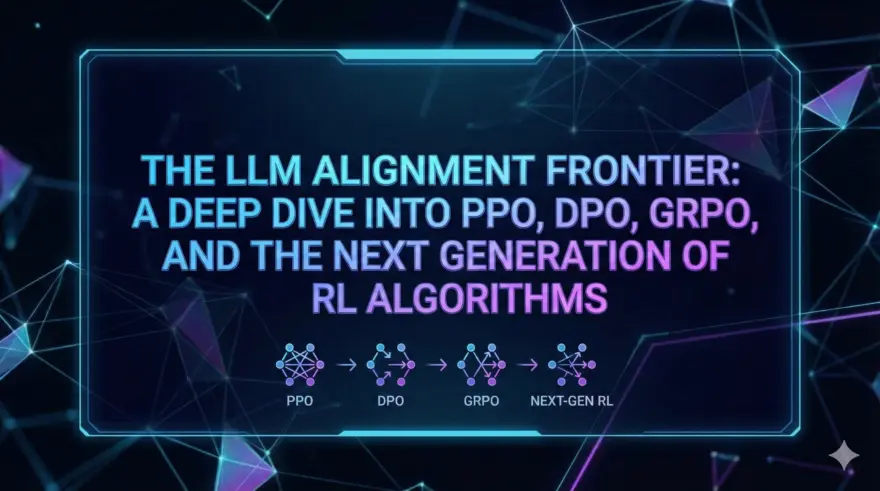
As we close out 2025, the competitive moat for AI engineering has shifted from raw pre-training compute to the Alignment Layer. While Supervised Fine-Tuning (SFT) provides the baseline for instruction following, it is Reinforcement Learning (RL) that transforms a statistical parrot into a world-class reasoning agent.
This article provides a zero-fluff, code-first analysis of the algorithms defining the current state of AI: PPO, DPO, GRPO, DAPO, and the emerging GSPO framework.
1. The Engineering Bottleneck: Why RL is Mandatory
Large Language Models (LLMs) trained via Maximum Likelihood Estimation (MLE) excel at predicting the next probable token but struggle with truthfulness, safety, and multi-step reasoning.
- Pre-training Limitations: Models merely “imitate” language patterns and do not inherently understand task instructions or human safety boundaries.
- SFT Limitations: While SFT teaches a model “how to do” a task, it cannot effectively penalize hallucinations or optimize for subjective human preferences.
- The RL Solution: Reinforcement Learning (RLHF) teaches the model to “do it better” by aligning outputs with human values and complex reasoning requirements through exploration and feedback.
2. Technical Architecture Evolution
The evolution of RL algorithms represents a strategic move from complex, multi-model orchestrations toward stable, compute-efficient optimizations.
2.1 PPO (Proximal Policy Optimization)
Proximal Policy Optimization (PPO), developed by OpenAI, is the foundational on-policy algorithm for RLHF. It uses an Actor-Critic architecture to balance training stability and sample efficiency.
- Mechanism: It utilizes a Value Network (Critic) to evaluate the long-term expected reward of an action and a Policy Network (Actor) to execute actions.
- The Clipping Function: To prevent “catastrophic forgetting,” PPO clips the policy update ratio within a range (typically ).
- Engineering Bottleneck: PPO is resource-heavy, requiring four models (Actor, Critic, Reward, and Reference) to be held in VRAM simultaneously.
2.2 DPO (Direct Preference Optimization)
Direct Preference Optimization (DPO) revolutionized alignment by proving that a reward model is mathematically redundant if you have high-quality preference pairs.
- Mechanism: It is an off-policy algorithm that treats alignment as a classification task between “chosen” and “rejected” responses.
- Key Advantage: It bypasses the need for a separate reward model and a complex RL loop, making it the most stable and compute-efficient choice for chat-style alignment.
3. The Reasoning Frontier: Group-Based Optimization
For mathematical and logical reasoning, absolute rewards are sparse. Modern engineering has shifted to Group Relative metrics to provide nuanced training signals.
3.1 GRPO (Group Relative Policy Optimization)
Popularized by the DeepSeek-Math team in their DeepSeekMath Paper, GRPO eliminates the Critic network entirely.
- Logic: It samples a group of outputs for a single prompt and uses the group’s mean and standard deviation as a dynamic baseline.
- The Problem: GRPO often suffers from Length Bias, where the model learns to generate redundant content to “dilute” negative signals.
3.2 Advanced Variants: Dr.GRPO and DAPO
- Dr.GRPO: Corrects the length and difficulty biases of GRPO by removing specific normalization terms, significantly improving token efficiency.
- DAPO (Decoupled Clip & Dynamic Sampling): Introduced in DAPO: An Open-Source LLM Reinforcement Learning System at Scale, this algorithm is specifically designed for long-sequence reasoning (e.g., math proofs). It introduces Clip-Higher logic and Dynamic Sampling to prevent entropy collapse in long-form generation.
4. Sequence-Level Mastery: GSPO
The current state-of-the-art for massive models (like Qwen-2.5) is GSPO (Group Sequence Policy Optimization), detailed in the GSPO Paper.
- The Innovation: It shifts optimization granularity from the individual token to the entire sequence.
- Why it Matters: Token-level importance sampling accumulates noise in long sequences. GSPO performs importance sampling at the sequence level, enabling stable training for Mixture-of-Experts (MoE) models and long-context reasoning.
5. Comparative Analysis for Engineers
| Metric | PPO | DPO | GRPO | GSPO |
|---|---|---|---|---|
| Learning Paradigm | On-Policy | Off-Policy | On-Policy | On-Policy |
| Critic Network | Required | None | None | None |
| Stability | Low (Finicky) | Very High | Moderate | Extremely High |
| Resource Cost | Very High | Lowest | Medium | Medium |
| Best For | General RL | Rapid Alignment | Math/Code | MoE/Long Context |
6. Implementation Strategy
To deploy these algorithms, senior engineers should follow this prioritized logic:
- For Stylistic Alignment: Use DPO via the Hugging Face TRL library for rapid prototyping and dialogue quality.
- For Reasoning (Math/Code): Use GRPO or Dr.GRPO. If the task involves long chains of thought, integrate DAPO‘s dynamic sampling to maintain exploration.
- For Production MoE Scales: Implement GSPO using the veRL (Volcano Engine RL) framework to ensure gradient stability across distributed clusters.
Core Advantage Calculation (Python)
import torch

def compute_group_relative_advantage(rewards):
    """
    Standardizes rewards across a group (G) for a specific prompt.
    This logic is the core of GRPO and GSPO.
    """
    # rewards shape: [batch_size, group_size]
    mean = rewards.mean(dim=1, keepdim=True)
    std = rewards.std(dim=1, keepdim=True)

    # Calculate standardized advantage
    # Advantages > 0 mean the output outperformed the group average
    advantages = (rewards - mean) / (std + 1e-8)
    return advantages
The Path to AGI Alignment
The evolution from PPO to GSPO marks the end of “unstable RL.” For 2026, the focus will shift toward GSPO-token, allowing for sequence-level stability with token-level fine-grained control for multi-turn dialogue.