In 2024, the question was, “Do we need a Vector Database?”
In 2026, the question is, “Which Vector Database won’t bankrupt us at scale?”
For the Enterprise Architect, the “Vector DB” is no longer just a search index; it is the Long-Term Memory of your AI application. It is mission-critical infrastructure, sitting right alongside your Postgres (OLTP) and Snowflake (OLAP) warehouses.
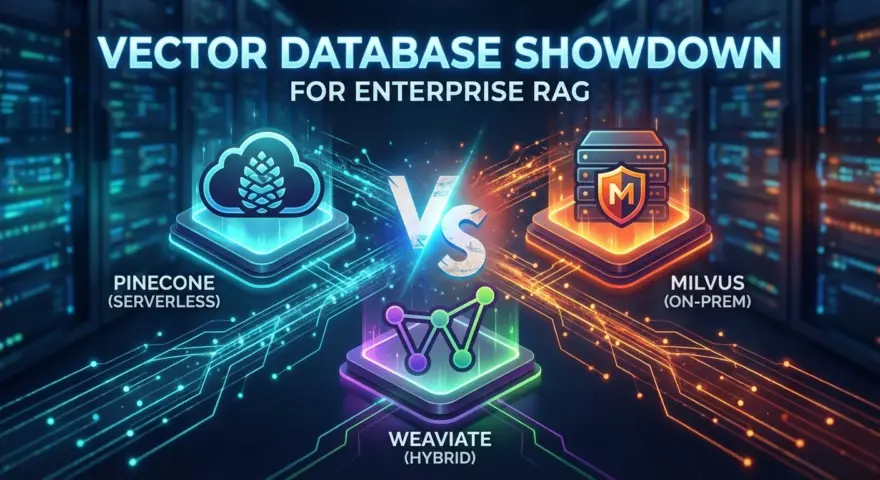
The market has consolidated. While generic databases (pgvector, MongoDB Atlas) have added vector support, dedicated high-performance RAG pipelines still demand specialized engines. The “Big Three”—Pinecone, Milvus, and Weaviate—have diverged into distinct architectural philosophies.
This guide tears down the marketing fluff to compare them on Latency, TCO (Total Cost of Ownership), and Day-2 Operations.
The 2026 Landscape: What Matters Now?
Forget simple “Cosine Similarity.” Every database does that. The 2026 differentiation points are:
- Disk-Based Indexing (DiskANN): Keeping 100M vectors in RAM is financially ruinous. If the DB doesn’t support SSD-offloading (running indexes on NVMe), it’s not enterprise-ready.
- Native Hybrid Search: Pure vector search is insufficient for specific keywords (e.g., SKU numbers). The DB must handle Sparse (BM25) and Dense vectors in a single query with configurable alpha-weighting.
- Multi-Tenancy: If you are building a B2B SaaS, you need to isolate Customer A’s vectors from Customer B’s physically, not just with a
WHEREclause.
The Contenders
1. Pinecone (The “Serverless” Standard)
- Philosophy: “It just works.” Zero ops, fully managed.
- Best For: Teams who want to start now and scale without hiring a DevOps engineer.
- The 2026 Update: The Serverless architecture (introduced 2024) is now the default. It separates storage (S3) from compute, meaning you only pay for the queries you run, not for idle pods.
- Drawback: Data Sovereignty. You are trusting their cloud. High TCO at massive throughput.
2. Milvus (The “On-Prem Beast”)
- Philosophy: “Maximum Control.” Cloud-native, runs on Kubernetes, highly distributed.
- Best For: Banks, Defense, and Healthcare who need to run Air-Gapped or in a private VPC. Massive scale (1B+ vectors).
- The 2026 Update: Milvus 3.0 has perfected Knowhere (its query engine) for GPU acceleration, delivering the lowest latency in the market if you have the hardware.
- Drawback: Operational complexity. You are managing a distributed system (Etcd, MinIO, Pulsar).
3. Weaviate (The “AI-Native” Hybrid)
- Philosophy: “More than Vectors.” It stores the objects and the relationships, not just the embeddings.
- Best For: Applications that need Graph-like capabilities (cross-references) alongside vector search.
- The 2026 Update: Their Verba engine and modularization allows for tight integration with local inference models (Ollama/Llama-5).
- Drawback: Query syntax (GraphQL) can be a learning curve for SQL veterans.
The Blueprint: 10 Elite Configurations & Queries
You don’t “prompt” a database; you architect it. Below are the 10 critical configurations (Python/YAML/JSON) to extract maximum performance from these engines in a 2026 production environment.
1. Pinecone: Serverless Index Setup (Cost Optimization)
Define a serverless index that scales to zero to save costs.
from pinecone import Pinecone, ServerlessSpec

pc = Pinecone(api_key="os.environ['PINECONE_API_KEY']")

pc.create_index(
    name="enterprise-rag-v1",
    dimension=1536, # OpenAI/Cohere embedding size
    metric="dotproduct", # Optimized for Hybrid Search
    spec=ServerlessSpec(
        cloud="aws",
        region="us-east-1"
    ),
    deletion_protection="enabled" # Critical for Prod
)
2. Milvus: Partition Key Strategy (Multi-Tenancy)
Instead of creating 1000 collections, use Partition Keys to isolate tenant data efficiently.
from pymilvus import Collection, FieldSchema, CollectionSchema, DataType

# Define schema with a Partition Key for Multi-Tenancy
user_id = FieldSchema(
    name="user_id",
    dtype=DataType.VARCHAR,
    max_length=64,
    is_partition_key=True # <--- The Magic 2026 Flag
)

# Milvus physically groups data by this key for faster retrieval
schema = CollectionSchema(fields=[user_id, ...], description="SaaS Multi-Tenant RAG")
3. Weaviate: Hybrid Search with Fusion (Alpha Tuning)
Perform a query that balances Keyword match (BM25) and Vector match.
{
  Get {
    Article(
      hybrid: {
        query: "What is the revenue for Q3?"
        vector: [...]
        alpha: 0.75  # 0.75 = Lean towards Vector, 0.25 = Lean towards Keywords
        fusionType: relativeScoreFusion
      }
      limit: 5
    ) {
      title
      content
      _additional {
        score
        explainScore # Debugging why a result was returned
      }
    }
  }
}
4. Indexing: HNSW Parameter Tuning (Recall vs. Speed)
Configuration for the HNSW index (works for Weaviate/Milvus). Tuning efConstruction is vital for ingestion speed.
"vectorIndexConfig": {
    "skip": false,
    "cleanupIntervalSeconds": 300,
    "maxConnections": 64,  // Higher = Better Recall, More RAM
    "efConstruction": 128, // Higher = Slower Indexing, Better Search
    "ef": -1,              // Dynamic search list size
    "dynamicEfMin": 100,
    "dynamicEfMax": 500,
    "distance": "cosine"
}
5. Pinecone: Metadata Filtering (The “Where” Clause)
Restrict search space before scanning vectors.
results = index.query(
    vector=[0.1, 0.2, ...],
    filter={
        "$and": [
            {"genre": {"$eq": "finance"}},
            {"year": {"$gte": 2024}},
            {"access_level": {"$in": ["admin", "editor"]}}
        ]
    },
    top_k=10,
    include_metadata=True
)
6. Compression: Binary Quantization (BQ) Setup
Reduce vector size by 32x with minimal accuracy loss. Essential for 100M+ scale.
# Weaviate / Qdrant Style Config
"vectorIndexConfig": {
    "quantizer": {
        "enabled": true,
        "type": "bq",  # Binary Quantization (1-bit per dimension)
        "rescoreLimit": 100 # Fetch 100 candidates with BQ, rescore top with Float32
    }
}
7. Re-Ranking Integration (Python Client)
The database returns 20 results; the Cross-Encoder sorts them.
from sentence_transformers import CrossEncoder

# 1. Fast Retrieval from Vector DB
hits = vector_db.search(query_vector, top_k=20)

# 2. Slow, Accurate Re-Ranking
cross_encoder = CrossEncoder('cross-encoder/ms-marco-MiniLM-L-6-v2')
pairs = [[query_text, hit['text']] for hit in hits]
scores = cross_encoder.predict(pairs)

# 3. Sort by new score
hits_reranked = sorted(zip(hits, scores), key=lambda x: x[1], reverse=True)
8. Milvus: Resource Group Isolation (QoS)
Ensure your “Premium” users don’t get slowed down by “Free” users.
# Milvus Resource Group Configuration
kind: ResourceGroup
metadata:
  name: premium_tier_compute
spec:
  requests:
    nodeNum: 4 # Dedicated Query Nodes
  limits:
    nodeNum: 8
  transfer_from:
    - name: default_group
9. Weaviate: Cross-Reference (Graph) Schema
Linking a chunk to its parent document for context retrieval.
{
  "class": "Chunk",
  "properties": [
    {
      "name": "hasParentDocument",
      "dataType": ["Document"], # Link to another class
      "description": "The document this chunk belongs to"
    }
  ]
}
# Allows querying: "Give me chunks about X, and also return the Author of the parent Doc."
10. Backup & Disaster Recovery Policy
Infrastructure-as-Code to ensure you don’t lose your embeddings.
# Pinecone Collection Creation (Static Snapshot)
curl -X POST https://api.pinecone.io/collections \
  -H "Api-Key: $PINECONE_API_KEY" \
  -H "Content-Type: application/json" \
  -d '{
    "name": "backup-q1-2026",
    "source": "enterprise-rag-v1"
  }'
The Verdict: Which One for You?
Scenario A: The Lean Startup
Winner: Pinecone (Serverless)
Why: You have 3 engineers. You cannot afford to manage Kubernetes clusters or debug etcd failures. You need an API that accepts vectors and returns IDs. The consumption-based pricing fits your growth curve.
Scenario B: The Enterprise Bank / Healthcare
Winner: Milvus
Why: Compliance. Data cannot leave your VPC. You have a dedicated Platform Engineering team. You need RBAC, LDAP integration, and audit logs. Milvus running on your OpenShift/EKS cluster is the only compliant choice.
Scenario C: The Complex Knowledge App
Winner: Weaviate
Why: You aren’t just doing “Search.” You are building an agent that needs to navigate relationships (e.g., “Find contracts signed by this person after 2025″). Weaviate’s object-centric model fits the “Agentic” workflow better than pure vector stores.
The “Commoditization” of Vectors
In 2026, the vector database is boring. That is a good thing. It means the technology is mature.
Your choice should not be based on benchmarks (they all respond in <50ms now). It should be based on Developer Experience (DX) and Ops complexity.
Advice: Start with Pinecone Serverless for prototyping. It is the path of least resistance. Only migrate to Milvus self-hosted if your bill exceeds $5,000/month or InfoSec forces your hand.