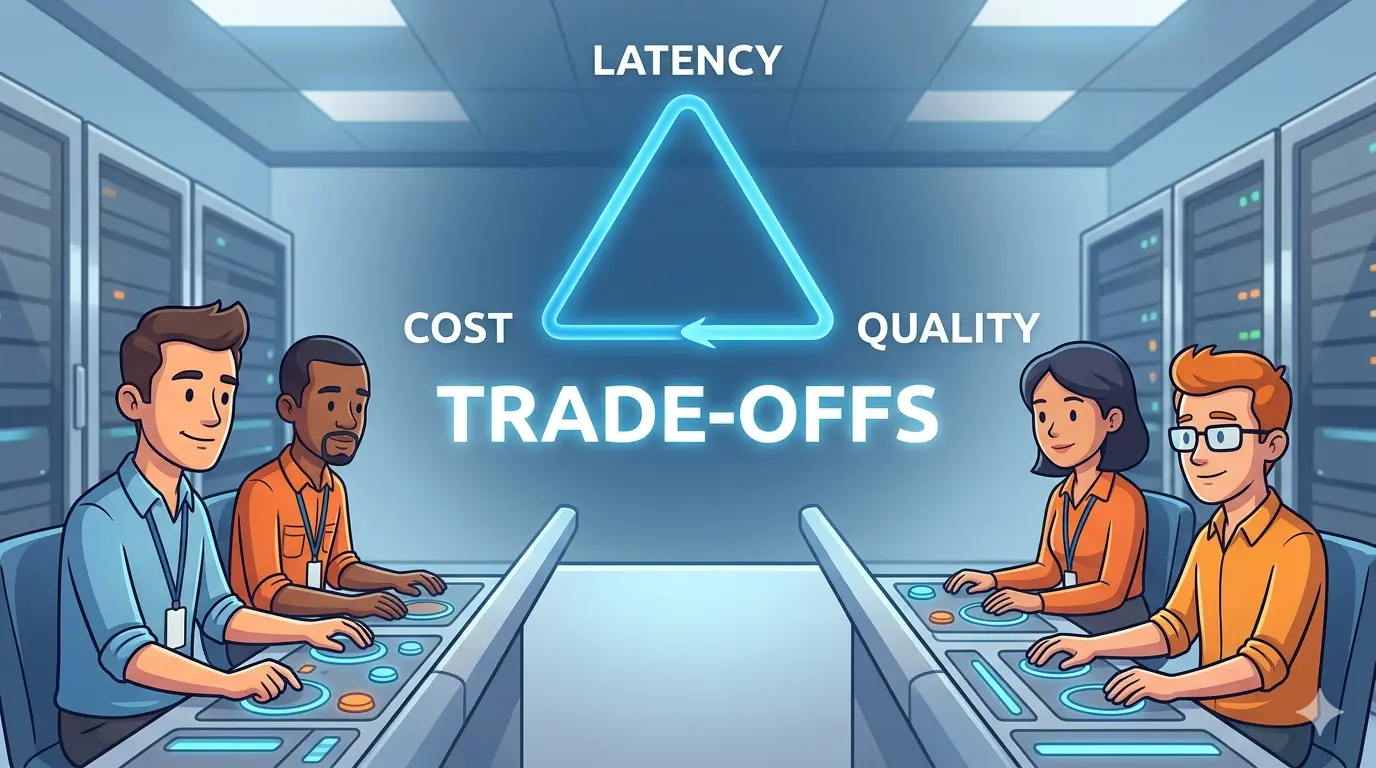
An AI feature can look promising in a demo and still collapse in production once real traffic arrives. Product wants better answers, engineering wants lower tail latency, and finance wants inference spend under control. That is where most AI systems teams get stuck: the fastest system is rarely the most capable one, the cheapest pipeline is rarely the most reliable one, and the highest-quality answer often arrives too late or costs too much to scale.
ChatGPT, Gemini, Claude, and DeepSeek can all help with this problem when used with the right framing. The prompts below are optimized as a universal foundation for AI engineers, ML platform teams, and technical product owners who need to make architecture decisions under pressure. Each model has different strengths, but the workflow stays the same: define the task clearly, expose the constraint that matters most, and make trade-offs on purpose instead of by habit.
If your workload mixes retrieval, tool calls, and long inputs, the trade-off usually gets worse as context expands, which is why The Context Window Trap: When to Choose RAG vs. Long-Context Models for Business Data is a useful companion to this kind of system design work.
Define The Service Envelope Before You Compare Models
Model Recommendation: Claude is often the better fit for this step because it handles structured reasoning and design constraints carefully.
You are acting as a senior AI systems architect.

I need to define the service envelope for an AI feature before choosing models or optimization tactics.

Feature Description:
[Describe the feature, user journey, and where the model is called]

Inputs:
- Primary user task:
- User tolerance for delay:
- Maximum acceptable P95 latency:
- Cost sensitivity per request or per session:
- Minimum acceptable answer quality:
- Failure consequences if the answer is weak, delayed, or missing:
- Whether this request is customer-facing, internal-only, or decision-support:
- Whether tool use, retrieval, or multi-step reasoning is required:

Output Requirements:
1. Define the real success condition for this feature.
2. Separate hard constraints from flexible preferences.
3. Identify what should be sacrificed first if latency, cost, and quality conflict.
4. List the workloads that deserve premium inference and the workloads that do not.
5. Produce a short decision memo using these labels:
   - Must Protect
   - Can Trade Off
   - High-Risk Failure Modes
   - Recommended System Posture

Be concrete. Do not give generic advice. Assume the feature will run at scale.
The Payoff: Most teams compare models too early. This prompt forces the decision back to the actual service envelope, which makes later routing, caching, fallback, and pricing choices much easier to defend.
Build A Latency-Cost-Quality Decision Matrix
Model Recommendation: DeepSeek works well for this step because it is useful when the task requires structured analysis, trade-off scoring, and technical decomposition.
You are evaluating AI system architectures using a latency-cost-quality framework.

I will give you a workload profile and several candidate architectures. Your job is to score them, remove dominated options, and explain the trade-offs.

Workload Profile:
[Paste request volume, concurrency, latency target, cost constraints, quality requirements, and failure sensitivity]

Candidate Options:
1. [Single premium model for every request]
2. [Cheap model first, premium escalation on failure]
3. [Classifier + routed model selection]
4. [Retrieval pipeline + smaller model]
5. [Any other architecture you want scored]

Scoring Instructions:
- Score each option from 1 to 5 on latency, cost efficiency, answer quality, operational complexity, and failure recoverability.
- Explain where an option looks attractive but becomes fragile in production.
- Identify which options are dominated and should be rejected.
- Identify which option is best as the default path.
- Identify which option is best for high-risk or high-value requests.
- End with a recommended architecture and a short rationale.

Return the answer as:
1. Comparison table
2. Dominated options
3. Best default path
4. Best premium path
5. Final recommendation
The Payoff: This prompt turns vague architecture debate into a repeatable comparison. It is especially useful when stakeholders keep arguing from isolated examples instead of from workload shape.
Route Requests By Complexity, Not By Habit
Model Recommendation: ChatGPT is a practical fit here because it works well for day-to-day workflow design, classification rules, and operational drafting.
You are helping me design a routing layer for an AI system.

I want to classify requests by complexity so I do not send every request to the most expensive path.

System Context:
[Describe the product, request types, current models, and where quality matters most]

Task:
1. Break requests into 4 buckets:
   - trivial
   - standard
   - complex
   - high-risk
2. For each bucket, define:
   - typical user intent
   - required reasoning depth
   - acceptable latency range
   - acceptable failure rate
   - recommended system path
3. Suggest a lightweight classifier that can decide which bucket a request belongs to.
4. Give 12 example user requests and show which bucket each one belongs to.
5. Flag the edge cases where a cheap route looks safe but should escalate.

Output Format:
- Bucket definitions
- Classification heuristics
- Example routing table
- Escalation triggers
- Implementation cautions

Keep the logic production-oriented rather than academic.
The Payoff: Many systems overspend because they treat every prompt like a flagship request. This routing prompt helps you reserve premium quality for the moments that actually justify the latency and cost.
Inspect The Whole Pipeline, Not Just The Final Answer
If you already collect traces, tool logs, evaluator outputs, and incident notes, the thinking behind Full-Stack AI Observability: Tracing Agentic Loops with OpenTelemetry & Arize pairs naturally with this step.
Model Recommendation: Gemini is often the better fit when you need to synthesize several documents, logs, transcripts, and scoring artifacts in one pass.
You are analyzing an AI system as a multi-stage pipeline, not a single model call.

I will provide:
- user requests
- model outputs
- retrieval context or tool results
- latency logs
- evaluator scores or human review notes
- failure examples

Your job is to find where quality is actually being lost.

Analysis Instructions:
1. Separate failures caused by retrieval, prompt design, tool schema, model choice, output parsing, and fallback behavior.
2. Identify whether latency is caused by model inference, retrieval overhead, tool latency, serialization overhead, or retries.
3. Identify whether high cost is caused by excessive context, redundant retries, oversized prompts, or premium-model overuse.
4. Rank the top 5 bottlenecks by expected impact if fixed.
5. Recommend the cheapest fix, the fastest fix, and the highest-leverage fix.
6. Return a clear action plan with this structure:
   - Root Cause
   - Evidence
   - Impact On Latency
   - Impact On Cost
   - Impact On Quality
   - Recommended Fix

Be strict about causality. Do not blame the model if the pipeline design is the real issue.
The Payoff: Teams often blame the visible model when the real problem lives upstream in retrieval, tools, or orchestration. This prompt helps isolate where the trade-off is truly happening.
Design Fallbacks That Fail Soft, Not Blind
Model Recommendation: Claude is useful here because it is often the better fit for careful policy writing, fallback logic, and user-facing failure behavior.
You are designing fallback and degradation behavior for an AI product.

System Context:
[Describe the feature, model stack, latency target, quality target, and any safety or compliance requirements]

Design a fallback policy that covers:
- model timeout
- retrieval timeout
- tool failure
- empty or low-confidence answer
- budget exhaustion
- traffic spike or queue backlog

For each failure case, provide:
1. detection rule
2. fallback action
3. user-facing behavior
4. whether to retry, degrade, escalate, or abort
5. what telemetry should be logged

Then produce:
- a simple decision tree
- a degraded response policy
- escalation triggers for human review or premium inference
- implementation mistakes to avoid

Optimize for graceful failure, not silent failure.
The Payoff: A good fallback policy protects both quality and trust. Instead of pretending the system still works, it gives the product a controlled way to degrade under pressure without hiding risk.
Cut Token Waste Before You Buy More Quality
When you need a quick sizing sanity check while trimming prompts or context, TipTinker’s AI Token Calculator is a practical companion to this workflow.
Model Recommendation: ChatGPT works well for this step because it is strong at iterative rewriting, prompt compression, and day-to-day optimization tasks.
You are optimizing an AI system prompt and context payload for lower latency and lower cost without hurting output quality.

I will provide:
- current system prompt
- developer instructions
- retrieval context
- tool schema or function descriptions
- example user requests

Your task:
1. Find repeated instructions, redundant context, and low-value prompt text.
2. Separate content into:
   - must keep
   - compress
   - move to retrieval only
   - remove entirely
3. Rewrite the prompt stack so it is shorter, clearer, and less repetitive.
4. Preserve critical constraints and formatting rules.
5. Explain where quality might drop if compression goes too far.
6. Return both:
   - optimized prompt stack
   - risk notes for the compression

Do not just shorten everything. Keep the parts that protect output quality.
The Payoff: Teams sometimes pay premium-model prices to compensate for bloated prompt design. This prompt helps reduce waste first, which often improves both latency and cost before any model swap is needed.
Turn Architecture Arguments Into A Controlled Experiment
Model Recommendation: DeepSeek is a strong choice here when you need a rigorous experiment design with explicit variables, hypotheses, and comparison logic.
You are turning an AI system trade-off debate into a controlled experiment.

Decision Under Review:
[Describe the architecture change being debated]

Current System:
[Describe current model path, latency, cost pressure, and known quality issues]

Proposed Change:
[Describe the alternative model, routing strategy, retrieval change, cache layer, or fallback logic]

Create an experiment brief with:
1. the exact hypothesis
2. primary success metrics
3. guardrail metrics
4. required test cases
5. segmentation by request type or user cohort
6. likely confounders
7. stopping conditions
8. rollout recommendation

Output Format:
- Hypothesis
- Success Metrics
- Guardrails
- Test Design
- Risks To Validity
- Recommended Rollout Plan

Make the experiment realistic for a production AI team with limited time.
The Payoff: This prompt is useful when the team has several opinions but no decision process. It creates a concrete test plan so trade-offs can be judged with evidence instead of intuition.
Pro-Tip: Chain Prompts From Triage To Decision
The strongest workflow is usually not one giant prompt. Start with service-envelope definition, move to routing and bottleneck analysis, then finish with an experiment brief. That chaining mindset is the same reason Universal Workflow: 10 Elite AI Prompts to Supercharge Any Profession stays useful across roles: one prompt frames the problem, the next narrows the choice, and the last drives action.
Teams that manage latency, cost, and quality well do not hunt for a single perfect model. They define the job clearly, route work intentionally, and improve the system one constrained decision at a time.