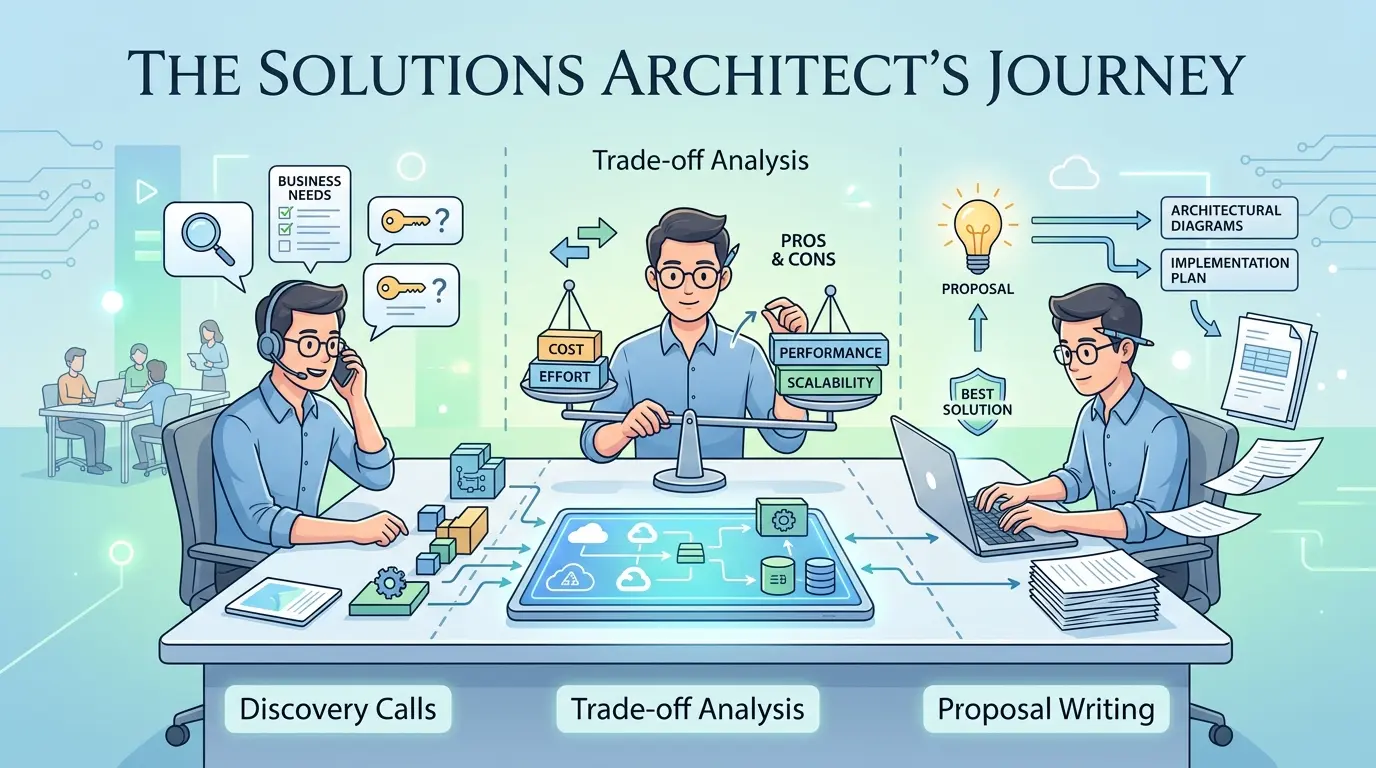
Solutions architects rarely struggle with ideas. The real bottleneck is turning incomplete stakeholder input into a defensible architecture path, then turning that path into a proposal the client, delivery team, and executive sponsors can all support. Discovery calls drift. Trade-off discussions get vague. Proposal drafts become long, repetitive, and hard to align with actual delivery constraints.
That is where well-structured AI Prompts help. ChatGPT, Gemini, Claude, and DeepSeek can all accelerate architecture work when the prompt is built around the actual job: uncover business drivers, surface hidden constraints, compare options, and write proposals that reflect both technical and commercial reality. These prompts are designed as a universal foundation for solutions architects, while recognizing that each model has different strengths. If you want to build more repeatable prompt workflows across roles, Universal Workflow: 10 Elite AI Prompts to Supercharge Any Profession is a useful companion framework.
These prompts are optimized as a universal foundation for solutions architects across major AI models, while still respecting the practical differences between each one.
Build A Discovery Call Brief Before The Meeting
Model Recommendation: ChatGPT works well for fast, adaptable pre-call preparation when you need a practical briefing in minutes.
You are acting as a senior solutions architect helping me prepare for a client discovery call.

Context:
- Client company: [company]
- Industry: [industry]
- Known business goal: [goal]
- Known technical environment: [stack, cloud, data, vendors]
- Stakeholders attending: [roles]
- Suspected pain points: [pain points]
- Opportunity area: [migration, integration, data platform, AI, security, app modernization, etc.]

Produce a discovery call brief with these sections:
1. Likely business priorities
2. Likely technical pain points
3. Assumptions that need validation
4. Top 12 questions to ask, grouped by business, technical, security, operations, and governance
5. Red flags that may indicate delivery risk or hidden scope
6. A short opening summary I can use to frame the conversation

Keep the questions sharp, non-generic, and tailored to the context.
The Payoff: This prompt helps you arrive with a structured hypothesis instead of a blank page. It also improves the quality of the first meeting by forcing the conversation toward constraints, not just aspirations.
Extract Business Drivers And Success Criteria From Messy Notes
Model Recommendation: Claude is often the better fit when you need careful synthesis from rough notes without losing nuance.
Act as a solutions architect reviewing raw discovery notes.

My notes:
[paste call notes]

Turn these notes into a clean architecture intake summary with the following sections:
1. Business objective
2. Operational pain points
3. User or customer impact
4. Technical constraints already stated
5. Compliance, security, or governance requirements
6. Success criteria and measurable outcomes
7. Open questions and unresolved assumptions
8. Items that sound like out-of-scope requests

Then provide a final section called "Architect's Interpretation" where you explain what problem the client is actually trying to solve beneath the surface symptoms.

Do not invent details. If something is unclear, label it as an assumption or open question.
The Payoff: Discovery notes are usually incomplete and contradictory. This prompt turns them into a reusable decision artifact you can share internally before solution design starts.
Turn A Discovery Call Into A Requirements Matrix
Model Recommendation: Gemini is useful when you need to organize larger volumes of notes, documents, and follow-up material into one structured view.
You are helping a solutions architect create a requirements matrix from discovery material.

Inputs:
- Discovery notes: [paste]
- Existing RFP or statement of need: [paste if available]
- Current-state environment details: [paste]

Create a requirements matrix in table format with these columns:
- Requirement ID
- Requirement statement
- Category (business, functional, integration, data, security, operations, compliance, cost)
- Priority (must, should, could)
- Source evidence
- Known gaps or ambiguity
- Architecture implication

After the table, list:
1. The top 5 requirements most likely to drive architecture decisions
2. The top 5 requirements that still need validation
3. The missing non-functional requirements I should clarify before proposing a target design
The Payoff: Good proposals fail when hidden requirements emerge late. This prompt gives you a working matrix that exposes uncertainty before it becomes rework.
Surface Non-Functional Requirements Before They Derail The Design
Model Recommendation: DeepSeek is useful when you want a more structured decomposition of architecture risks and technical dependencies.
Act as a principal architect reviewing a client opportunity for hidden non-functional requirements.

Context:
- Business objective: [objective]
- Proposed solution area: [solution]
- User scale or transaction volume: [details]
- Data sensitivity: [details]
- Geography or residency needs: [details]
- Existing platform constraints: [details]

Identify likely non-functional requirements in these categories:
1. Availability and resilience
2. Performance and latency
3. Scalability
4. Security and identity
5. Compliance and auditability
6. Observability and supportability
7. Data governance and retention
8. Disaster recovery

For each category, provide:
- Likely requirement
- Why it matters in this context
- Questions I should ask the client
- What architecture decisions it may influence
The Payoff: Many discovery calls stay stuck at features. This prompt pushes the conversation into the real architecture drivers that shape topology, cost, and delivery complexity.
Compare Architecture Options With Explicit Trade-Offs
Model Recommendation: DeepSeek works well for structured comparison when you need option-by-option reasoning rather than generic recommendations.
You are a senior solutions architect facilitating an architecture trade-off review.

Context:
- Business goal: [goal]
- Current environment: [environment]
- Constraints: [budget, timeline, compliance, team skill, vendors]
- Candidate options:
  - Option A: [describe]
  - Option B: [describe]
  - Option C: [describe]

Create a trade-off analysis with these sections:
1. Evaluation criteria
2. Weighted decision matrix
3. Strengths and weaknesses of each option
4. Delivery risk for each option
5. Operational impact for each option
6. Security and compliance impact for each option
7. Cost pattern for each option
8. Recommended option with rationale
9. Conditions under which a different option would become preferable

Be explicit about what is a fact, what is an assumption, and what needs validation.
The Payoff: This is the prompt you use when the answer is not obvious and the client wants a defensible recommendation. It sharpens trade-off logic before you present it to stakeholders.
Stress-Test The Recommended Architecture Against Real Delivery Risk
Model Recommendation: Claude is often the better fit for careful risk framing and structured reasoning when recommendations need to hold up in executive review.
Act as a skeptical architecture review board.

Here is the proposed architecture:
[paste architecture summary]

Here is the project context:
- Timeline: [timeline]
- Delivery model: [team, partner, internal, phased]
- Client maturity: [details]
- Constraints: [details]

Challenge this solution from the perspective of:
1. Implementation complexity
2. Integration risk
3. Security and governance gaps
4. Operational readiness
5. Adoption and change management
6. Commercial assumptions

Output:
- Top 10 risks
- Likelihood and impact for each
- Early warning indicators
- Recommended mitigations
- What I should rewrite in the proposal to address these risks proactively
The Payoff: A proposal looks stronger when it acknowledges risk before the client raises it. This prompt helps you sound credible, not overconfident.
Turn Technical Analysis Into Executive Language
Model Recommendation: Claude works well for translating architecture logic into clear business-facing narrative without flattening the nuance.
You are helping a solutions architect explain a technical recommendation to executive stakeholders.

Inputs:
- Business objective: [objective]
- Current pain points: [pain points]
- Recommended architecture: [summary]
- Rejected alternatives: [summary]
- Key risks and mitigations: [summary]

Write three versions of the recommendation:
1. A 120-word executive summary
2. A board-style rationale focused on business value, risk reduction, and implementation practicality
3. A short talk track for presenting the recommendation in a client meeting

Avoid jargon where possible, but keep the reasoning intact.
Make the trade-offs explicit without overwhelming the audience.
The Payoff: Strong architecture work still fails if the explanation is too technical. This prompt helps you bridge the gap between engineering logic and executive buying criteria.
Draft A Proposal Scope That Does Not Hide Assumptions
Model Recommendation: ChatGPT is a practical fit for drafting and iterating proposal structure quickly when you already know the main solution path.
Act as a solutions architect drafting a proposal scope section.

Context:
- Client objective: [objective]
- Recommended solution: [solution]
- Included services: [discovery, design, implementation, migration, training, support, etc.]
- Exclusions: [list]
- Dependencies: [list]
- Assumptions: [list]
- Delivery phases: [list]

Write a proposal scope section with these parts:
1. Scope overview
2. Included workstreams
3. Deliverables by phase
4. Client responsibilities
5. Assumptions
6. Out-of-scope items
7. Dependencies and risks

Keep the wording professional, specific, and resistant to scope ambiguity.
The Payoff: This prompt reduces vague scope language that later becomes delivery friction. It is especially useful when multiple teams are contributing to one proposal draft.
Build A Strong Statement Of Value For The Proposal
Model Recommendation: Claude is often the better fit for persuasive but disciplined proposal writing where tone, structure, and precision matter.
You are helping a solutions architect write the value proposition section of a client proposal.

Inputs:
- Client pain points: [pain points]
- Desired outcomes: [outcomes]
- Recommended solution: [solution]
- Differentiators: [why this approach or team is credible]
- Risks addressed: [risks]

Write a proposal value section that includes:
1. The business problem in plain language
2. Why the current state is limiting performance, growth, or control
3. How the proposed solution addresses the problem
4. Why this approach is practical for the client's timeline, team, and risk profile
5. A concise closing paragraph that reinforces confidence without hype

Do not oversell. Make the case through logic, fit, and clarity.
The Payoff: Many proposals describe features instead of value. This prompt forces the narrative back toward business impact and architectural fit.
Convert A Draft Proposal Into A Client-Ready Final Pass
Model Recommendation: Gemini is useful when you need to review longer proposal drafts against multiple source documents, notes, and architecture artifacts.
You are a final proposal reviewer acting on behalf of a senior solutions architect.

Review this proposal draft:
[paste draft]

Check it against this context:
- Discovery notes: [paste]
- Architecture recommendation: [paste]
- Risks and assumptions: [paste]
- Client priorities: [paste]

Perform a final review and provide:
1. Inconsistencies between the proposal and the discovery material
2. Scope ambiguity that may create delivery disputes
3. Missing assumptions or dependencies
4. Places where the technical rationale is too thin
5. Places where the language is too generic to be persuasive
6. A revised version of any weak sections

Prioritize clarity, defensibility, and alignment.
The Payoff: This prompt acts like a pre-submission review pass. It is especially valuable when the proposal has been edited by sales, delivery, and technical contributors with different priorities.
Pro-Tip
Do not use these prompts as isolated one-offs. Chain them. Start with the discovery brief, run the notes through the requirements matrix, pressure-test the recommendation, and only then draft the proposal. If you are working with large architecture decks, call transcripts, or RFP text, tighten context before each step and use the AI Token Calculator to avoid dumping too much raw material into one prompt.
For reusable prompt system design, Meta-Prompting Mastery: 10 Advanced AI Prompts for Professional Prompt Engineering is a strong next read.
The best solutions architects do not just design systems. They structure ambiguity, expose trade-offs early, and turn technical judgment into decisions clients can act on. These prompts help make that process more consistent, faster, and easier to defend.