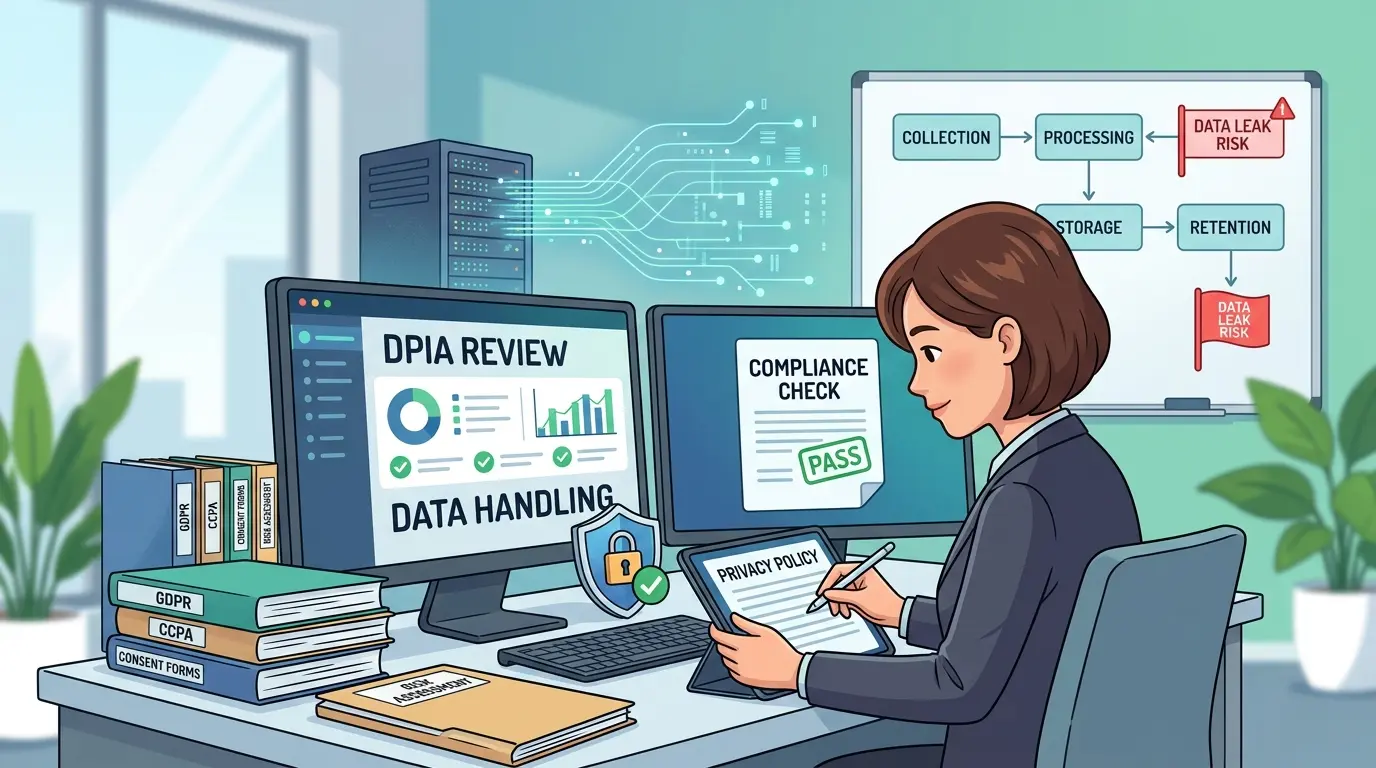
Privacy officers rarely lose time because the policy language is unavailable. They lose time because launch plans, vendor questionnaires, architecture notes, retention rules, and stakeholder assurances arrive in fragments that do not yet form a defensible record. The real bottleneck is not awareness. It is turning scattered inputs into a DPIA, a data handling review, and compliance documentation that can survive internal challenge.
Whether you use ChatGPT, Gemini, Claude, or DeepSeek, the task is the same: extract the processing facts, pressure-test the risks, identify the missing controls, and document the decision clearly enough for legal, security, product, and leadership review. The AI Prompts below are built as a universal foundation for privacy officers who need repeatable analysis instead of one-off chat output. Each model has different strengths, but the workflow stays portable. If your team is building a broader internal prompt library, TipTinker’s Prompts archive is a useful companion.
What To Gather Before You Start
Before you run any prompt, collect the minimum evidence pack:
- product or feature summary
- categories of personal data involved
- user types and jurisdictions
- systems, vendors, and subprocessors in the flow
- retention and deletion rules
- security controls already claimed
- launch deadline or approval checkpoint
- open questions from legal, security, engineering, or procurement
Why It Matters: Privacy review quality collapses when the model has to guess the processing context. Strong prompts work best when the evidence pack is concrete, incomplete areas are labeled honestly, and the model is asked to expose uncertainty instead of hiding it.
Prompt 1: Map A Feature Into A DPIA-Ready Processing Summary
Model Recommendation: Claude is often the better fit for structured writing, careful reasoning, and surfacing missing logic without flattening the review into a generic template.
You are acting as a senior privacy officer preparing the first-pass scoping summary for a DPIA.

I will give you product notes, architecture details, vendor information, and operational context.

Return a DPIA-ready scoping summary with these sections:
1. Feature or Processing Activity
2. Business Purpose
3. Data Subjects Affected
4. Categories of Personal Data
5. Data Sources
6. Systems and Vendors Involved
7. Internal and External Recipients
8. Possible Cross-Border Transfers
9. Claimed Security and Governance Controls
10. Main Privacy Risks
11. Unknowns That Block a Reliable Decision
12. Recommended Next Review Step

Rules:
- do not invent lawful basis, technical controls, or transfer safeguards
- separate confirmed facts from assumptions
- flag any data category that may require heightened review
- mark missing information explicitly
- keep the output concise enough for a working review document

Source material:
[PASTE FEATURE NOTES, DATA FLOW DETAILS, AND VENDOR CONTEXT]
The Payoff: This prompt turns a loose launch brief into a structured privacy scoping document. It also exposes where the team is still speaking in abstractions instead of verifiable processing facts.
Prompt 2: Turn Product And Engineering Documents Into A Data Handling Inventory
Model Recommendation: Gemini works well when you need to synthesize PRDs, diagrams, tickets, API notes, and vendor materials into one operational view.
You are building a data handling inventory for privacy review.

I will provide several documents, such as:
- PRD or feature brief
- architecture notes
- API documentation
- data flow diagrams
- vendor or subprocessor documentation

Create a structured inventory table with these columns:
- processing step
- personal data involved
- source of the data
- system storing or transmitting the data
- purpose of the processing
- internal recipients
- external recipients or vendors
- retention or deletion signal mentioned
- security control mentioned
- unresolved privacy question

Then provide:
1. A short summary of the overall data lifecycle
2. The three areas with the weakest documentation
3. A list of contradictions across the documents
4. A short list of questions to resolve before approval

Rules:
- quote uncertainty when documents conflict
- do not assume data fields that are not described
- note when a vendor role is unclear
- keep the inventory practical for a privacy working session

Documents:
[PASTE OR SUMMARIZE THE DOCUMENT SET]
The Payoff: Privacy reviews often stall because the same processing story is split across five documents owned by three teams. This prompt consolidates that story into a reviewable inventory instead of another round of guesswork.
Prompt 3: Stress-Test Data Minimization, Purpose Limitation, And Retention Logic
Model Recommendation: DeepSeek is often the better fit when you need structured analysis, explicit tradeoffs, and clean decomposition of field-by-field necessity.
You are reviewing a feature for data minimization, purpose limitation, and retention discipline.

I will provide:
- the feature description
- the personal data fields involved
- the claimed business purpose
- any known retention rules
- any deletion or archival behavior

For each data field or data category, return:
1. Why the team says it is needed
2. Whether the purpose is specific or vague
3. Whether a lower-risk alternative may exist
4. Whether the retention logic appears justified
5. Whether the field should be challenged, limited, masked, pseudonymized, or removed

Then provide:
- a risk-ranked list of the weakest justifications
- the strongest follow-up questions for product and engineering
- a short recommendation on whether the current design appears proportionate

Rules:
- do not assume the collection is necessary just because it is convenient
- challenge blanket retention language
- separate operational need from speculative future use
- keep the output suitable for a formal privacy review note

Context:
[PASTE FEATURE, DATA FIELDS, PURPOSE, AND RETENTION DETAILS]
The Payoff: This prompt helps privacy officers move from “what data is present” to “what data is actually justified.” If the harder problem is preparing safer inputs before any AI inference step, TipTinker’s GDPR & AI Compliance: 10 Elite Prompts to Anonymize Sensitive Data Before Inference is the closer companion read.
Prompt 4: Review A Vendor Or Internal AI Workflow For High-Risk Exposure Paths
Model Recommendation: DeepSeek works well for complex logic, data path analysis, and technical decomposition when the workflow crosses multiple systems and control boundaries.
You are assessing a vendor or internal AI workflow for privacy risk.

I will provide workflow details that may include:
- user input types
- prompt or instruction flow
- logs and analytics behavior
- human review access
- model provider involvement
- storage locations
- output sharing behavior
- vendor claims about training or retention

Return the answer in this structure:
1. Workflow Summary
2. Personal Data Touchpoints
3. Highest-Risk Exposure Paths
4. Third-Party Dependence Risks
5. Transfer or access concerns
6. Logging and retention concerns
7. Control gaps
8. Immediate blocker issues
9. Remediation options ranked by urgency

Rules:
- do not treat vendor marketing language as evidence
- note where the workflow description is too vague to approve
- identify risks created by copied prompts, logs, support access, or model-provider handling
- distinguish between low-confidence concerns and well-supported risks

Workflow details:
[PASTE WORKFLOW, VENDOR ANSWERS, AND SYSTEM NOTES]
The Payoff: Vendor questionnaires often create the illusion of certainty without explaining how data actually moves. This prompt turns workflow descriptions into a real exposure analysis with blockers, not just a list of vendor claims.
Prompt 5: Generate The Missing Questions Before Sign-Off
Model Recommendation: ChatGPT works well for day-to-day review support when you need a fast, structured interview guide for cross-functional follow-up.
You are helping me prepare for a privacy review meeting.

I will give you the current documentation for a feature or processing activity.

Generate the missing questions I should ask before sign-off.

Group the questions by:
- product
- engineering
- security
- legal
- procurement or vendor management

For each question, include:
1. Why the question matters
2. What kind of answer would reduce uncertainty
3. What kind of answer would raise the risk level

Then provide:
- the five highest-priority questions overall
- the three questions that are most likely to reveal a launch blocker

Rules:
- avoid generic questions unless the documentation is truly thin
- focus on decision-critical gaps
- keep the wording direct enough to use in a meeting or ticket

Current documentation:
[PASTE NOTES, INVENTORY, DPIA DRAFT, OR VENDOR RESPONSES]
The Payoff: Good privacy review is not passive reading. This prompt helps you turn incomplete documentation into a disciplined working session that surfaces real blockers before the sign-off meeting becomes theater.
Prompt 6: Draft A Compliance Memo That Leadership Can Actually Read
Model Recommendation: Claude is useful when you need professional nuance, careful language, and a balanced explanation of risk, controls, and residual uncertainty.
You are drafting a privacy compliance memo for leadership review.

I will provide the findings from a DPIA, data handling review, and stakeholder follow-ups.

Write the memo with these sections:
1. Processing Activity Summary
2. Why Review Was Required
3. Confirmed Data Handling Facts
4. Main Privacy Risks
5. Controls Already in Place
6. Gaps or Open Issues
7. Launch Decision Options
8. Recommended Position
9. Required Follow-Up Actions

Rules:
- keep the memo concise and executive-readable
- do not make legal conclusions stronger than the evidence supports
- separate confirmed controls from proposed controls
- make residual risk visible instead of hiding it in soft language
- avoid filler and generic compliance phrasing

Review findings:
[PASTE FINDINGS, DECISIONS, AND OPEN ISSUES]
The Payoff: Privacy work often loses influence when the documentation is technically correct but unreadable. This prompt helps convert detailed review findings into a memo that supports a real decision instead of being filed and ignored.
Prompt 7: Build A Reusable Compliance Documentation Pack From The Review Trail
Model Recommendation: Gemini is often the better fit when you need to organize multiple evidence sources into one documentation structure with clear traceability.
You are organizing a privacy review trail into a reusable compliance documentation pack.

I will provide outputs such as:
- DPIA draft notes
- data handling inventory
- meeting summaries
- vendor answers
- issue tracker decisions
- retention and deletion notes
- leadership decision memo

Create a documentation pack with:
1. Recommended folder or section structure
2. Required document names
3. What evidence belongs in each document
4. A decision log format
5. A versioning and ownership scheme
6. Missing artifacts that should be created
7. A short checklist for audit readiness

Rules:
- keep the structure practical for ongoing review, not just one feature
- separate source evidence from summary documents
- make ownership explicit
- do not assume a document exists if it has not been provided

Source materials:
[PASTE OR SUMMARIZE THE REVIEW OUTPUTS]
The Payoff: A privacy review is harder to defend when the evidence trail is trapped in chats, tickets, and personal notes. This prompt turns scattered outputs into a documentation pack that is easier to audit, update, and reuse.
Pro-Tip: Chain the Prompts in Review Order
Start with the inventory and DPIA scoping prompts, then run the minimization and exposure review, then use the missing-questions prompt before drafting the memo and documentation pack. That order keeps the model grounded in evidence before it writes formal language. If your team is standardizing a reusable house style for privacy review prompts, TipTinker’s Meta-Prompting Mastery: 10 Advanced AI Prompts for Professional Prompt Engineering is a practical companion.
The strongest privacy use of AI is not faster wording. It is better review discipline. When prompts are tied to evidence, explicit uncertainty, and documented decisions, privacy work becomes easier to scale, easier to audit, and much harder to wave through without scrutiny.