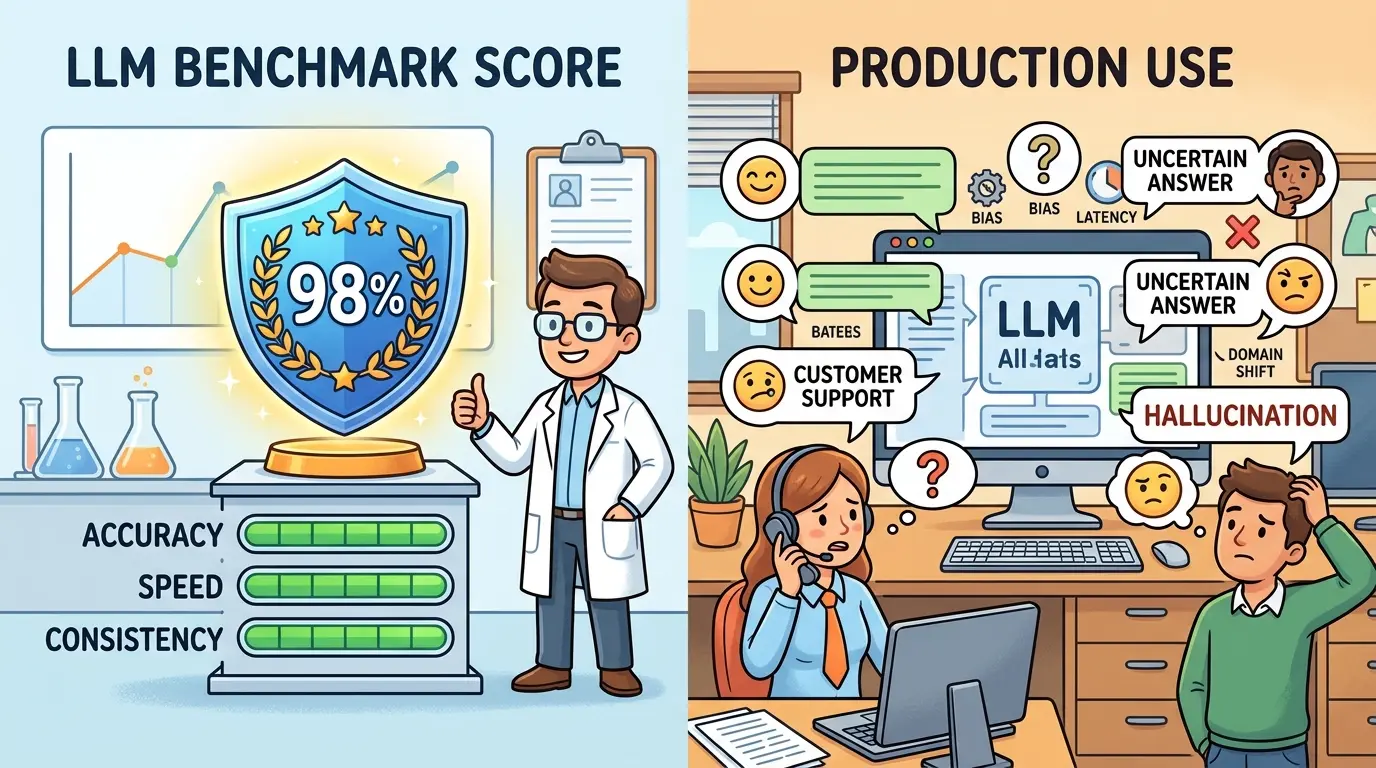
Teams run into the same bottleneck again and again: a model looks dominant on benchmarks, clears a few internal demos, and still disappoints after launch. The failure usually is not raw intelligence. It is mismatch. Production systems need stable formatting, retrieval discipline, policy-aware language, cost control, tool reliability, and consistent behavior across messy multi-turn inputs. That is why ChatGPT, Gemini, Claude, and DeepSeek can all look strong in evaluation reports while behaving very differently inside a real product.
The prompts below are optimized as a universal foundation for AI engineers, product teams, and applied researchers who need to evaluate models against actual work instead of leaderboard theater. Each model has different strengths, but the workflow stays portable: define the job clearly, replay realistic inputs, score the business outcome, and trace failures back to the layer that actually broke.
Map The Workflow Benchmarks Ignore
Model Recommendation: Claude is often the better fit when you need careful reasoning about workflow gaps, hidden assumptions, and evaluation blind spots.
You are an LLM evaluation architect.

I am assessing an AI feature for this production workflow:
[describe the feature, user type, task, tools involved, and business outcome]

Do not discuss generic benchmark scores first.
Instead, identify what real production requirements common benchmarks usually miss.

Return the answer in this structure:
1. Core user objective
2. Operational constraints
3. Failure modes that benchmarks under-measure
4. Risks with business impact
5. A ranked list of test scenarios I should add before launch

For each test scenario, include:
- Why it matters in production
- What a false positive success would look like
- What evidence would show the model actually passed
The Payoff: This prompt forces the team to evaluate the job, not the headline score. It quickly exposes where a benchmark win hides operational weaknesses such as brittle formatting, weak escalation behavior, or poor recovery after missing context.
Turn Logs, Tickets, And Escalations Into Eval Cases
Model Recommendation: Gemini works well for multi-document synthesis when you need to combine chats, tickets, notes, and workflow artifacts into a usable eval set.
You are building a production evaluation dataset from real support and usage evidence.

I will give you:
- customer tickets
- agent handoff notes
- conversation snippets
- internal bug reports

Your job is to convert them into evaluation cases for an AI system.

For each case, produce:
1. User intent
2. Hidden context the model would need
3. Expected useful output
4. Common failure pattern
5. Severity if the model fails
6. Tags for grouping similar cases

Then create:
- a balanced eval set
- a hard-case eval set
- a release-blocker eval set

Keep the wording production-focused and remove redundant noise.
The Payoff: Benchmark tasks are clean. Production tickets are not. This prompt turns messy evidence into repeatable test coverage so you can stop relying on synthetic cases that flatter the model.
Recreate The Full Multi-Turn Conversation
Model Recommendation: DeepSeek is useful when you need structured decomposition of branching conversations, missing information, and failure cascades.
You are simulating realistic multi-turn user interactions for an AI feature.

Given this task:
[describe the task]

Generate 12 realistic conversation flows that include combinations of:
- vague initial requests
- contradictory follow-up instructions
- missing required information
- changing goals midstream
- user frustration or urgency
- tool or retrieval failure in the middle of the exchange

For each flow, include:
1. Turn-by-turn conversation
2. The exact point where weak systems tend to fail
3. What a production-quality response should do next
4. A pass/fail checklist

Make the scenarios realistic for business use, not theatrical edge cases.
The Payoff: Many benchmark leaders still degrade once the task becomes conversational, interrupt-driven, or stateful. This prompt helps you test the interaction loop instead of grading a single polished answer.
This is also where teams realize that a single prompt is rarely the whole system. Production quality depends on workflow design, which is the same shift described in Prompt Engineering 3.0: The End of Prompting and the Rise of Flow Engineering.
Test Retrieval, Context Packing, And Source Fidelity
Model Recommendation: Gemini is often the better fit when the task involves larger document packs, synthesis across sources, and citation-aware comparisons.
You are evaluating whether an AI workflow uses context effectively.

I will provide:
- the user request
- the retrieved documents or notes
- the final model answer

Analyze the interaction and return:
1. Which retrieved items were actually relevant
2. Which critical facts were missing from the context
3. Whether the answer relied on unsupported claims
4. Whether the context window was overloaded with low-value text
5. How to improve retrieval, ranking, chunking, or citation behavior

Then produce a revised evaluation checklist with specific pass criteria for:
- factual grounding
- citation fidelity
- context efficiency
- hallucination resistance
The Payoff: A benchmark can reward reasoning while saying almost nothing about whether your system selected the right evidence. This prompt helps separate model quality from retrieval quality so the fix lands in the right layer.
If your team keeps solving failures by stuffing in more context, read The Context Window Trap: When to Choose RAG vs. Long-Context Models for Business Data before expanding token budgets again.
Measure Format Reliability Under Real Constraints
Model Recommendation: ChatGPT is a strong day-to-day choice for fast iteration on schema compliance, structured output checks, and repeated format testing.
You are a QA lead for structured AI outputs.

I need to test whether a model can reliably produce output in this required format:
[paste schema, JSON contract, tool arguments, markdown template, or downstream format]

Generate a test suite of 20 prompts that vary by:
- ambiguity
- missing data
- extra irrelevant details
- conflicting instructions
- long context
- urgent user tone

For each test, provide:
1. The input
2. The expected structure
3. The most likely formatting failure
4. A validator rule I can apply automatically
5. A stricter version for regression testing

End with the top 5 reasons format compliance breaks in production.
The Payoff: A model can be impressive in open-ended writing and still fail the moment your product requires strict JSON, clean markdown, or tool-safe arguments. This prompt turns format reliability into something measurable.
Audit Business Quality, Not Just Technical Correctness
Model Recommendation: Claude works well for judging nuance, professional tone, escalation discipline, and whether the answer is actually usable by a human operator.
You are reviewing AI outputs for business readiness.

I will give you:
- the user request
- the model answer
- the business context

Score the answer from 1 to 5 on:
- correctness
- clarity
- actionability
- tone appropriateness
- risk awareness
- escalation judgment
- trustworthiness

Then explain:
1. What is technically correct but operationally weak
2. What would confuse a real user
3. What could create compliance, trust, or support risk
4. What a stronger answer would change first

Return a concise rubric I can reuse for future reviews.
The Payoff: Benchmark success often compresses quality into a narrow score. Production performance depends on whether the answer is safe to ship, easy to act on, and unlikely to generate avoidable support debt.
Compare Cost, Latency, And Recovery Paths
Model Recommendation: ChatGPT is often the practical choice for repeated comparison work when you need quick iteration across scenario tables, budgets, and deployment tradeoffs.
You are evaluating model choices for production deployment.

Compare candidate models for this feature:
[describe feature]

Optimize for:
- user-visible quality
- latency budget
- token budget
- retry tolerance
- tool reliability
- failure recovery

Return a decision table with these columns:
1. Likely strength in this workflow
2. Likely weakness in this workflow
3. Best use case
4. Worst use case
5. Risk if deployed without fallback
6. Suggested fallback or routing rule

Then recommend:
- a primary model
- a fallback model
- a budget-safe routing strategy
- one scenario where the benchmark winner should not be the default
The Payoff: The best model on paper can still be the wrong default if it misses your latency or recovery envelope. Production systems win by balancing output quality with operational control.
When budget is part of the release decision, use the AI Token Calculator to pressure-test whether a higher-scoring model is still economically sensible at production volume.
Trace Failure Loops Before You Retune Prompts
Model Recommendation: DeepSeek is useful when you need a structured breakdown of root cause across retrieval, prompting, orchestration, tools, and post-processing.
You are diagnosing repeated AI system failures.

I will give you:
- the user input
- the retrieved context
- the system or developer prompt
- tool calls and outputs
- the final response
- the failure complaint

Identify the most likely root cause.

Classify the issue into one primary bucket:
- retrieval failure
- prompt scope failure
- reasoning failure
- tool selection failure
- tool output handling failure
- schema or parser failure
- post-processing failure
- policy or escalation failure

Then provide:
1. Evidence for the diagnosis
2. The smallest fix to test first
3. A regression test prompt
4. A metric or trace to watch after the fix
The Payoff: Teams waste time when every production miss gets blamed on prompting. This prompt helps isolate the actual broken layer so you stop over-tuning language while ignoring orchestration defects.
If you are not tracing failures across the full request path, Full-Stack AI Observability: Tracing Agentic Loops with OpenTelemetry & Arize is a useful reference for making these diagnoses faster and less subjective.
Build A Release Gate That Reflects Real Risk
Model Recommendation: Claude is often the better fit when you need a release rubric that balances nuance, business risk, and defensible pass criteria.
You are designing a production release gate for an AI feature.

Based on this product context:
[describe user type, task, risk level, and operational constraints]

Create a release checklist with weighted pass criteria for:
- functional quality
- structured output reliability
- safety and escalation behavior
- retrieval quality
- latency and cost ceilings
- fallback behavior
- human review requirements

Output:
1. Must-pass tests
2. Nice-to-have tests
3. Release blockers
4. Suggested score thresholds
5. What should be monitored immediately after launch

Keep the checklist practical for weekly iteration cycles.
The Payoff: Benchmarks help shortlist candidates. Release gates decide whether the feature is trustworthy enough to ship. This prompt turns that decision into a repeatable operating rule instead of a gut feeling.
Pro-Tip: Chain Diagnosis Into Revalidation
Run these prompts as a sequence, not as isolated exercises. Start by mapping workflow gaps, convert real logs into evals, replay multi-turn failures, trace the broken layer, and only then retune prompts or routing. ChatGPT is often the fastest for everyday iteration, Claude is stronger for nuanced review, Gemini is useful for large source packs, and DeepSeek is a strong option when you need structured decomposition.
Benchmark wins are useful for narrowing the field, but they do not prove production readiness. Real performance comes from testing the workflow, the constraints, and the failure loops that users trigger every day.