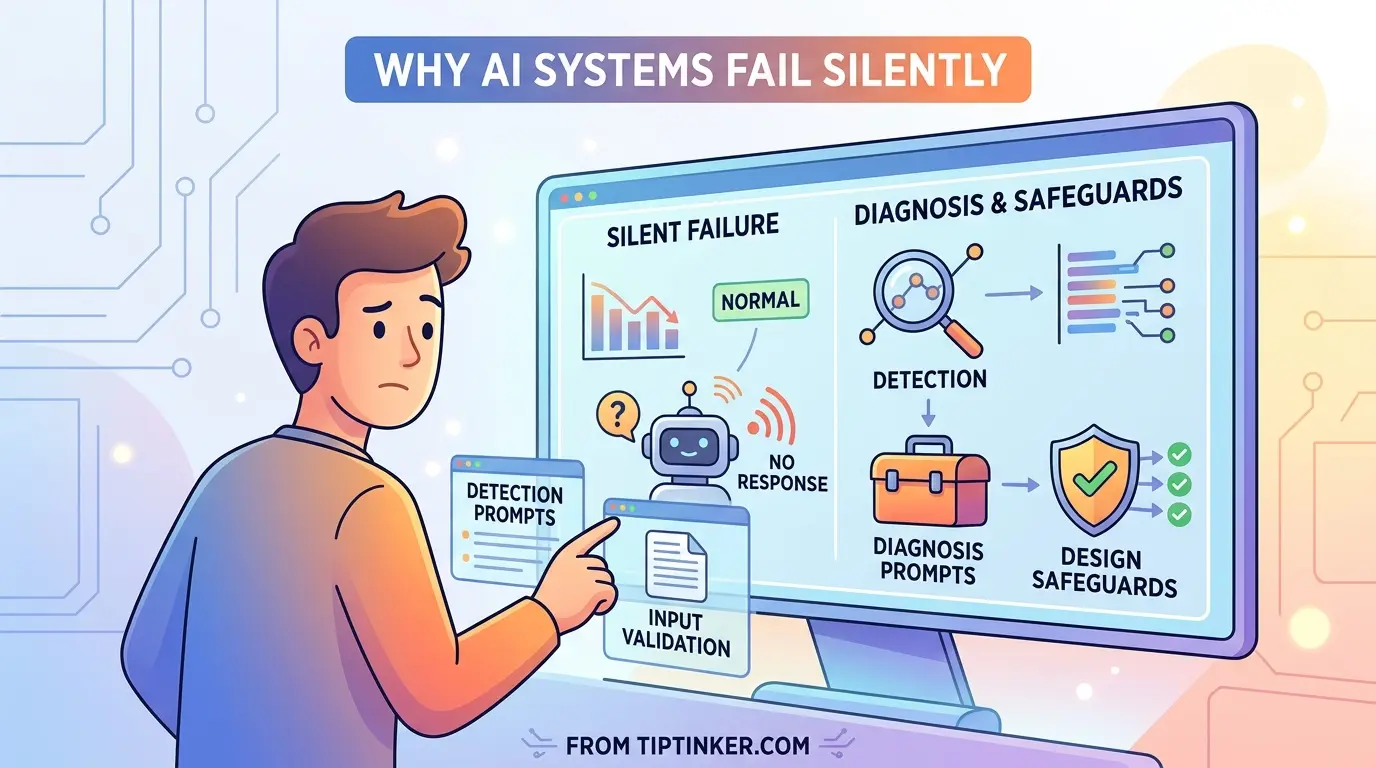
The most dangerous AI failure is not a crash. It is a clean-looking response that moves through the pipeline without obvious alarms. The UI renders, the JSON parses, the latency stays inside budget, and the system still returns a stale retrieval result, a missing field, an unsupported recommendation, or a false sense of certainty.
Whether your team works with ChatGPT, Gemini, Claude, or DeepSeek, silent failure usually comes from weak system design rather than one bad model call. The AI Prompts below are optimized as a universal foundation for AI engineers, platform teams, technical product managers, and workflow builders who need to expose hidden failure modes before users discover them. Each model has different strengths, but these prompts work best when treated as part of a repeatable design loop for checks, evidence rules, fallback behavior, and regression coverage.
Prompt 1: Map Where Silent Failure Can Hide
Model Recommendation: Claude is often the better fit for this step because it handles structured reasoning, system boundaries, and failure analysis with useful precision.
You are auditing an AI system for silent failure risk.

I will give you a workflow description, system boundaries, and any known weak signals.

Your job is to map every stage where the system can appear healthy while still being wrong.

Return a table with these columns:
1. Stage Name
2. Input Assumption
3. Silent Failure Mode
4. What The User Or Downstream System Sees
5. Why Standard Monitoring Misses It
6. Detection Signal
7. Recommended Safeguard Or Redesign

Cover these layers even if the user forgets to name them:
- input normalization
- retrieval or context loading
- prompt assembly
- model output generation
- tool calling
- output parsing and validation
- routing or policy logic
- fallback behavior
- UI or downstream integration

Then rank the top 5 silent failure risks by:
- user harm
- likelihood
- difficulty of detection

System Description:
[PASTE SYSTEM ARCHITECTURE, MAIN TASK, INPUTS, OUTPUTS, AND DEPENDENCIES]

Known Incidents Or Suspicions:
[PASTE INCIDENTS, WEIRD CASES, USER COMPLAINTS, OR EMPTY IF NONE]
The Payoff: Most teams start by blaming the model. This prompt forces a broader audit across the full pipeline, which is usually where silent failure actually begins.
If your product is already moving from one-shot prompts into chained execution, Prompt Engineering 3.0: The End of Prompting and the Rise of Flow Engineering is useful background because silent failure surfaces multiply as steps connect.
Prompt 2: Turn “Good Enough” Into A Verifiable Contract
Model Recommendation: DeepSeek is often the better fit when the job requires structured analysis, explicit scoring logic, and technical decomposition.
You are converting an AI task into a verifiable response contract.

I will give you the task, the intended output, and the operational risk.

Return:
1. Required Claims Or Fields The Output Must Contain
2. Disallowed Behaviors
3. Evidence Requirements For Each Required Claim
4. Low-Confidence Conditions
5. Contradiction Rules
6. Missing-Context Rules
7. Automatic Fail Checks
8. Human Review Triggers
9. A Compact Validator In Pseudocode Or JSON-Like Rules

If the task involves recommendations, decisions, or summaries, require the system to:
- state when evidence is insufficient
- distinguish facts from assumptions
- avoid inventing certainty
- return an abstain condition when needed

Task:
[PASTE TASK DESCRIPTION]

Output Shape:
[PASTE EXPECTED FORMAT OR SCHEMA]

Risk Level And Failure Consequence:
[PASTE WHAT GOES WRONG IF THE ANSWER LOOKS FINE BUT IS WRONG]
The Payoff: Silent failures survive when quality remains subjective. This prompt turns vague expectations into an explicit contract you can wire into evaluators, parsers, and release checklists.
Prompt 3: Force The System To Expose Uncertainty
Model Recommendation: Claude works well for this step because it is often strong at careful reasoning, boundary setting, and safer output framing.
You are redesigning the answer format for a safety-aware AI system.

For the task below, create an output schema that forces the system to expose uncertainty instead of hiding it.

The output must include:
1. Final Answer
2. Evidence Summary
3. Confidence Level
4. Confidence Rationale
5. Assumptions Made
6. Missing Information
7. Alternative Interpretations
8. Recommended Next Action
9. Explicit "Do Not Act Yet" Condition

Then provide 3 worked examples:
- high confidence
- low confidence
- conflicting evidence

For each example, show how the answer should change when the system is not certain.

Task Context:
[PASTE THE SYSTEM TASK, USER INTENT, AND DATA SOURCES]

Current Output Style:
[PASTE EXISTING OUTPUT FORMAT OR SUMMARIZE IT]
The Payoff: A silent failure often sounds polished because the system never had to admit uncertainty. This prompt makes uncertainty legible to users, reviewers, and downstream systems.
Prompt 4: Stress-Test Retrieval, Tools, And Schema Drift
Model Recommendation: Gemini is useful when you need to synthesize multiple documents, tool schemas, sample records, and edge cases in one pass.
You are building a silent-failure stress test pack for an AI system that depends on retrieval, tools, and structured outputs.

Using the system docs, tool schemas, and sample data below, generate 20 test cases that target quiet failure.

Cover cases such as:
- stale retrieval
- partial or truncated documents
- conflicting sources
- null values and empty arrays
- enum drift
- unit mismatches
- reordered columns or fields
- partial tool timeout
- parser success with semantically wrong content
- fallback selecting outdated or incomplete data

For each test case, return:
1. Test ID
2. Setup
3. Failure Surface
4. Expected Safe Behavior
5. Wrong Behavior To Block
6. Telemetry To Capture
7. Severity

Then group the tests into:
- pre-release smoke tests
- high-risk production tests
- retrieval-specific tests
- tool-specific tests

System Docs:
[PASTE ARCHITECTURE NOTES OR WORKFLOW SUMMARY]

Tool Schemas:
[PASTE TOOL INPUTS, OUTPUTS, AND ERROR SHAPES]

Sample Data:
[PASTE EXAMPLE RECORDS, DOCUMENTS, OR TABLES]
The Payoff: This catches the class of failures where everything still returns 200 OK, but the meaning is wrong. That is the signature of a system that fails silently.
If your workflow keeps oscillating between long context and retrieval, The Context Window Trap: When to Choose RAG vs. Long-Context Models for Business Data helps frame when quiet retrieval failure is really a design-choice problem.
Prompt 5: Design Degraded Behavior For Ambiguous Results
Model Recommendation: Claude is often the better fit for fallback policy writing, user-facing safeguards, and clear abstention logic.
You are writing the degradation policy for an AI system.

For each scenario below, define how the system should fail soft instead of failing silently:
- low confidence answer
- contradictory retrieval
- tool timeout
- missing critical field
- parser failure
- budget exhaustion
- traffic spike or queue backlog

For each scenario, return:
1. Detection Rule
2. Whether To Retry, Degrade, Abstain, Escalate, Or Abort
3. User-Facing Response
4. Telemetry Event Name And Payload
5. Whether Premium Inference Is Justified
6. Whether Human Review Is Required
7. What Must Never Be Silently Filled In

Then produce:
- a compact decision tree
- a degraded response policy
- escalation triggers
- implementation mistakes to avoid

System Context:
[PASTE FEATURE DESCRIPTION, LATENCY TARGET, QUALITY TARGET, AND FAILURE CONSEQUENCES]
The Payoff: Reliable systems do not pretend everything is fine when evidence is weak. They degrade openly, preserve trust, and make the next step explicit.
If your team needs better visibility into these branches, Full-Stack AI Observability: Tracing Agentic Loops with OpenTelemetry & Arize is a useful companion for designing traces that explain why the fallback path activated.
Prompt 6: Turn Incidents Into Regression Evaluations
Model Recommendation: DeepSeek works well here because it is useful for transforming messy incidents into reusable test cases, scoring rules, and release gates.
You are transforming silent AI failures into a reusable regression suite.

I will provide incident notes, bad outputs, retrieval snapshots, tool traces, and reviewer comments.

For each incident, return:
1. Test Name
2. Failure Category
3. Minimal Reproducible Setup
4. Expected Safe Behavior
5. Wrong Behavior To Block
6. Evaluation Dimensions
7. Scoring Rubric
8. Monitor Or Alert To Add
9. Owner
10. Retest Cadence

Then group the incidents into:
- smoke set
- pre-release set
- high-risk production set
- retrieval failures
- tool-use failures
- policy and fallback failures

Also identify recurring patterns that suggest a system-level redesign rather than a prompt tweak.

Incident Inputs:
[PASTE INCIDENT LOGS, FAILURE EXAMPLES, AND REVIEW NOTES]
The Payoff: The moment a hidden failure becomes reproducible, it stops being an anecdote and becomes engineering work. That is how silent failure turns into measurable reliability improvement.
Pro-Tip: Chain Design Prompts Before You Tune Prompt Wording
Start with Prompt 1 and Prompt 2 before touching any system message. Silent failure is usually a contract problem, a boundary problem, or a fallback problem before it becomes a wording problem. Once the contract is explicit, use Prompt 4 and Prompt 6 every time retrieval sources, tool schemas, or routing logic change.
The goal is not to make AI systems sound confident. It is to make them legible under uncertainty. When your pipeline can expose weak evidence, degrade openly, and replay silent failures as tests, reliability stops being accidental and starts becoming a design property.